
Revit Certification Practice Test
$69.00
- Buy to unlock unlimited access to all Quiz questions.
- After purchase you can print a PDF of the whole quiz at any point. The PDF will contain the questions and the correct answers.
About this Exam
The Revit Certification exam, specifically the Autodesk Certified Professional in Revit for Architectural Design, is a globally recognized credential that validates an individual's advanced skills and proficiency in Building Information Modeling (BIM) using the Autodesk Revit software. This certification is designed for architectural designers, engineers, CAD managers, and other industry professionals who use Revit extensively and wish to demonstrate their expertise to employers and clients. Achieving this certification proves that you have the comprehensive knowledge and practical skills required to create complex architectural models, manage BIM projects, and collaborate effectively within a team environment.
Ready to test your knowledge?
Buy Now to Access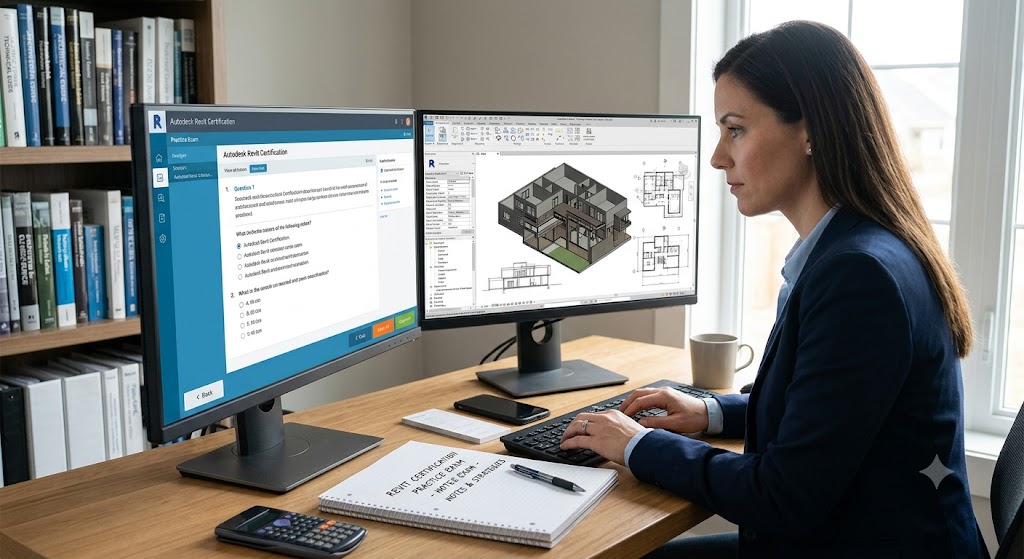
Additional Information
What the Course Entails and Exam Details
Preparing for the Revit Certification involves mastering a broad spectrum of modeling, documentation, and management skills within the software. While this practice test focuses on assessing your readiness, the official exam content typically covers the following key domains:
Modeling: Creating and modifying complex architectural elements such as walls, floors, roofs, stairs, and railings.
Documentation: Generating precise views, including plans, sections, elevations, and callouts, and annotating them with text, dimensions, and tags.
Families: Developing and managing parametric families (custom components and equipment) to meet specific project requirements.
Collaboration: Setting up worksharing, creating worksets, and managing linked files for multi-user project environments.
Analysis and Views: Using visibility graphics controls, creating schedules, and analyzing model data.
Project Management: Setting up project templates, managing phases, and preparing sheets for construction documentation.
What to Expect in the Final Exam
The official Autodesk Certified Professional exam is a performance-based assessment, meaning you will need to complete actual tasks within the Revit software rather than just answering multiple-choice questions.
Here’s what you should expect during the exam:
Format: The exam consists of both multiple-choice questions and live-in-the-software tasks. You will be given a set of instructions and a Revit model file, and you must perform specific operations (e.g., modifying elements, creating views, editing families) within the interface.
Time Limit: The exam usually has a strict time limit, typically around 120 minutes. Time management is crucial.
Scoring: To pass, you typically need to achieve a score of 70% to 80% or higher. Your score is based on the correctness of the final state of the model after completing the requested tasks and the accuracy of your answers to the multiple-choice questions.
Passing: You will receive your results immediately after completing the exam.
How to Study and Exam Centers
Preparation is paramount for success on the performance-based Revit Certification exam.
Utilize Practice Exams: Taking practice tests, like this one, is one of the most effective ways to study. These tests simulate the exam environment and types of questions you will encounter, helping you identify your weaknesses and build confidence.
Hands-on Practice: There is no substitute for spending significant time actually using Revit. Complete full projects, experiment with different tools, and practice creating complex elements and families.
Autodesk Official Training: Consider enrolling in courses offered by Autodesk Authorized Training Centers (ATCs) or utilizing self-paced learning paths available through Autodesk University or other online educational platforms.
Study Guides: Review the official Autodesk Exam Objectives to ensure you are familiar with all topics covered on the test.
Exam Centers: When you are ready to take the official certification, you will need to schedule your appointment through Pearson VUE, Autodesk's official testing partner. Exams can be taken either online via remote proctoring or in-person at a certified Pearson VUE testing center located worldwide.
Job Opportunities from the Course
Earning your Revit Certification unlocks numerous career opportunities in the Architecture, Engineering, and Construction (AEC) industry. It makes you a highly attractive candidate for roles that require validated BIM expertise. Potential career paths and job titles include:
BIM Manager: Overseeing BIM implementation, standards, and workflow across an organization.
BIM Coordinator: Managing BIM models and coordination for specific projects, ensuring interdisciplinary collaboration.
Revit Technician / Modeler: Creating detailed 3D models and construction documentation using Revit.
Architectural Technologist: Bridging the gap between architectural design and construction technology, heavily utilizing Revit.
Structural Drafter / Designer: (For the Structure-specific exam) Creating structural models and drawings using Revit Structure.
MEP Designer: (For the MEP-specific exam) Designing mechanical, electrical, and plumbing systems within the BIM environment.
Frequently Asked Questions
Reviews
5.0
Based on 0 reviews
Leave a Review
No reviews yet. Be the first to review!