
Responsible Alcohol Practice Test & Exam Prep | Canada
$69.00
- Buy to unlock unlimited access to all Quiz questions.
- After purchase you can print a PDF of the whole quiz at any point. The PDF will contain the questions and the correct answers.
About this Exam
Are you aiming for a career in Canada's dynamic hospitality industry or seeking to enhance your professional skills? Preparing for and successfully passing a responsible alcohol service test is a crucial, often mandatory step. This comprehensive study guide, designed for the Responsible Alcohol Practice Exam, provides a structured path to mastering the essential knowledge required for various service roles across Canada.
Whether you're aspiring to be a server, bartender, barback, or manage a licensed establishment, understanding the principles of responsible service is vital. This guide is tailored for students and working professionals like you, ensuring you are thoroughly equipped to handle situations involving the sale and service of alcohol safely, legally, and professionally. The training you prepare for is fundamental to public safety and ensuring a positive and lawful environment in Canada’s diverse social venues. This guide helps you navigate the key concepts and prepare with confidence for the official certifications required by different Canadian provinces.
Ready to test your knowledge?
Buy Now to Access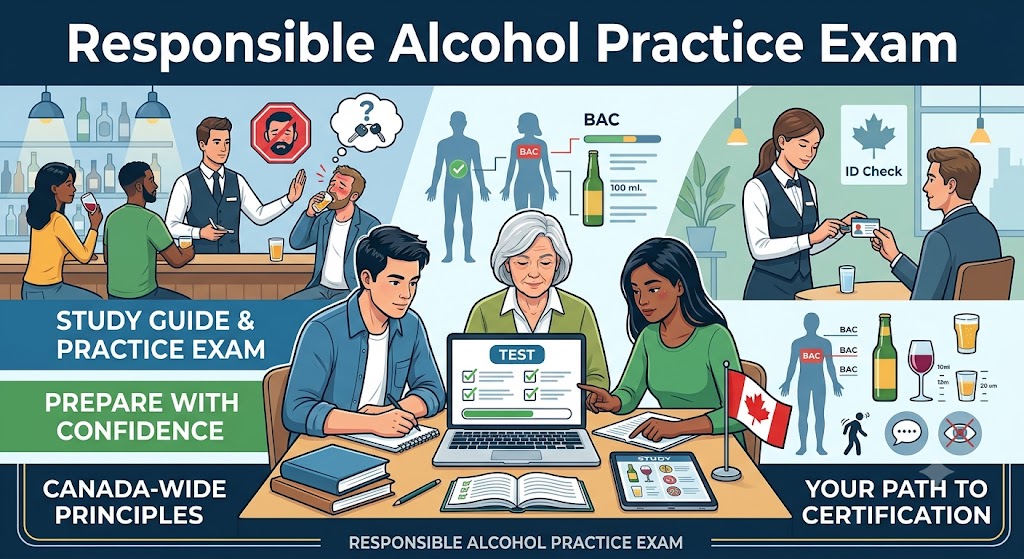
Additional Information
What the Course Entails and Exam Details
This preparation material and the associated practice exams
will comprehensively cover the core principles and common themes of responsible
alcohol service within Canada. While specific certifications (like Smart Serve
in Ontario, Serving It Right in British Columbia, or ProServe in Alberta) have
unique aspects, the fundamental knowledge they test is very similar and will be
the focus here.
You can expect to delve into critical areas such as:
- Canadian
Alcohol Laws and Regulations: An overview of common federal and
general provincial rules governing liquor licensing, service hours, and
legal requirements.
- The
Effects of Alcohol on the Body: Understanding how alcohol is
processed, absorbed, and eliminated, and how it impacts judgment,
co-ordination, and reaction times.
- Signs
of Intoxication: Learning to effectively observe and identify both
subtle and obvious physical and behavioral cues that indicate a person may
be intoxicated.
- Blood
Alcohol Concentration (BAC): Grasping the concept of BAC, standard
drink measurements, and how various factors like body size, sex, and time
affect intoxication levels.
- Preventing
Intoxication and Over-Service: Developing strategies to monitor guest
behavior, slow down service, and effectively say "no" to further
alcohol service.
- Checking
Identification (ID): Knowing how to properly verify legal drinking
age, recognize authentic identification documents, and understand your
legal responsibility.
- Handling
Difficult Situations: Developing the skills to manage situations with
intoxicated individuals, prevent dangerous behaviors (including drinking
and driving), and resolve conflicts professionally.
- Legal
Liability: Understanding both personal and establishment liability in
the context of responsible service.
The course training usually consists of interactive modules,
scenarios, and quizzes leading up to the final assessment, all designed to
ensure you not only know the rules but can apply them.
What to Expect in the Final Exam
While the final official certification exam is taken after
completing the actual course from an authorized provider, this guide and the
associated practice material will familiarize you with the typical structure
and requirements you will encounter. In most Canadian jurisdictions, the
official exam will generally align with these common characteristics:
- Format:
The exam is almost universally delivered in an online, interactive format.
It consists of multiple-choice and/or true/false questions, and often
includes scenario-based questions that test your ability to apply the
knowledge you've learned. The specific number of questions can vary but
usually ranges from 30 to 50.
- Passing
Score: To achieve your responsible alcohol service certification, you
will need to demonstrate a strong grasp of the material. A high passing
score, commonly around 80% or similar, is required to show a significant
level of proficiency. Some programs may offer a small grace period for
incorrect answers or allow multiple attempts within one course purchase.
- Time
Limit: Official exams are typically timed, with the duration often
being around one hour or slightly less, encouraging focused and efficient
completion of the questions.
- Rules
and Integrity: Integrity is paramount in these assessments. Official
online exams may involve various security measures or require you to
complete the test alone to ensure fairness and adherence to rules. You'll
need to demonstrate your personal understanding to obtain a valid
certification. Specific rules regarding external resources, notes, and
other aids should be verified for each province's official test. Some
platforms might use online proctoring or other validation techniques.
How to Study and
Exam Centers
Preparation is key to success on both practice and official
exams. Here are effective strategies and details on where and how to engage
with the testing process:
- How
to Study:
- Engage
with All Materials: Thoroughly review all course modules, videos, and
study guides provided by the training platform. Don't skip any sections.
- Use
Practice Exams Diligently: Take full advantage of practice exams,
such as those that may be a part of this guide. Practice tests are
invaluable for familiarizing yourself with the common question types,
identifying areas where you need more study, and building your overall
confidence. Repeatedly taking practice tests can significantly enhance
your recall of key facts and scenarios.
- Focus
on Key Topics: Dedicate extra study time to areas like legal
obligations, the signs of intoxication, and blood alcohol concentration.
These are cornerstone topics that frequently appear on exams.
- Simulate
Exam Conditions: Set aside uninterrupted time and create a quiet,
distraction-free environment for taking practice exams. This will help
you experience and manage potential exam pressure. Time yourself during
some of these sessions.
- Take
Summary Notes & Create Flashcards: Summarize important concepts
and create flashcards for common terms, signs, or legal limits. Active
note-taking and testing yourself reinforces learning.
- Understand
'Standard Drinks': Master the definitions of standard drinks and
practice calculating alcohol volumes and estimated BAC levels using
various scenarios.
- Scenario
Practice: Mentally walk through real-world scenarios and apply the
responsible service principles you’ve learned to determine the best and
safest courses of action.
- Stay
Updated: Laws and best practices can change. Ensure that the study
materials you are using are current for the time and province you are
certifying for. Check for any recent updates to liquor laws or
responsible service guidelines.
- Exam
Centers and Access:
- Primarily
Online: For the vast majority of official responsible alcohol service
certifications in Canada, there are no physical testing centers required.
The complete course and the final exam are accessed directly and
conveniently online. You can complete the process from any computer with
a stable internet connection.
- Authorized
Provincial Providers: You must take the final, official certification
course and exam through the specific organization authorized by your
province's government (e.g., AGCO for Smart Serve in Ontario, AGLC for
ProServe in Alberta, various providers for Serving It Right in BC). Study
materials and official support resources will be provided upon
enrollment.
- Institutional
Options: Some educational institutions, training organizations, or
large employers might offer facilitation or specific programs that
incorporate these certifications. However, even in these cases, the final
exam itself is almost always a digital submission to the official
provincial body.
Job Opportunities
from the Course
A valid responsible alcohol service certification opens the
door to numerous exciting job opportunities within Canada's vibrant hospitality
and event sectors. While this guide helps you prepare, the resulting
certification is a standard requirement for positions that involve selling,
serving, or handling alcohol in all types of licensed venues. Completing the
certification significantly enhances your employability and can lead to a
diverse range of roles, including:
- Bartenders
and Barbacks
- Servers
and Wait Staff
- Hosts
and Hostesses
- Bar
Managers and Supervisors
- Security
and Door Staff
- Cashiers
and Retail Staff
- Event
Staff and Hospitality Professionals
- Promotional
Staff
Frequently Asked Questions
Reviews
5.0
Based on 0 reviews
Leave a Review
No reviews yet. Be the first to review!