
Respiratory System Practice Test
$69.00
- Buy to unlock unlimited access to all Quiz questions.
- After purchase you can print a PDF of the whole quiz at any point. The PDF will contain the questions and the correct answers.
About this Exam
The Respiratory System Practice Exam is a crucial self-assessment tool designed for students pursuing careers in healthcare, including nursing, respiratory therapy, emergency medical services, and sports medicine. This comprehensive test evaluates your understanding of the complex structures and vital functions that govern human respiration. Mastering this material is not only essential for academic success in anatomy and physiology courses but also forms the foundation for safe and effective clinical practice. Whether you are preparing for a midterm or reinforcing knowledge before a licensing exam, this resource helps identify your strengths and critical areas for improvement.
Ready to test your knowledge?
Buy Now to Access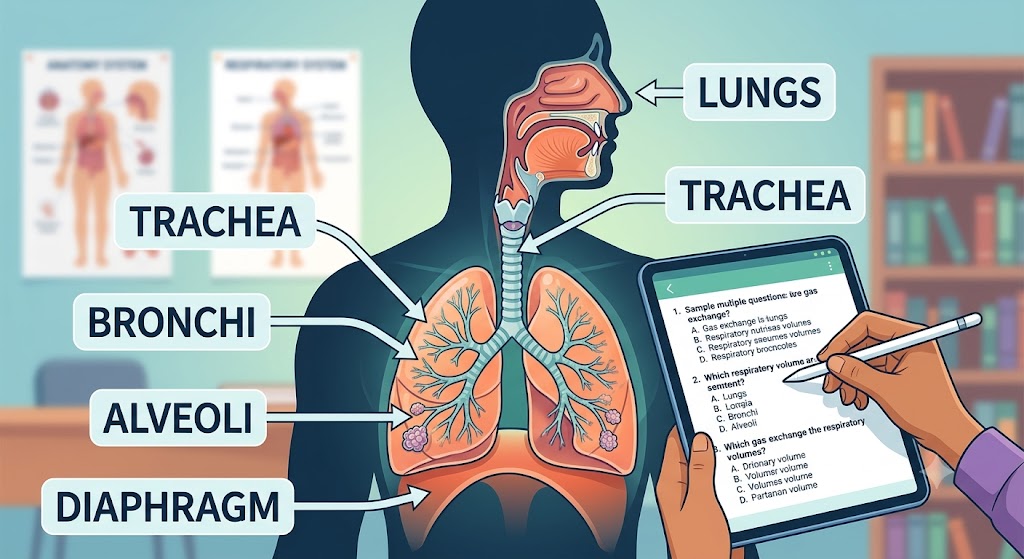
Additional Information
What the Course Entails and Exam Details
This examination covers the complete syllabus of a standard respiratory system module. You will be tested on your ability to identify major and minor anatomical structures, explain physiological processes, and apply this knowledge to clinical scenarios.
Key topics include:
Gross Anatomy: Identification of the upper and lower respiratory tracts, including the nasal cavity, pharynx, larynx, trachea, bronchi, and lungs.
Microscopic Anatomy: The structure and function of alveoli, alveolar type I and II cells, and the respiratory membrane.
Mechanics of Breathing: Pulmonary ventilation, inspiration and expiration processes, and the role of the diaphragm and intercostal muscles.
Gas Exchange and Transport: Understanding external and internal respiration, partial pressures of gases, and hemoglobin's role in oxygen and carbon dioxide transport.
Control of Respiration: Neural and chemical regulation of breathing.
Respiratory Volumes and Capacities: Definitions and calculations for Tidal Volume (TV), Vital Capacity (VC), Residual Volume (RV), etc.
Respiratory Pathology: Introduction to common conditions like asthma, COPD, pneumonia, and emphysema.
What to Expect in the Final Exam
This practice exam is designed to simulate the challenge of official certifying or academic finals. The final format consists entirely of randomized, multiple-choice questions (MCQs), matching, and diagram-labeling exercises.
For an official academic final or certification (such as the NBRC exams), you should expect a time limit (often ranging from 90 to 120 minutes) and a structured passing score requirement, typically set between 70% and 80%. Our practice test is untimed, allowing you to focus on comprehensive review, but we recommend aiming for a score of 85% or higher before attempting your official graded exam.
How to Study and Exam Centers
Preparation for the Respiratory System Practice Exam must involve repeated, active recall. We recommend starting with visual learning—labeling blank diagrams of the lungs and airways until you can do so flawlessly. Use digital flashcards to memorize definitions and the physiological functions of specific cells and structures.
The single most effective strategy is to take this practice test multiple times. Review the explanations provided for any questions you answered incorrectly. Group study sessions are also highly beneficial for explaining complex concepts like gas exchange partial pressure gradients.
For the actual academic final, your exam center will be determined by your institution (e.g., a university testing hall). For professional licensing (like the CRT or RRT), exams are usually administered via secure online portals or at specialized testing centers, such as Pearson VUE, depending on your location and certifying body.
Job Opportunities from the Course
A strong understanding of the respiratory system is foundational for a wide array of rewarding health professions. Successfully mastering this material opens doors to numerous career paths:
Registered Nurse (RN): Required for assessing lung sounds, administering respiratory medications, and managing patients on ventilators.
Respiratory Therapist (CRT or RRT): The primary specialists in diagnosing, treating, and managing patients with breathing disorders.
Emergency Medical Technician (EMT) or Paramedic: Critical for managing airway emergencies and respiratory distress in pre-hospital settings.
Sleep Technologist (Polysomnographic Technician): Analyzing sleep studies for respiratory-related conditions like sleep apnea.
Pulmonary Function Technologist: Administering specialized tests to measure lung volumes and diffusion capacity.
Medical Assistant: Assisting physicians with basic respiratory care procedures in outpatient clinics.
Frequently Asked Questions
Reviews
5.0
Based on 0 reviews
Leave a Review
No reviews yet. Be the first to review!