
Respiratory Protection Program Practice Test
$69.00
- Buy to unlock unlimited access to all Quiz questions.
- After purchase you can print a PDF of the whole quiz at any point. The PDF will contain the questions and the correct answers.
About this Exam
This practice exam is a crucial resource for professionals and students aiming to validate their knowledge of implementing and maintaining a robust Respiratory Protection Program (RPP) in compliance with safety regulations like OSHA. It is designed for employees who may need to use respirators, safety managers, industrial hygienists, environmental health and safety (EHS) coordinators, and supervisors responsible for workplace safety where respiratory hazards exist. The practice test serves as a comprehensive self-assessment to ensure readiness for certification exams or to reinforce practical knowledge.
Ready to test your knowledge?
Buy Now to Access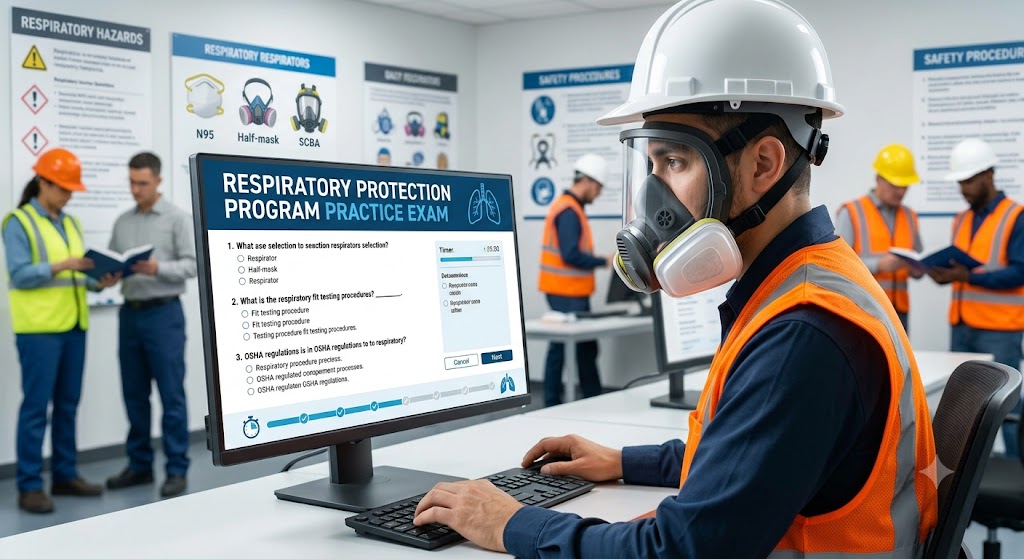
Additional Information
What the Course Entails and Exam Details
A comprehensive respiratory protection course typically covers essential elements such as identifying airborne contaminants, understanding the requirements of relevant standards (e.g., OSHA 29 CFR 1910.134), and learning about the different types of respirators (including air-purifying, atmosphere-supplying, half-mask, full-facepiece, and SCBA). Key areas of focus include selecting the proper respirator for specific hazards, conducting medical evaluations for employees, performing quantitative and qualitative fit testing, and ensuring proper respirator maintenance, storage, and cleaning procedures. Participants also gain insights into employee training responsibilities, program evaluation, and recordkeeping.
What to Expect in the Final Exam
The actual certification exam will rigorously evaluate your understanding of respiratory protection principles. You can expect a format consisting primarily of multiple-choice questions, which may include scenario-based problems requiring you to apply regulations to real-world situations. The exam will challenge your ability to determine appropriate protection factors, interpret medical clearance requirements, and recognize signs of respirator wear and tear. Passing scores and specific time limits will vary depending on the certifying body or training provider, but you should anticipate needing to demonstrate a high level of competency and accuracy across all program elements.
How to Study and Exam Centers
Effective preparation for the Respiratory Protection Program certification involves a multi-faceted approach. Start by thoroughly reviewing the relevant safety standards, your organization's written RPP, and all course materials provided by your training program. Take full advantage of this practice exam, retaking it multiple times to build confidence and identify areas where you need further study. Study guides, flashcards, and online resources can also be valuable tools. The final exam is typically administered either online through authorized training platforms or at physical testing centers operated by accredited safety organizations, community colleges, or professional associations. Check with your training provider for specific instructions on scheduling and location.
Job Opportunities from the Course
A strong understanding of respiratory protection programs is a highly sought-after skill across various industries. Completing relevant courses and passing related exams can lead to opportunities such as:
Environmental Health and Safety (EHS) Coordinator
Industrial Hygienist
Occupational Safety and Health Specialist
Safety Officer
Construction Manager
Hazardous Materials Technician
Facility Manager
Site Safety Supervisor
Mining Operations Supervisor
Chemical Plant Operator
Laboratory Safety Manager
Healthcare Facility Safety Coordinator
Frequently Asked Questions
Reviews
5.0
Based on 0 reviews
Leave a Review
No reviews yet. Be the first to review!