
Residential Wiring Practice Exam
$69.00
- Buy to unlock unlimited access to all Quiz questions.
- After purchase you can print a PDF of the whole quiz at any point. The PDF will contain the questions and the correct answers.
About this Exam
The Residential Wiring certification is a specialized credential designed to validate the knowledge and practical skills required to safely and effectively install, maintain, and repair electrical systems within residential structures. This exam is meticulously crafted for aspiring electricians, vocational students completing their electrical training, and maintenance professionals looking to specialize in home electrical systems. It serves as a critical benchmark, ensuring that individuals possess a thorough understanding of essential electrical principles, safety protocols, and current National Electrical Code (NEC) requirements. By earning this certification, candidates demonstrate their readiness to enter the workforce as qualified residential electricians, providing homeowners and builders with confidence in their technical competence.
Ready to test your knowledge?
Buy Now to Access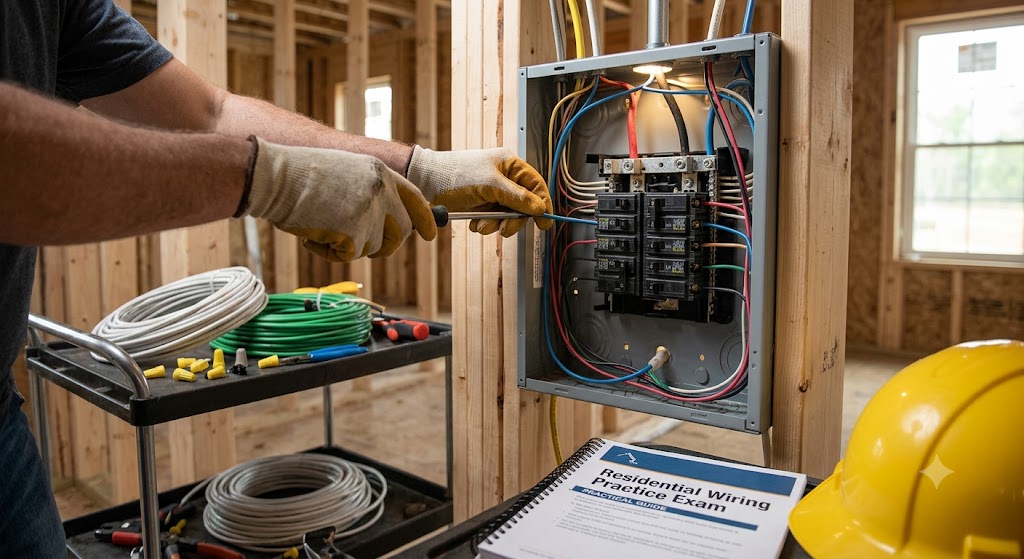
Additional Information
What the Course Entails and Exam Details
A comprehensive preparation course for this exam covers a wide range of topics essential for residential electrical work. The syllabus is typically structured around key competencies derived from the National Electrical Code (NEC) and best industry practices. The core topics included are:
Electrical Fundamentals: Basic theory of circuits, voltage, current, and resistance.
National Electrical Code (NEC) Interpretation: Understanding and applying codes relevant to residential settings, including branch circuits, feeder calculations, grounding, and bonding.
Safety Practices: Recognizing and mitigating hazards, proper use of personal protective equipment (PPE), and safe work procedures.
Residential Wiring Methods: Installation techniques for various types of cables and raceways (e.g., NM-B, MC cable).
Services and Service Equipment: Sizing, installing, and maintaining electrical panels and service connections.
Lighting and Receptacles: Placement, installation, and control of lighting fixtures and power outlets.
Special Systems: Brief overviews of communication, alarm, and home automation wiring requirements.
What to Expect in the Final Exam
The Residential Wiring certification exam is designed to be a rigorous and comprehensive assessment of a candidate’s capabilities. The exact format may vary by certifying body, but candidates should generally prepare for a multiple-choice format. This written portion typically evaluates knowledge of theoretical concepts and practical application through code scenarios.
Key Exam Details:
Format: Primarily multiple-choice questions, which may include matching and true/false in some instances.
Number of Questions: This can range from 80 to 120 questions, depending on the specific exam version.
Time Limit: Candidates are usually given between 2 and 3 hours to complete the examination.
Passing Score: Most programs require a minimum passing score of 70% to 75%.
Specific Rules: Depending on the organization (e.g., licensing boards), the exam may be 'open book' for the NEC portion, allowing candidates to use an authorized copy of the codebook. Be sure to confirm this rule with your specific testing authority. Candidates should expect strict proctoring, whether the exam is administered online or in person.
How to Study and Exam Centers
Achieving success on the Residential Wiring Practice Exam requires a strategic and disciplined approach to studying. Your preparation should combine rigorous theoretical study with focused practical application.
Actionable Study Strategies:
Study the National Electrical Code (NEC): This is your most critical resource. Make sure you are studying the version specified by the certifying body and are familiar with navigating its articles and tables.
Utilize Official Practice Tests: Take multiple timed practice exams to get comfortable with the pacing and question format. This is vital for building exam stamina and identifying weak areas.
Enroll in a Comprehensive Course: Participate in an accredited vocational program or electrical apprenticeship. These courses provide structured learning and expert guidance.
Focus on Code Applications: Don’t just memorize definitions. Practice solving code-based problems that simulate real-world residential wiring scenarios.
Use Flashcards for Key Terms and Formulas: Memorize common formulas (e.g., Ohm’s Law, Power Formula) and important definitions.
Exam Centers:
Depending on the specific certification or licensing body you are using, the exam may be administered through several channels. These include:
Proctored Online Portals: Many certifying organizations utilize secure online testing platforms that allow you to take the exam from a quiet, monitored location.
Third-Party Testing Centers: Major providers like Pearson VUE have widespread locations where you can register and take the exam in a controlled environment.
Authorized Schools and Apprenticeship Programs: Many state electrical boards and vocational schools are approved to administer these certification exams directly to their students.
Job Opportunities from the Course
Earning this certification opens significant career pathways in the electrical trade, providing a strong foundation for future specializations. Qualified individuals can pursue a variety of rewarding positions.
Residential Electrician Apprentice
Residential Electrician Trainee
Licensed Residential Wireman (after meeting state experience requirements)
Residential Electrical Helper
Maintenance Electrician (specializing in residential properties)
Electrical Systems Installer
Home Automation and Security System Installer
Frequently Asked Questions
Reviews
5.0
Based on 0 reviews
Leave a Review
No reviews yet. Be the first to review!