
Reserve Component Maneuver Captains Career Course (RC‑MCCC) Phase 3 Practice Test
$69.00
- Buy to unlock unlimited access to all Quiz questions.
- After purchase you can print a PDF of the whole quiz at any point. The PDF will contain the questions and the correct answers.
About this Exam
The Reserve Component Maneuver Captains Career Course (RC‑MCCC) Phase 3 is a critical professional military education milestone designed specifically for mid-grade officers in the Army Reserve and National Guard, focusing on the Maneuver branches: Infantry and Armor.
This phase, typically delivered in a resident or blended format, serves as the operational and tactical-level culmination of the course, preparing Captains for the increased responsibilities of company command and battalion staff officer positions (e.g., S3 operations and S1 personnel).
The course bridges the gap between foundational leader skills and the complex, synchronized application of combined arms warfighting, ensuring officers can effectively lead and plan within a multi-domain operational environment.
Ready to test your knowledge?
Buy Now to Access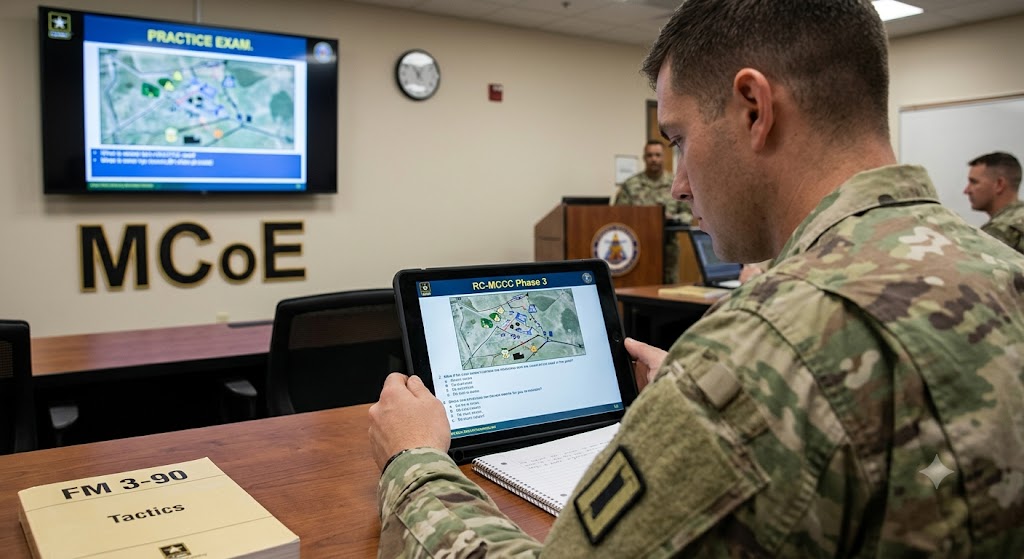
Additional Information
What the Course Entails and Exam Details
RC‑MCCC Phase 3 is primarily focused on the practical application of tactics and operational art. The comprehensive curriculum covers core tenets including, but not limited to:
The Military Decision-Making Process (MDMP): Master all seven steps of MDMP, from receipt of mission to orders production, focusing on generating thorough, viable, and flexible tactical plans at the battalion and company levels.
Troop Leading Procedures (TLPs): Apply the small-unit leadership equivalent of MDMP, ensuring discipline and precision in executing company and platoon-level operations.
Combined Arms Operations: Understand and integrate all elements of combat power—maneuver, fires, sustainment, protection, and intelligence—within offensive, defensive, and stability operations.
Army Doctrine and Tactic: In-depth study and application of fundamental doctrine, including ADP 3-0 (Operations), FM 3-90 (Tactics), and branch-specific techniques for Infantry and Armor units.
Training Management: Gain proficiency in preparing, executing, and assessing realistic unit training to maintain readiness.
What to Expect in the Final Exam
The final assessment for RC‑MCCC Phase 3 is designed to test your ability to apply, not just recall, the information learned throughout the course.
Students should expect a rigorous, multifaceted evaluation that includes a three-part comprehensive, open-book examination worth 30% of the course grade. The exam consists of short answer questions, problem-situation questions, and multiple-choice questions focusing on doctrine and tactical application.
Beyond the written portion, you must demonstrate proficiency through a tactical practical exercise, requiring you to produce elements of an operations order (OPORD) and conduct necessary briefings.
To pass, students are required to achieve a minimum score of 80% on each module exam, and academic honors require a first-time "GO" on all evaluations. The multiple-choice section will present scenarios and ask you to select the best method for Course of Action (COA) analysis—such as Belt, Box, or Avenue-in-Depth.
How to Study and Exam Centers
Effective study for the RC‑MCCC Phase 3 exam requires a dedication to mastering both doctrine and process.
Doctrine is Paramount: Dedicate significant time to studying key Army publications. Memorize definitions for tactical mission tasks, the steps of MDMP and TLPs, and the products generated at each step. Pay special attention to "gotcha" definitions, like the difference between "Proof" and "Clear" in breach operations.
Practice MDMP: The best preparation is doing. Find or create tactical scenarios and go through the entire MDMP with a study group. Practice generating COA sketches, synchronization matrices, and decision support tools.
Take Practice Tests: Utilizing our comprehensive practice exams will help you become familiar with the phrasing of the multiple-choice questions and identify areas where your doctrinal knowledge is weak.
Utilize Academic Proofreading: For any written requirements, ensure your OPORDs and briefings are clear, concise, and adhere to Army writing standards.
The Phase 3 resident portions and final exams are conducted at the Maneuver Center of Excellence (MCoE), Fort Moore (formerly Fort Benning), Georgia, within the specified small group seminar environments. Contact your unit training officer for enrollment via the Army Training Requirements and Resources System (ATRRS).
Job Opportunities from the Course
Successful completion of the RC‑MCCC, culminating in Phase 3, unlocks essential leadership and staff roles. Here are the clear career paths this certification opens:
Company Commander
Battalion S3 (Operations) Officer
Battalion S1 (Personnel) Officer
Battalion S4 (Logistics) Officer
Brigade or Higher Staff Officer (e.g., in a specialized cell)
Observer, Controller, Trainer (OC/T)
Small Group Leader (SGL) at a Captains Career Course
Joint or Interagency Staff Officer
Frequently Asked Questions
Reviews
5.0
Based on 0 reviews
Leave a Review
No reviews yet. Be the first to review!