
Research in Social Work Practice Test
$69.00
- Buy to unlock unlimited access to all Quiz questions.
- After purchase you can print a PDF of the whole quiz at any point. The PDF will contain the questions and the correct answers.
About this Exam
The Research in Social Work Practice Exam evaluates a candidate's understanding of foundational research principles crucial to the field of social work.
It assesses proficiency in the scientific method, research ethics, diverse methodologies, and the ability to apply findings to improve client outcomes and agency practices.
This exam is designed for social work students (BSW or MSW), practicing social workers needing to demonstrate proficiency, or individuals preparing for license-specific research modules.
Ready to test your knowledge?
Buy Now to Access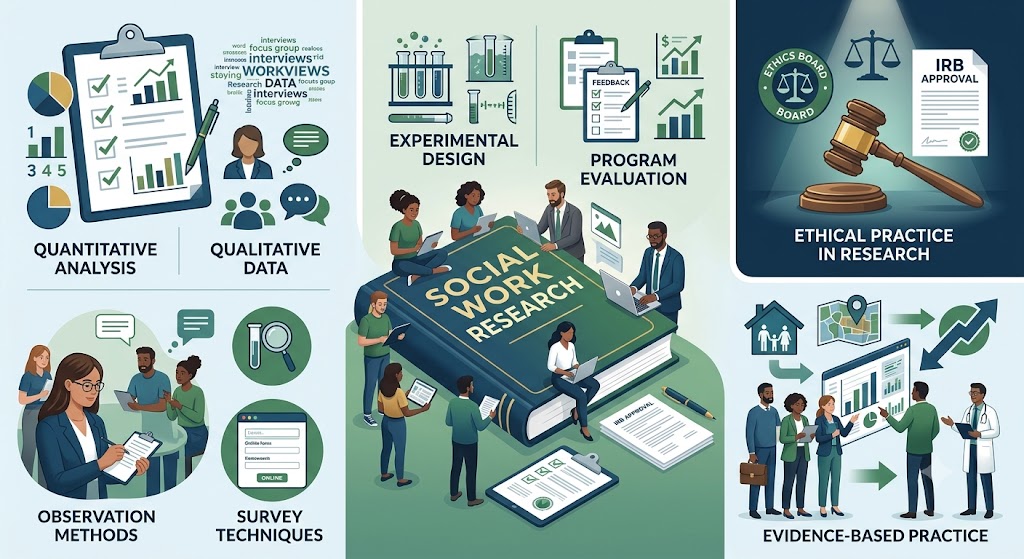
Additional Information
What the Course Entails and Exam Details
The course prepares students for the entire research journey.
Key topics include formulating a research question, performing systematic literature reviews, understanding research ethics (human subjects, IRB), selecting appropriate quantitative (experimental, quasi-experimental, longitudinal) and qualitative (case study, ethnography, phenomenology) designs, sampling methods, and implementing reliable data collection techniques like surveys or interviews.
Participants will master data analysis using statistical software or thematic coding and learn to synthesize findings into practice-informed reports.
What to Expect in the Final Exam
The final exam typically follows a standardized multiple-choice format, often with 75–100 questions.
It may include scenario-based questions where candidates must identify the most rigorous study design or the ethical breach in a given situation.
A passing score is generally around 70-75% (or based on a scaled score for professional boards).
Time limits are usually around 90 to 120 minutes, simulating the time pressures found in actual field settings or other social work licensing exams.
How to Study and Exam Centers
Effective preparation requires both content review and practice.
Start by thoroughly reading the assigned research methods textbook.
Focus on defining key terms like independent/dependent variables, types of reliability and validity, and specific study design characteristics.
Take multiple comprehensive practice exams to improve speed and endurance.
These practice tests help candidates become familiar with common question formats and identify knowledge gaps.
Study groups are also beneficial for debating complex ethical scenarios.
The test can often be taken online through a university's proctoring service or a dedicated certification portal.
If a physical testing center is required, students may be directed to university computer labs or an approved third-party center like Pearson VUE.
Job Opportunities from the Course
Mastering social work research opens doors beyond direct client service.
Example titles include:
Research Analyst for Social Services Agencies
Program Evaluation Specialist in Non-Profit Organizations
Community Needs Assessment Coordinator
Social Policy Researcher
Data-Driven Practice Consultant
Social Work Instructor
Principal Investigator in Academic Research
Frequently Asked Questions
Reviews
5.0
Based on 0 reviews
Leave a Review
No reviews yet. Be the first to review!