
Rescue Task Force (RTF) Practice Exam
$69.00
- Buy to unlock unlimited access to all Quiz questions.
- After purchase you can print a PDF of the whole quiz at any point. The PDF will contain the questions and the correct answers.
About this Exam
The Rescue Task Force (RTF) model represents a critical shift in how first responders manage active shooter and mass casualty incidents in the "warm zone"—an area where a threat has been mitigated but not fully eliminated. This practice exam is designed for EMS providers (EMTs, Paramedics), firefighters, and law enforcement officers seeking to master the specific protocols of integrated response. The certification validates your ability to operate as part of a coordinated unit, providing immediate life-saving care (TECC/TCCC) and rapid extraction of victims while under protective cover. This practice exam bridges the gap between static training and operational proficiency, helping you build confidence for real-world application.
Ready to test your knowledge?
Buy Now to Access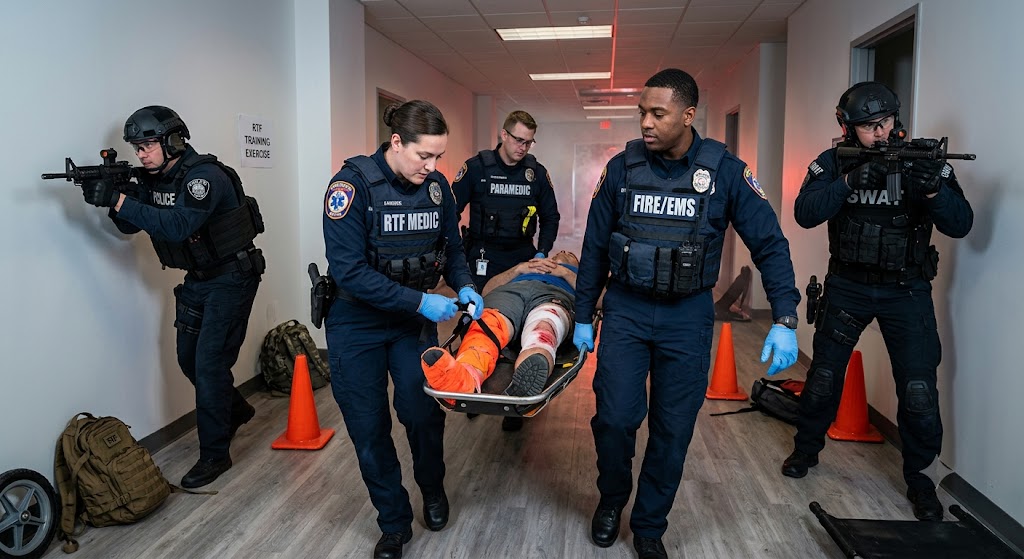
Additional Information
What the Course Entails and Exam Details
The comprehensive training program, which this practice exam mirrors, focuses on seamless integration between medical and law enforcement personnel. Core topics covered in the course include:
Integrated Operations: Unified command structures, communication protocols between distinct agencies, and warm zone movement drills.
Tactical Emergency Casualty Care (TECC): Applied principles for managing bleeding, airway issues, and tension pneumothorax in high-threat environments.
Warm Zone Dynamics: Recognizing threat levels, identifying safe corridors, and understanding the 'Direct Threat' vs. 'Indirect Threat' care phases.
Mass Casualty Triage & Treatment: Rapid assessment techniques adapted for high-risk, fluid situations.
Extraction Techniques: Methods for quickly moving non-ambulatory patients from the warm zone to Casualty Collection Points (CCP) or Ambulance Exchange Points (AXP).
Ballistic Protection & Self-Aid/Buddy-Aid: Proper use of protective equipment and personal medical skills.
What to Expect in the Final Exam
The Rescue Task Force exam typically consists of multiple components, assessing both knowledge and physical skill application.
Written Examination
Format: Multiple-choice questions, scenario-based problem-solving.
Topics: TECC/TCCC guidelines, RTF operational protocols, triage algorithms, and unified command principles.
Passing Score: Usually requires a minimum score of 80%.
Time Limit: Approximately 60 to 90 minutes.
Practical/Scenario-Based Assessment
Format: A simulated operational environment (e.g., active shooter exercise).
Requirements: Candidates must operate in integrated teams (LE and Fire/EMS), demonstrate proper movement in the warm zone, apply life-saving medical care (tourniquets, wound packing, airway management), and execute rapid victim extraction under time pressure.
Evaluation: Critical fail criteria usually apply (e.g., compromising safety, failing to perform life-saving interventions correctly).
How to Study and Exam Centers
Preparing for the RTF exam requires both academic study and practical skill rehearsal.
Actionable Study Strategies
Master TECC Guidelines: The foundation of RTF medical care is Tactical Emergency Casualty Care. Regularly review the latest TECC protocols for Direct Threat and Indirect Threat Care.
Review Operational Manuals: Study the specific RTF policies and procedures of your local or state agencies. Understand the roles and communication channels.
Conduct Peer Scenarios: Work with colleagues from other disciplines (e.g., EMS practicing with PD). Simulate warm zone entries, triage, and extraction in different environments (buildings, stadiums).
Practice High-Stress Skills: Drill essential medical interventions—especially rapid tourniquet application—under stress or in awkward positions.
Exam Centers and Delivery
Rescue Task Force certifications are typically not administered through general standardized testing centers like Pearson VUE. Instead, they are delivered via:
State or Regional Public Safety Academies: Fire, police, and EMS training centers that specialize in interagency coordination.
Authorized Specialized Training Providers: Private companies or educational institutions approved to deliver certified RTF courses.
Hosted Training Operations: Large-scale training events organized by regional emergency management offices.
Online Components: Some programs may offer a hybrid model with an online cognitive exam, followed by in-person practical evaluations. Check with your specific course coordinator for exact details.
Job Opportunities from the Course
Successfully completing an RTF course and passing the associated exam positions first responders for specialized, high-impact roles within emergency services. This certification is a valuable asset for career advancement in the following fields:
Special Operations EMT / Paramedic
Tactical Medic (TEMS)
Firefighter/Paramedic with Special Ops Specialization
Active Shooter / Mass Casualty Response Team Member
Law Enforcement Officer (LEO) with Advanced Medical Training
EMS Supervisor / Field Training Officer (FTO)
Emergency Management Coordinator
Disaster Response Specialist
Hospital Emergency Preparedness Liaison
Frequently Asked Questions
Reviews
5.0
Based on 0 reviews
Leave a Review
No reviews yet. Be the first to review!