
Rescue Squad Assessment Practice Test
$69.00
- Buy to unlock unlimited access to all Quiz questions.
- After purchase you can print a PDF of the whole quiz at any point. The PDF will contain the questions and the correct answers.
About this Exam
The Rescue Squad Assessment Practice Exam is a crucial stepping stone for aspiring and current emergency responders looking to join or advance within elite technical rescue teams. Designed to evaluate a candidate's readiness, skills, and knowledge, this test serves as comprehensive preparation for the final certification or selection process for specialized rescue units. Whether you are aiming for a career in technical rescue, fire department rescue squads, or urban search and rescue teams, this practice resource assesses your understanding of critical procedures, equipment, and safety protocols essential for high-risk operations in dynamic and challenging environments. By simulating the rigors of the official assessment, it helps build confidence and identifies areas for improvement.
Ready to test your knowledge?
Buy Now to Access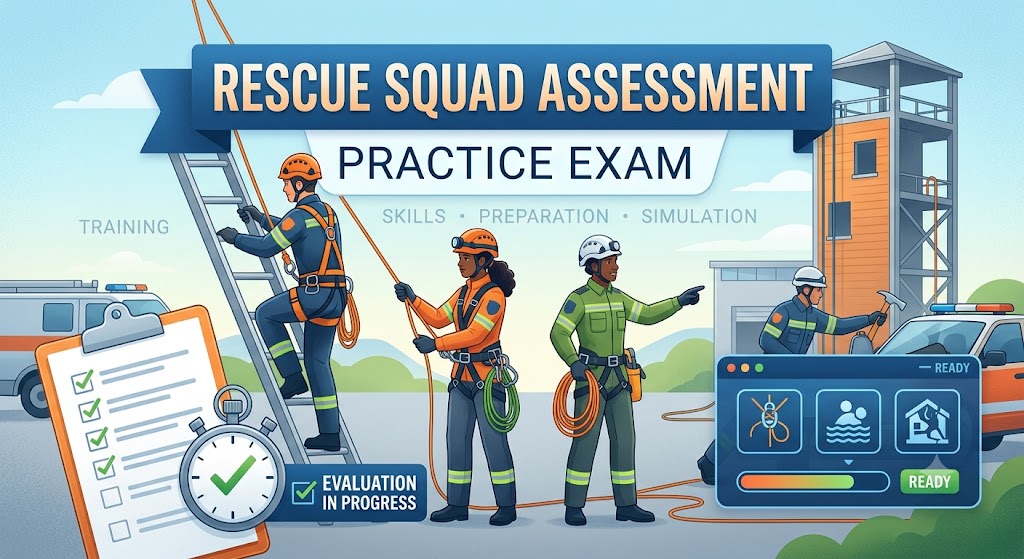
Additional Information
What the Course Entails and Exam Details
While specific requirements can vary between organizations and regions, core topics covered in rescue squad assessments and this practice exam typically include:
Standard operating procedures (SOPs) and safety protocols.
Specialized rescue disciplines: rope rescue, confined space, structural collapse, trench rescue, vehicle and machinery extrication, and swiftwater/surface water rescue.
Incident Command System (ICS) principles and radio communications.
Rescue equipment use, inspection, and maintenance.
Triage and basic emergency medical care in rescue contexts.
Knots, anchor systems, mechanical advantage systems, and victim packaging.
Hazard recognition and risk assessment.
Reading construction blueprints and understanding structural stabilization for collapse.
The primary goal is to ensure a standardized level of competency in essential rescue techniques and decision-making skills.
What to Expect in the Final Exam
The final rescue squad assessment is typically a comprehensive process with both written and practical components.
Written Exam
Format: Multiple-choice questions, true/false, and short answer questions.
Topics: Theory, definitions, protocols, standards, and problem-solving scenarios.
Time Limit: Often ranges from 2 to 4 hours.
Passing Score: Generally requires a minimum of 70% to 80%.
Practical Skills Assessment
Format: Hands-on evaluation performing specific rescue tasks.
Examples: Deploying a z-rig, performing a horizontal litter basket evacuation, setting up an aerial ladder for victim extraction, or executing a vehicle extrication.
Scenarios: Often timed, simulating real-world pressure and conditions.
Passing Criteria: Typically based on successful completion without critical safety errors or deviations from standard procedures. Evaluators use checklists.
How to Study and Exam Centers
Effective study for a rescue squad assessment requires a blend of knowledge and practical application.
Review official training manuals, SOPs, reference books, and applicable industry standards (e.g., NFPA guidelines).
Use flashcards for key terms, knot names, equipment functions, and mechanical advantage principles.
Participate in practical training sessions, drills, and simulations with a mentor or team. Practice knot tying and equipment setups until they become second nature.
Form study groups with colleagues to review scenarios and discuss challenging concepts.
Take and retake timed practice exams. This simulates the testing environment, improves time management, and highlights areas needing more review. Analyze your mistakes.
Exam Centers
The location for the final assessment varies:
Written exams may be held at certified training facilities, educational institutions, fire academies, or online through secure proctoring platforms.
Practical skills assessments are almost always conducted at physical training grounds equipped with specialized props, towers, vehicles, and other resources relevant to the rescue disciplines being tested. Contact your sponsoring agency or training coordinator for details.
Job Opportunities from the Course
A successful rescue squad assessment unlocks career paths within specialized rescue and emergency services.
Firefighter/Rescue Technician
Technical Rescue Specialist
Urban Search and Rescue (US&R) Team Member
Rescue Squad Officer/Supervisor
Industrial Rescue Specialist
Emergency Medical Services (EMS) Special Operations Medic
Disaster Response Coordinator
Confined Space Rescue Specialist
Trench Rescue Specialist
Water Rescue Specialist
Rope Access Technician (in industrial settings)
Frequently Asked Questions
Reviews
5.0
Based on 0 reviews
Leave a Review
No reviews yet. Be the first to review!