
Republic Airlines ERJ 170/175 Limitations Practice Test
$69.00
- Buy to unlock unlimited access to all Quiz questions.
- After purchase you can print a PDF of the whole quiz at any point. The PDF will contain the questions and the correct answers.
About this Exam
This specialized practice test is meticulously crafted for commercial pilots, flight instructors, and students who are either actively flying the Embraer ERJ 170/175 or are preparing for a specific operator's limitations assessment, such as those conducted by Republic Airlines.
Mastering aircraft operating limitations is not just about passing an exam; it's fundamental to safe flight operations. These limitations define the structural and performance boundaries within which the aircraft can be operated without exceeding design parameters. This certification practice resource focuses on ensuring you know exactly where these boundaries are, without hesitation. It's designed for those who want a rigorous, realistic, and highly relevant self-assessment tool to validate their readiness for the next level of training or certification.
Ready to test your knowledge?
Buy Now to Access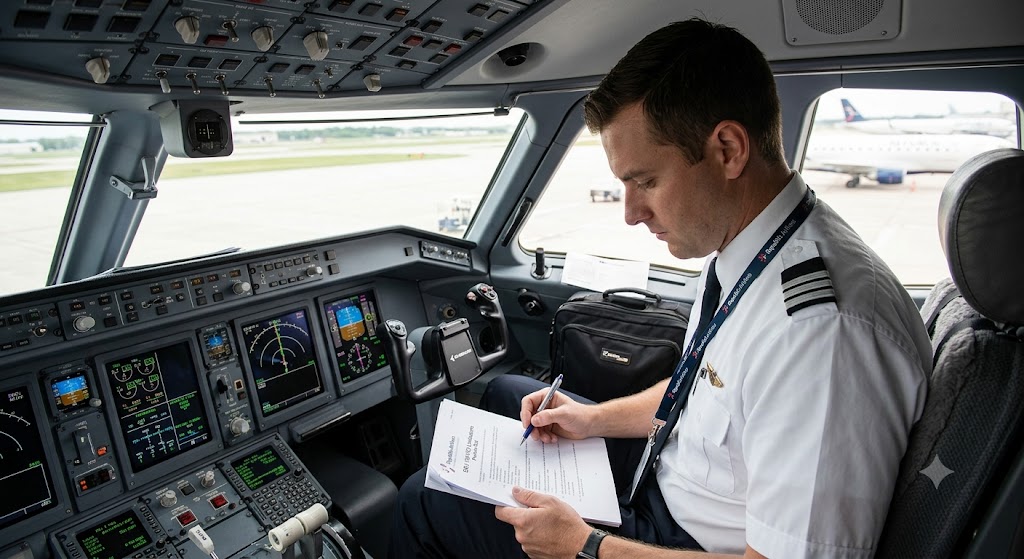
Additional Information
What the Course Entails and Exam Details
The Republic Airlines ERJ 170/175 Limitations Practice Test is a focused curriculum that covers the critical operational constraints of this popular regional jet series. It doesn't teach you how to fly the aircraft; rather, it benchmarks your knowledge of the essential rules of the aircraft. The course content delves deeply into the following key areas as specified in the official Airplane Flight Manual (AFM) and operator manuals:
Aircraft General and Dimensions: Specific lengths, spans, and height limitations.
Weight & Balance Parameters: Maximum structural weights, including Maximum Taxi Weight (MTW), Maximum Takeoff Weight (MTOW), Maximum Landing Weight (MLW), and Maximum Zero Fuel Weight (MZFW).
Operational Envelopes: Maximum operating altitudes, specific limitations for takeoff and landing elevation, and ambient temperature restrictions.
Speed Limitations: V-speeds including Vmo/Mmo (Maximum Operating), Vfe (Flaps Extended), Vlo/Vle (Landing Gear), and turbulent air penetration speeds.
Powerplant (Engine) Limitations: Understanding thrust settings, N1 and N2 limits, ITT (Interstage Turbine Temperature) limits for start, takeoff, and continuous operation, and oil pressure/temperature requirements for the General Electric CF34-8E engines.
System Limitations: Specific constraints for the APU (Auxiliary Power Unit), fuel system, hydraulic system, electrical system, environmental control, and pressurization, including maximum differential pressures.
Landing Gear and Brakes: Limitations on brake application, cooling periods, and tire speeds.
Ice and Rain Protection: Critical parameters for activating anti-ice systems and limitations during flight in icing conditions.
The detailed practice exam then evaluates your ability to recall and apply these limitations correctly across all flight phases.
What to Expect in the Final Exam
While this is a practice test designed to prepare you for official evaluaciones, it is structured to mirror the typical experience you will encounter in an airline training environment or an official certification exam. Here is what you can expect in a final, formal limitations evaluation:
Format: Multiple-Choice and True/False Questions. You will face a standardized exam requiring you to select the correct limitation parameter from several options, often featuring distractors based on common misconceptions or limitations of different aircraft variants. Some sections might require direct fill-in-the-blank numerical values for key speeds or weights.
Passing Score: Stringent Requirements. In an actual airline evaluation, the pass mark for limitations is often 100%. If any answer is incorrect, immediate debriefing, retraining, and re-evaluation are usually required. In some scenarios, a pass mark might be 90-95% for an initial quiz, but absolute mastery (100% correct) is expected before entering a flight simulator or aircraft.
Time Limit: A Strict Countdown. The final exam will be timed, simulating the need to access and apply limitations information rapidly during flight operations. Expect to have limited time per question to ensure fluency and discourage guesswork.
Specific Rules: Closed Book. Official limitations exams are invariably closed book. You will not be permitted to use your Pilot's Operating Handbook (POH), Flight Manual (AFM), or any other reference material. Success hinges purely on rote memorization and deep system knowledge.
Our practice test replicates these conditions, including a timed format and realistic question types, so you are fully prepared for the intensity of the official evaluation.
How to Study and Exam Centers
Actionable Study Strategies
Achieving 100% on a limitations exam requires a structured and relentless study approach. You cannot rely on passive reading. Try these methods:
Create Digital and Physical Flashcards: This is the most effective technique. Create cards for every single limitation. Review them daily using an active recall system like spaced repetition (apps like Anki or Quizlet are excellent). Test yourself from "Limitation Name" to "Value" and vice versa.
Simulate with Mock Scenarios: Don't just recall numbers. Imagine you are at MTOW on a specific runway at a specific elevation. What is your required flap setting, and what are your critical V-speeds? This practice links the data to real-world application.
Practice with Time Pressure: When using our practice test, focus on speed and accuracy. Set a stricter time limit for yourself than what you expect in the official exam to build a buffer of fluency.
Focus on 'Distractor' Numbers: Pay special attention to parameters where the ERJ 170 differs from the ERJ 175. Also, note values that change based on flight phase (e.g., maximum APU start vs. maximum APU continuous operation altitudes).
Where to Take the Official Exam
Official limitations exams are proprietary and conducted directly by the operator or their designated training partner.
Operator Internal Training: If you are a newly hired pilot at Republic Airlines, the limitations exam will be a mandatory hurdle within the Initial Qualification training program at one of their training hubs (e.g., Indianapolis). These are not open to the general public.
Authorized Flight Training Organizations (FTOs): Certain large flight academies that hold contracts for "Airline-Direct" training might administer official ERJ 170/175 limitations quizzes on behalf of the operator to screen candidates or validate training readiness. Examples might include large schools like FlightSafety International or L3Harris Flight Academy. You would take these exams at their specific locations.
Job Opportunities from the Course
Mastering the operating limitations of the ERJ 170/175 isn't just about unlocking a single job; it is a critical skill for an entire professional piloting career within the regional airline sector. This knowledge is your prerequisite for any role involving this aircraft type. Successful completion of your limitations evaluations and the subsequent type rating program unlocks a clear career progression, particularly relevant to carriers like Republic Airlines:
Airline First Officer (FO): This is the immediate and most common entry point. As a First Officer, you are responsible for monitoring limitations as a core function, ensuring every flight remains within the safe operating envelope defined by the AFM. This is the foundation upon which you build experience.
Airline Captain (PIC): Promotion to Captain carries ultimate responsibility for the safety of the flight, including strict adherence to all operational limitations. A Captain must possess an instinctual, unwavering knowledge of the aircraft's limits to make rapid, sound command decisions.
Check Airman / Check Pilot: These are senior Captains who administer evaluations (like limitations quizzes and check rides) to other pilots. Mastering limitations is non-negotiable for this role, as you are the standard-bearer for the entire pilot group.
Simulator Instructor: You will utilize your deep knowledge to train new hires or upgrade pilots in full-motion flight simulators, where you will intentionally create scenarios that push the limits to teach critical decision-making.
Airline Training Captain: In this role, you oversee the development and delivery of ground school curricula, including the very limitations training material you have just mastered, helping other pilots succeed.
Flight Safety Officer (FSO): Understanding limitations is crucial for identifying operational risks and analyzing incidents to improve airline safety protocols.
Frequently Asked Questions
Reviews
5.0
Based on 0 reviews
Leave a Review
No reviews yet. Be the first to review!