
Republic Act (RA) 5527 Medical Technology Act of 1969 Practice Test
$69.00
- Buy to unlock unlimited access to all Quiz questions.
- After purchase you can print a PDF of the whole quiz at any point. The PDF will contain the questions and the correct answers.
About this Exam
The Republic Act (RA) 5527, also known as the Philippine Medical Technology Act of 1969, is the foundational law that regulates the practice of medical technology in the Philippines. This practice test is a comprehensive, tailored resource designed specifically for aspiring Filipino medical technologists who are preparing for the ultimate milestone: the Medical Technologist Licensure Examination (MTLE). The MTLE is administered by the Professional Regulation Commission (PRC). Our specialized RA 5527 practice test aims to familiarize you with the types of questions, the scope of the law, and the essential clinical subjects you will encounter, building the knowledge and confidence required to pass.
Ready to test your knowledge?
Buy Now to Access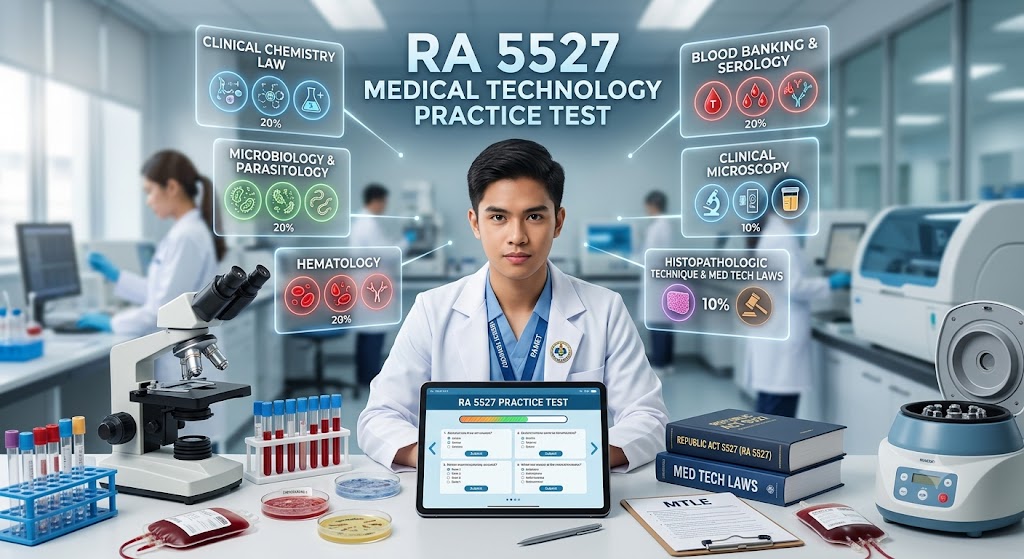
Additional Information
What the Course Entails and Exam Details
This preparation material focuses on the implementation of RA 5527, which encompasses both the legal framework and the full clinical syllabus of medical technology. The final licensure exam itself does not just test the law, but uses it as the basis for the entire profession's regulation.
The core subjects covered in the MTLE, which you must master, include:
Clinical Chemistry (20%): Principles and procedures of analyzing blood, urine, and other body fluids for chemical components (e.g., glucose, cholesterol, electrolytes, enzymes, hormones, toxicology).
Microbiology and Parasitology (20%): Identification of pathogenic microorganisms (bacteria, viruses, fungi) and parasites, including their characteristics, life cycles, and laboratory diagnostic methods.
Hematology (20%): The study of blood cells (RBC, WBC, platelets), coagulation mechanisms, and related disorders.
Blood Banking and Serology (20%): Principles and procedures of blood typing, cross-matching, blood donor screening, and serological tests for diseases.
Clinical Microscopy (10%): Examination of urine, feces, and other body fluids for physical, chemical, and microscopic characteristics.
Histopathologic Techniques and Medical Technology Laws (10%): Principles and procedures of preparing tissue samples for microscopic examination, Laboratory Management, and a deep dive into the provisions of RA 5527, its amendments (e.g., RA 6138, PD 498, PD 1534), and the Code of Ethics.
What to Expect in the Final Exam
The actual MTLE is a significant undertaking that requires thorough mental and physical preparation. It is a pencil-and-paper, multiple-choice examination.
Key exam details to keep in mind:
Format: The exam consists of six separate tests corresponding to the subjects listed above. Each subject test typically contains 100 multiple-choice questions.
Passing Score: To pass the MTLE, a candidate must obtain a general average of at least 75% in the entire examination, with no grade lower than 50% in any of the six major subjects. If an examinee fails one or two subjects but obtains a general average of 75%, they will be conditioned and required to retake only the failed subject(s) in the next exam.
Time Limits: The examination is usually held over two consecutive days, with specific time slots for each subject. You are typically given 1.5 to 2 hours per subject test.
Specific Rules: All PRC licensure exams enforce strict rules against cheating, the use of programmable calculators, and mobile phones. You must bring the required application documents, your notice of admission, and a sharp pencil.
How to Study and Exam Centers
Preparation for the MTLE is a marathon, not a sprint. Success depends on a mix of thorough clinical understanding and comprehensive legal knowledge of RA 5527.
Actionable Study Strategies:
Deconstruct the Syllabus: Focus heavily on the "Must Know" and "Desirable to Know" sections of the Table of Specifications (TOS) provided by the PRC Board of Medical Technology. Don't waste too much time on "Nice to Know" until you've mastered the core.
Use Official Resources: Your primary references should be well-established medical technology textbooks used in your curriculum and the full, annotated text of RA 5527 and its amendments.
Active Learning and Practice Tests: Don't just re-read. Create flashcards, draw diagrams of metabolic pathways or life cycles, and take practice tests like this one repeatedly. Analyze the rationale for both correct and incorrect answers.
Enroll in a Review Center: Many students find value in specialized review programs (online or in-person) that offer structured schedules, expert lectures, and mock board exams.
Where and How to Take the Exam:
The MTLE is a national licensure examination administered by the Professional Regulation Commission (PRC). It is not taken via online portals like Pearson VUE. It is a physical examination held at specific PRC-designated testing centers throughout the Philippines, such as:
Manila
Baguio
Cebu
Davao
Iloilo
Legazpi
Lucena
Rosales
Tuguegarao
Zamboanga
Application is done online through the PRC's official website (prc.gov.ph) during the prescribed application period.
Job Opportunities from the Course
Passing the MTLE and becoming a Registered Medical Technologist (RMT) under RA 5527 opens the door to a wide array of stable and impactful career paths in the health sector, both in the Philippines and abroad.
Specific job titles and career paths include:
Registered Medical Technologist (RMT): Working in hospital clinical laboratories (tertiary, secondary, primary), free-standing laboratories, and diagnostic centers.
Laboratory Supervisor/Manager: With experience, leading a team of technologists and overseeing lab operations.
Quality Assurance Officer: Ensuring the accuracy, precision, and compliance of laboratory testing.
Research Assistant/Associate: Working in academic institutions, pharmaceutical companies, or research organizations on medical and diagnostic studies.
Public Health Medical Technologist: Working for government agencies like the Department of Health (DOH) or local health units, often involving community-based diagnostic programs.
Forensic Medical Technologist: Working with law enforcement agencies (e.g., NBI, PNP) on forensic analysis, DNA testing, and toxicology.
Product Specialist/Sales Representative: Working for medical diagnostic companies, providing technical support or selling laboratory instruments and reagents.
Academician/Instructor: Teaching medical technology students in recognized schools.
Frequently Asked Questions
Reviews
5.0
Based on 0 reviews
Leave a Review
No reviews yet. Be the first to review!