
Reproductive Physician Assistant National Certifying Examination (PANCE) Practice test
$69.00
- Buy to unlock unlimited access to all Quiz questions.
- After purchase you can print a PDF of the whole quiz at any point. The PDF will contain the questions and the correct answers.
About this Exam
Welcome to your comprehensive guide on the specialized practice resource for the Reproductive Physician Assistant National Certifying Examination (PANCE) Practice test.
First and foremost, it is crucial to clarify a common misconception: there is no standalone "Reproductive PANCE" exam. All graduates of accredited Physician Assistant (PA) programs must pass the general PANCE, administered by the National Commission on Certification of Physician Assistants (NCCPA), to obtain their PA-C designation and practice in any field.
However, once you are a certified PA-C, you can choose to subspecialize in a wide range of fields, including Reproductive Endocrinology and Infertility (REI), Women's Health, or Obstetrics and Gynecology. This practice test and guide are specifically designed to help you master the material for the Reproductive System section of the general PANCE, which makes up approximately 7% of the final exam. Mastering this subset of questions is essential, especially for those looking to build a career in a fertility or reproductive health clinic. It provides focused, in-depth preparation to ensure you excel on these highly technical and emotionally sensitive questions.
Ready to test your knowledge?
Buy Now to Access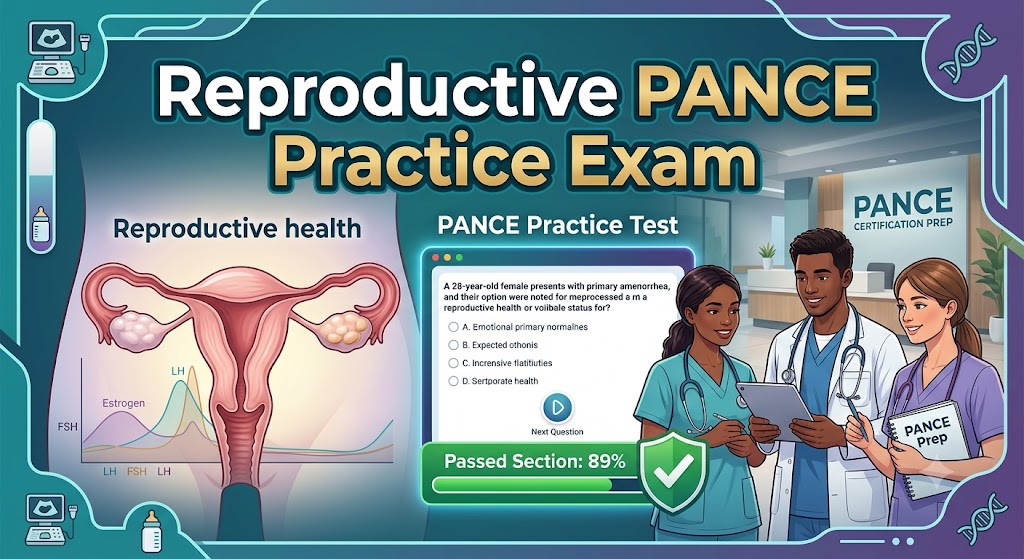
Additional Information
What the Course Entails and Exam Details
A specialized "Reproductive PANCE Practice Exam" is not a formal course but a targeted study tool. It distills the extensive Reproductive System content blueprint from the NCCPA into practice questions and review material.
This focused practice resource covers critical areas from the entire lifespan, from embryology to menopause. Core topics you must master include:
Menstrual Cycle & Disorders: Understanding the hormonal regulation of the follicular and luteal phases, amenorrhea (primary and secondary), dysmenorrhea, abnormal uterine bleeding, and polycystic ovary syndrome (PCOS).
Contraception: Mechanism, efficacy, contraindications, and management of various methods (barrier, hormonal, IUD, sterilization).
Infertility: Male and female factors, diagnostic workups, and an overview of treatment options like intrauterine insemination (IUI) and in-vitro fertilization (IVF).
Obstetrics: Normal pregnancy physiology, prenatal care, complications (gestational diabetes, hypertensive disorders of pregnancy like pre-eclampsia, placenta previa, and placental abruption), labor and delivery, and postpartum care.
Infectious Diseases: Diagnosis, treatment, and management of sexually transmitted infections (STIs), pelvic inflammatory disease (PID), and vaginitis.
Reproductive Oncology: Benign and malignant conditions, including breast, cervical, endometrial, and ovarian cancers.
Other Disorders: Management of endometriosis, uterine fibroids, ovarian cysts, mastitis, and benign breast disease.
This study resource helps you translate theoretical knowledge into practical clinical decision-making.
What to Expect in the Final Exam
Since this is not a separate exam but a focused study area, you should prepare for how these questions are integrated into the actual PANCE.
The final PANCE is a six-hour, computer-based exam consisting of 300 multiple-choice questions.
Here is what you can expect in the final test setting:
Format: The exam is delivered in five distinct blocks of 60 questions each.
Time Limit: You are given 60 minutes to complete each 60-question block, totaling five hours of testing time.
Integration: Approximately 7% of these 300 questions (around 21 questions) will be related to the Reproductive System. They will be distributed throughout the various blocks and will require you to apply multiple task skills, such as formulating a most likely diagnosis, using diagnostic studies, and implementing pharmaceutical therapeutics.
Scoring: To pass the PANCE, you must achieve a minimum scaled score of 350 on a scale of 200 to 800.
Specific Rules: On the day of the exam, you will be given 45 minutes of total break time to divide between the blocks as you see fit. You must manage your time carefully.
How to Study and Exam Centers
Preparation is key to success. For the reproductive health content on the PANCE, your strategy should be both broad and deep.
Targeted Study: Use specialized question banks and practice tests, like a "Reproductive PANCE Practice Exam," to repeatedly test your knowledge on this 7% of the content. This builds stamina and highlights weak areas.
Core Material Review: Do not solely rely on practice questions. Use comprehensive PA review textbooks (like PANCE Prep Pearls or Current Medical Diagnosis & Treatment) to study the detailed physiology and management protocols for reproductive disorders.
Understand the Tasks: Pay attention to how questions are framed. NCCPA categorizes tasks into seven areas (e.g., History Taking, Formulating Most Likely Diagnosis, Clinical Intervention). Ensure you can answer questions from all task perspectives.
Clinical Rotations: If possible, elect for an OBGYN or REI rotation during your PA school. The real-world experience is invaluable for connecting complex concepts.
As for exam centers, you cannot "take" a specific reproductive exam. You must register to take the final PANCE with the NCCPA.
Once your application and $550 fee are processed, you can schedule your testing appointment at one of over 300 authorized Pearson VUE testing centers across the United States. You must take the physical exam at one of these centers; online proctoring is not available for the PANCE.
Job Opportunities from the Course
While there is no separate certification called "Reproductive Physician Assistant," excelling on the reproductive health questions of the PANCE and pursuing additional specialization leads to highly rewarding career paths.
After earning your PA-C, you can build a career as a Physician Assistant Certified (PA-C) specializing in one of the following roles.
Specific job titles include:
Fertility PA-C: Working within private or hospital-based reproductive endocrinology and infertility (REI) clinics. You will be integral to patient assessments, managing IVF and IUI protocols, performing pelvic ultrasounds, and educating couples navigating infertility.
OBGYN PA-C: Practicing in a collaborative obstetrics and gynecology clinic. Your responsibilities include prenatal and postpartum care, well-woman exams, family planning, and assisting in surgeries (like C-sections).
Women’s Health PA-C: Focusing on primary care specifically for female patients, including preventive screenings, contraception counseling, and managing chronic women's health conditions.
Reproductive Health Educator: Working within public health, non-profits, or university settings to provide community education and policy advocacy.
Frequently Asked Questions
Reviews
5.0
Based on 0 reviews
Leave a Review
No reviews yet. Be the first to review!