
Renaissance and Reformation Practice Test
$69.00
- Buy to unlock unlimited access to all Quiz questions.
- After purchase you can print a PDF of the whole quiz at any point. The PDF will contain the questions and the correct answers.
About this Exam
The Renaissance and Reformation Practice Test is an essential study tool for students of early modern European history. Designed for individuals preparing for academic evaluations, standardized tests (such as AP European History), or comprehensive university courses, this practice exam covers the seminal two hundred years when Europe transitioned from the medieval period into the modern age. It is the perfect simulation for evaluating your understanding of an era characterized by the revival of classical learning, explosive artistic achievement, and profound religious and political restructuring. This comprehensive assessment ensures you have mastered the complex historical threads that defined this pivotal turning point in global history.
Ready to test your knowledge?
Buy Now to Access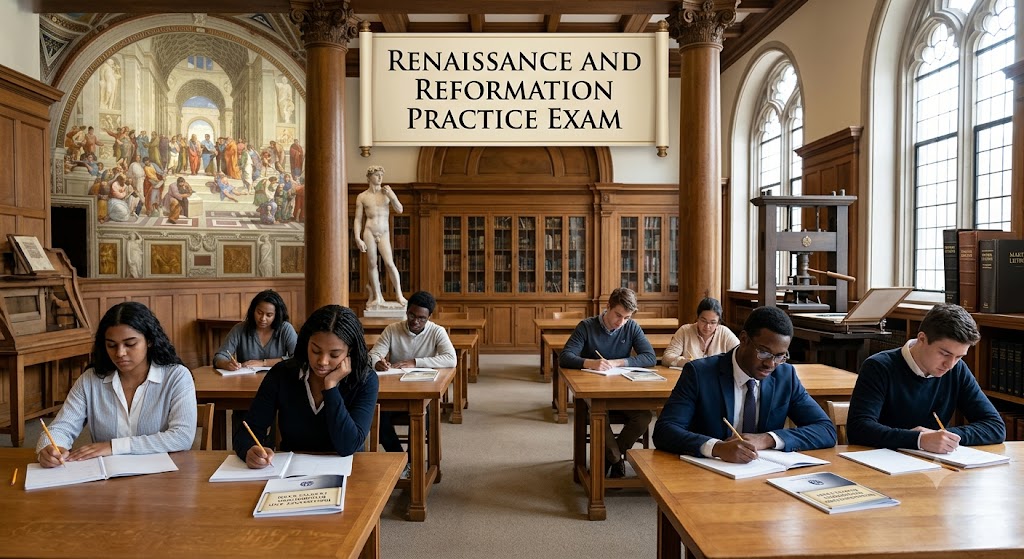
Additional Information
What the Course Entails and Exam Details
Outline the core topics, syllabus, or skills covered.
This examination draws from a broad curriculum that analyzes the cultural, social, political, and economic shifts between roughly 1450 and 1650. Mastery of this content requires a deep understanding of several core topics:
The Renaissance: The cultural and intellectual flourishing in Italy and Northern Europe, focusing on humanism, the impact of the printing press, classical revival in art (e.g., Leonardo, Michelangelo), architecture, and civic involvement.
The Protestant Reformation: The religious critique of the Catholic Church initiated by Martin Luther, John Calvin, and Huldrych Zwingli, including doctrines of salvation, the Council of Trent, the Jesuits, and the resulting wars of religion (e.g., The Thirty Years’ War).
Religious and Political Interplay: The ways in which religious reform was used by European monarchs (like Henry VIII and Elizabeth I) and German princes to consolidate national power and sovereignty.
The Commercial Revolution and Age of Exploration: The economic roots of the Renaissance, trade expansion, and the impact of New World contact on European society and culture.
Key Historical Figures and Dates: An analysis of seminal events (e.g., 1453, 1517, 1555) and major influential thinkers, rulers, and artists.
What to Expect in the Final Exam
Detail the exam format (multiple choice, practical, etc.), passing score requirements, time limits, and any specific rules.
While this practice test is a simulation, typical formal exams on the Renaissance and Reformation utilize diverse formats to test both recall and critical analysis. The final exam you are preparing for may include:
Multiple-Choice Questions: Assessing specific factual knowledge of key terms, dates, treaties, and historical figures across all covered centuries.
Short-Answer Questions (SAQs): Requiring concise, evidence-based responses to prompts about specific historical trends or concepts (e.g., comparing Northern vs. Italian humanism).
Document-Based Question (DBQ): Analyzing diverse primary and secondary sources to construct a coherent historical argument on a complex topic (e.g., the extent of change during the Counter-Reformation).
Long Essay Question (LEQ): Developing a thesis-driven essay addressing broad themes and continuity or change over an extended period (e.g., evaluating the political vs. religious motivations behind the Thirty Years' War).
Passing scores vary by institution and exam board. For example, AP Exams typically require a minimum score of 3 (on a 1-5 scale) to earn college credit, while university courses may require a passing grade based on a conventional percentage scale (e.g., 60% or higher). Exams generally range from 2 to 3 hours in length.
How to Study and Exam Centers
Provide actionable study strategies and practice methods. Explain where and how to take the exam (e.g., online portals, Pearson VUE, specific physical testing centers or authorized schools).
Effective preparation for this comprehensive test involves multi-layered strategies beyond simple rote memorization. Start by establishing a structured study plan that allocates time for:
Content Review: Revisit key texts, lecture notes, and thematic outlines. Practice using spaced repetition with digital flashcards for essential vocabulary and dates.
Primary Source Analysis: Actively read excerpts from figures like Erasmus, Machiavelli, Luther, and Loyola, analyzing their purpose, context, and point of view.
Essay Writing: Regularly practice constructing thesis statements and outlining detailed arguments for historical prompts.
Taking Full-Length Practice Exams: Utilize timed simulations, like this practice test, to build stamina and familiarize yourself with the pace of standard evaluations. Review your answers against detailed explanations to identify knowledge gaps.
Students can typically take their official final exams, which this practice test is designed for, in several ways depending on the specific program:
Authorized School Testing Centers: If you are a high school student enrolled in AP European History or a similar course, the exam is often administered directly on your school campus under standard testing conditions.
College/University Campus: Students enrolled in university courses will complete their exams during standard final assessment weeks in designated lecture halls or testing centers.
Online Portals: Many online academic courses (e.g., through platforms like Coursera, edX, or university distance learning) utilize secure online exam proctoring systems that allow you to take the exam remotely.
Job Opportunities from the Course
Create a clear list or table showing the specific job titles and career paths this certification unlocks. (I do not need tables here)
A strong command of the Renaissance and Reformation era provides a critical foundation for numerous careers in academia, culture, and communication. Expertise in analyzing complex historical change, working with primary sources, and understanding the roots of modern Western civilization opens diverse professional paths, including:
High School History Teacher (Secondary Education)
Museum Curator (Specializing in European, Art, or Medieval/Early Modern Collections)
Historical Researcher for Media and Publishing
Archivist or Rare Books Librarian
Post-Secondary History Instructor or University Professor
Preservation Specialist and Conservator
Educational Consultant and Curriculum Developer
Cultural Tour Guide and Historical Travel Planner
Writer and Biographer of Early Modern Historical Figures
Government and Policy Analyst (Utilizing Historical Contextualization)
Frequently Asked Questions
Reviews
5.0
Based on 0 reviews
Leave a Review
No reviews yet. Be the first to review!