
Registration Exam for Practical Nursing (REx-PN) Practice Test
$69.00
- Buy to unlock unlimited access to all Quiz questions.
- After purchase you can print a PDF of the whole quiz at any point. The PDF will contain the questions and the correct answers.
About this Exam
The Registration Exam for Practical Nursing (REx-PN) is the official entry-to-practice examination for aspiring Registered Practical Nurses (RPNs) in the Canadian provinces of Ontario and British Columbia. Developed in collaboration with the British Columbia College of Nurses and Midwives (BCCNM) and the College of Nurses of Ontario (CNO), this exam is specifically designed to assess whether a candidate possesses the minimal knowledge, skill, and judgment necessary to practice safely and effectively as an entry-level RPN. If you are a graduate of an approved practical nursing program and are looking to fulfill the registration requirements in either of these provinces, this is the final hurdle on your path to becoming a licensed nurse. It’s a testing experience that measures not just recall, but your ability to apply nursing knowledge in real-world, clinical scenarios, ensuring patient safety and high-quality care.
Ready to test your knowledge?
Buy Now to Access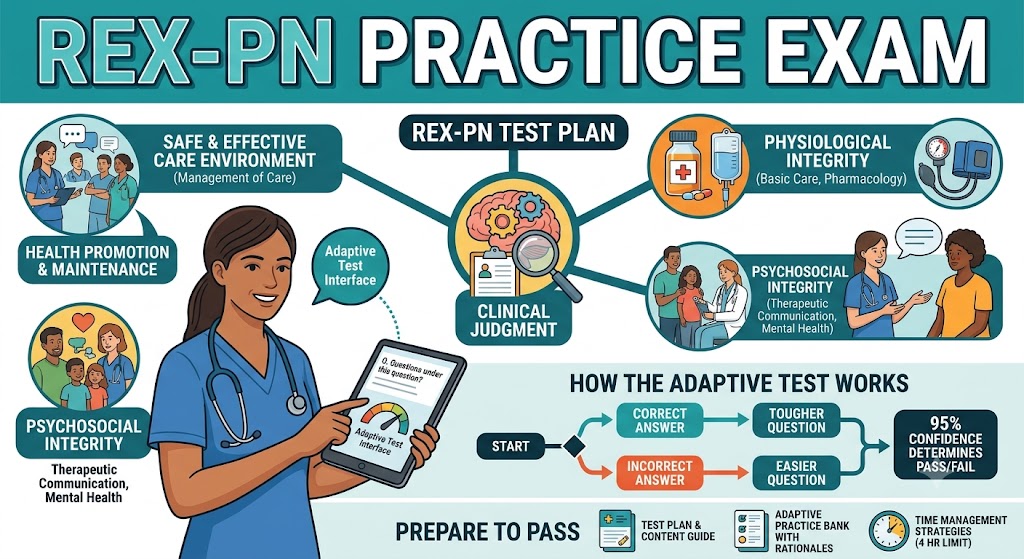
Additional Information
What the Course Entails and Exam Details
To prepare for the REx-PN, it’s critical to understand that it is a computerized adaptive test (CAT). This means the exam is personalized; the computer selects the next question based on your previous answers, aiming to pinpoint your exact ability level. The content is directly derived from the comprehensive REx-PN Test Plan, which is organized around four major 'Client Needs' categories, each integrating relevant nursing process and clinical judgment components. The four core areas are: Safe and Effective Care Environment (covering Management of Care and Safety and Infection Control), which accounts for 28-40% of the exam; Physiological Integrity (including Basic Care and Comfort, Pharmacological and Parenteral Therapies, Reduction of Risk Potential, and Physiological Adaptation), which forms 34-48% of the test; Psychosocial Integrity (8-14%); and Health Promotion and Maintenance (6-12%). The integration of clinical judgment within every question makes it essential that your preparation course or study program focuses heavily on critical thinking and decision-making skills rather than simple, rote memorization of facts.
What to Expect in the Final Exam
The REx-PN is a significant commitment. Candidates are given a maximum of four hours to complete the examination, which includes all tutorials and discretionary breaks. As it is an adaptive test, there is no fixed number of questions; however, candidates will be presented with a minimum of 90 questions and a maximum of 150 questions. The questions are primarily multiple-choice with a mix of alternate format items, such as 'Select All That Apply' (SATA) and 'Fill-in-the-Blank' calculation questions. The exam does not provide a numeric score; rather, it uses a PASS/FAIL model. The pass/fail decision is governed by three specific rules, the most common being the '95% Confidence Interval Rule,' where the exam stops when the computer is 95?rtain that your ability is either clearly above or clearly below the passing standard. The standard for passing represents the ability level required to practice safely as an entry-level nurse, and this standard is reviewed regularly to ensure it remains relevant to current practice.
How to Study and Exam Centers
Effective preparation is the key to success. Start by thoroughly downloading and reviewing the official REx-PN Test Plan provided by your regulatory body (BCCNM or CNO). Create a six-to-eight-week study plan, allocating specific time to each client need category, weighted by its percentage in the exam. Do not rely on memorization; instead, use question banks that offer high-quality, adaptive practice questions and, most importantly, detailed rationales for both correct and incorrect answers. These rationales teach you 'why' an answer is right and help you develop the critical clinical judgment required by the CAT format. Review all relevant practice documents and ethical guidelines from your college.
To take the exam, you cannot simply sign up at a school; you must go through the regulatory process. After your college determines you are eligible, you will receive an Authorization to Test (ATT) via email. This ATT will allow you to schedule your exam through Pearson Professional Assessments (Pearson VUE), the official administrator of the REx-PN. The exam is delivered at specific Pearson Professional Centres, which are highly secure, authorized physical testing sites. You can locate and select a testing center convenient for you during the online scheduling process. Be sure to book your appointment as soon as you receive your ATT, as testing slots can fill up quickly.
Job Opportunities from the Course
Successfully passing the REx-PN is the ultimate key, unlocking the license you need to work as a Registered Practical Nurse (RPN) in Ontario or British Columbia. This licensure opens a vast array of career paths and opportunities across diverse healthcare settings. Your REx-PN certification is a direct path to the following specific job titles and professional roles:
Registered Practical Nurse (RPN) in acute care hospitals (e.g., Medical-Surgical, Emergency, Pediatrics, Maternity).
RPN in long-term care homes and assisted living facilities.
Community Health Nurse / Home Care RPN.
Clinic Nurse in family practice, specialized medicine, or outpatient clinics.
RPN in mental health and addiction centers.
Palliative Care Nurse / Hospice RPN.
Rehabilitation Nurse.
Occupational Health Nurse in industrial settings.
Public Health Nurse.
Nursing Case Manager within community agencies.
Frequently Asked Questions
Reviews
5.0
Based on 0 reviews
Leave a Review
No reviews yet. Be the first to review!