
Registered Sleep Technologist Practice Exam
$69.00
- Buy to unlock unlimited access to all Quiz questions.
- After purchase you can print a PDF of the whole quiz at any point. The PDF will contain the questions and the correct answers.
About this Exam
The Registered Sleep Technologist (RST) certification, awarded by the American Board of Sleep Medicine (ABSM), is a prestigious credential for healthcare professionals specializing in sleep disorders.
Sleep technologists play a vital role in diagnosing and treating conditions like sleep apnea, insomnia, and narcolepsy by performing and analyzing polysomnographic studies.
This certification validates a technologist's advanced knowledge, clinical skills, and dedication to the field of sleep medicine.
The RST Practice Exam is an essential tool for candidates aiming to achieve this significant professional milestone.
Ready to test your knowledge?
Buy Now to Access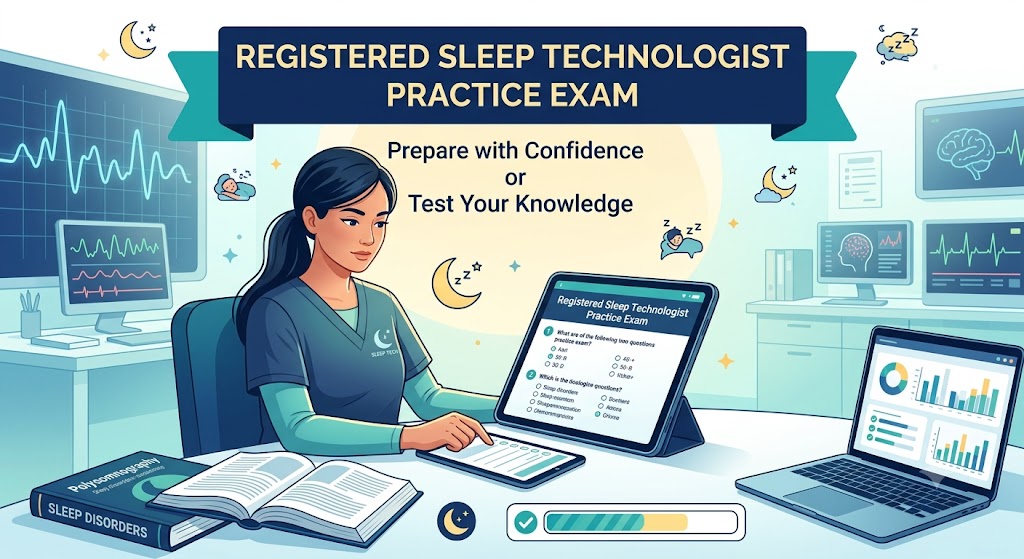
Additional Information
What the Course Entails and Exam Details
Preparing for the Registered Sleep Technologist Exam involves mastering a wide range of topics related to sleep medicine technology.
The core domains covered include the principles of sleep, patient assessment, and the setup and operation of sophisticated monitoring equipment.
Technologists must demonstrate proficiency in performing sleep studies (polysomnograms), recognizing various sleep stages, and scoring respiratory events, leg movements, and other physiological signals accurately.
Understanding therapeutic interventions, such as Continuous Positive Airway Pressure (CPAP) and Bilevel Positive Airway Pressure (BPAP) titration, is also fundamental.
Additionally, the exam addresses essential areas like patient safety, ethical practices, quality control, and data documentation within a sleep clinic or laboratory setting.
What to Expect in the Final Exam
The official Registered Sleep Technologist certification exam is a rigorous computerized test.
Candidates can expect to answer numerous multiple-choice questions covering all the core domains of sleep medicine technology mentioned above.
The total exam time is typically several hours, requiring sustained focus and critical thinking.
The questions assess not only theoretical knowledge but also the application of practical skills in clinical scenarios.
While the specific number of questions and time limit may slightly differ depending on the current iteration, candidates should be prepared for a comprehensive evaluation.
The scoring is performance-based, and a set standard must be achieved to pass and earn the prestigious RST designation.
How to Study and Exam Centers
Successfully preparing for the RST exam demands a strategic approach combining study and practical application.
Start by thoroughly reviewing the official ABSM content outline to understand the specific knowledge areas required.
Utilize recognized sleep medicine textbooks, guidelines from professional organizations (like the American Academy of Sleep Medicine), and online learning modules.
Taking Registered Sleep Technologist practice exams is critical for identifying strengths and weaknesses in your knowledge base and getting familiar with the question format and time constraints.
Discussing complex cases with peers and mentors can also provide valuable insights.
The Registered Sleep Technologist exam is administered by authorized testing centers, often through partners like Pearson VUE.
Upon completing all registration requirements, candidates can typically schedule their testing date and location directly through the testing agency's online portal, selecting a convenient time and nearby facility.
Job Opportunities from the Course
Earning the Registered Sleep Technologist credential opens doors to advanced roles and enhanced career stability in the growing field of sleep medicine.
Here are some of the job opportunities and career paths available:
Registered Sleep Technologist (RST): Working in hospitals, dedicated sleep labs, or clinical settings, performing and analyzing comprehensive sleep studies.
Lead Sleep Technologist / Senior Technologist: Supervising junior staff, coordinating daily operations, and ensuring quality assurance.
Sleep Center Coordinator or Manager: Overseeing the entire operation of a sleep facility, including budgeting, scheduling, and regulatory compliance.
Clinical Sleep Educator: Providing patient education about sleep disorders, CPAP compliance, and healthy sleep hygiene.
Sleep Medicine Research Assistant: Contributing to studies investigating sleep patterns, treatments, and associated health outcomes.
Durable Medical Equipment (DME) Specialist: Helping patients select and set up respiratory equipment, including CPAP and BPAP machines.
Traveling Sleep Technologist: Working short-term contracts in various locations, offering opportunities to explore different clinical settings.
Frequently Asked Questions
Reviews
5.0
Based on 0 reviews
Leave a Review
No reviews yet. Be the first to review!