
Registered Sanitarian Practice Test
$69.00
- Buy to unlock unlimited access to all Quiz questions.
- After purchase you can print a PDF of the whole quiz at any point. The PDF will contain the questions and the correct answers.
About this Exam
The Registered Sanitarian (RS) credential, often interchangeable with Environmental Health Specialist (REHS), is a cornerstone certification for professionals dedicated to protecting public health by managing the environmental factors that impact human well-being.
This certification is designed for individuals working in or aspiring to careers in environmental health, food safety, water quality, waste management, institutional sanitation, and vector control.
A Registered Sanitarian is a trained professional who investigates, assesses, and controls environmental hazards. They enforce health and safety regulations, educate the public, and implement programs to prevent disease and injury. The exam validates the comprehensive knowledge and critical skills required to perform these vital functions effectively.
Ready to test your knowledge?
Buy Now to Access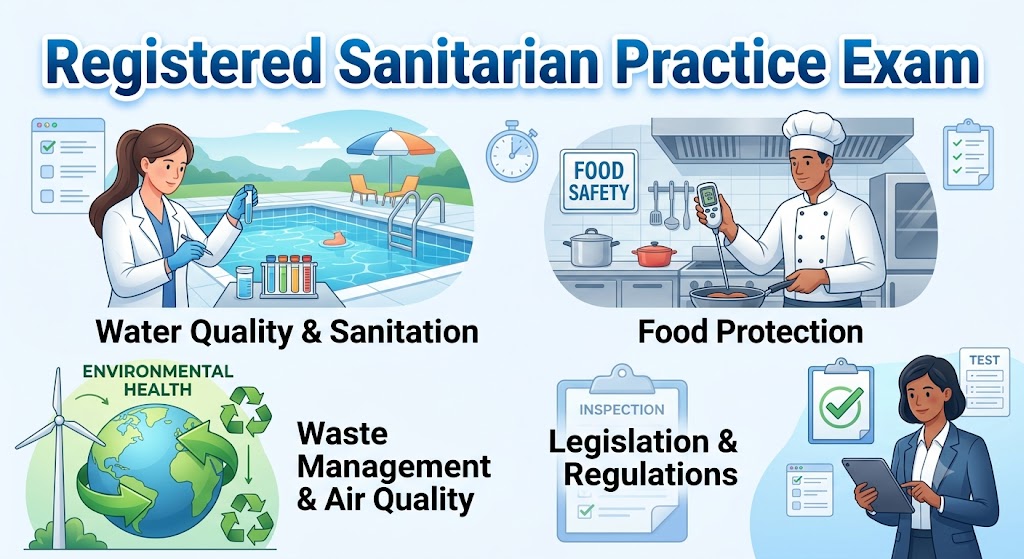
Additional Information
What the Course Entails and Exam Details
Preparing for the Registered Sanitarian exam requires a deep understanding of several core environmental health disciplines. A comprehensive practice course and study plan will cover these essential topics, which directly align with the major domains of the final examination.
The primary subjects you must master include:
Food Protection: This is often the largest section. It covers microbiology, foodborne illnesses, HACCP principles, facility plan review, food service sanitation regulations, and inspection techniques.
Water Quality: This includes both potable water (drinking water treatment, distribution, sampling) and recreational water (swimming pools, spas, monitoring).
Liquid and Solid Waste Management: You will study wastewater treatment systems (both on-site sewage and municipal), hazardous waste handling, landfill operations, and recycling programs.
Vector and Pest Control: Understanding the biology and control methods for insects and rodents that transmit diseases is crucial.
Air Quality and Noise Control: This covers indoor and outdoor air pollution sources, monitoring, health effects, and abatement strategies.
Housing and Institutional Sanitation: Focuses on health standards in dwellings, schools, hospitals, correctional facilities, and daycare centers.
Hazardous Materials and Emergency Response: Protocols for identifying, handling, and responding to spills and environmental disasters.
Statutes and Regulations: Familiarity with the relevant laws, codes, and legal procedures governing environmental health practice.
While a "course" usually refers to your structured study program or the knowledge base derived from an accredited Environmental Health degree, the exam details themselves are critical for your preparation.
What to Expect in the Final Exam
The final Registered Sanitarian exam is a rigorous assessment, typically administered through a state-specific licensing board or a national organization like the National Environmental Health Association (NEHA). The core structure is as follows:
Exam Format: The test is almost exclusively comprised of multiple-choice questions. These questions are designed not just to test recall but to assess your ability to apply environmental health principles to real-world scenarios.
Number of Questions: The length can vary significantly depending on the jurisdiction. National exams (NEHA REHS/RS) often contain around 225-250 questions, while state-specific exams may range from 100 to 200 questions.
Time Limit: You will be given a generous, but strict, time limit, typically between 3 to 5 hours. Effective time management is key.
Passing Score: The score required to pass is set by the state board or testing agency. A scaled score of 70% or 75% is a common benchmark, though the raw number of correct answers needed can change with different test versions.
Rules: The exam is proctored, closed-book, and strict ID verification is mandatory. Authorized calculators may or may not be permitted.
How to Study and Exam Centers
Preparation is the single most important factor in your success. Follow these actionable strategies to optimize your study time:
Utilize Official Study Guides: Begin with the content outlines and study guides provided by your state licensing board or the National Environmental Health Association (NEHA). These are your primary blueprints.
Focus on Reference Materials: Don't just rely on summaries. Consult key original sources such as the FDA Food Code, EPA regulations on water and waste, and recognized textbooks on environmental engineering and public health.
Take Multiple Practice Tests: Using a [Registered Sanitarian Practice Test] is crucial. It familiarizes you with the question style, difficulty level, and helps identify your weak areas. Take these tests under timed conditions to simulate the actual exam.
Create Flashcards: Memorize definitions, temperature requirements, chemical standards, and regulatory citations.
Join a Study Group: Collaborative learning with peers allows you to discuss complex scenarios and teach concepts to others, which reinforces your own knowledge.
Exam Centers and Registration
The process for taking the exam varies by state. In many cases, you must first apply and receive approval from your state’s health department or environmental health licensing board before you can schedule the test.
Once approved, you will typically take the computer-based exam at an authorized testing center. Common center networks include:
Pearson VUE
Prometric
NEHA-authorized testing locations (often including state-run facilities or universities)
You will need to use their online portals to find the nearest testing location and select an appointment time. Be prepared to schedule well in advance, especially during peak seasons.
Job Opportunities from the Course
Obtaining your Registered Sanitarian credential opens the door to diverse and impactful careers in both the public and private sectors. This certification demonstrates to employers that you possess the verified knowledge and skills to manage environmental risks.
A clear list of job titles and career paths available with this certification includes:
Environmental Health Specialist (REHS): This is the most common title, working for county, city, or state health departments.
Food Safety Inspector / Food Sanitarian: Specializing in inspecting restaurants, production facilities, and retail food stores.
Public Health Inspector / Health Inspector: A generalist role encompassing many environmental health disciplines.
Consumer Safety Officer: Working with federal agencies like the FDA, focused on food or product safety.
Industrial Hygienist: Evaluating and controlling environmental factors in the workplace.
Quality Control/Quality Assurance Manager: Ensuring compliance and safety standards in food manufacturing and private industry.
Water Quality Specialist: Working for water utilities or environmental agencies to ensure safe drinking and recreational water.
Waste Management/Solid Waste Inspector: Regulating the disposal and handling of municipal and hazardous waste.
Institutional Sanitarian: Managing environmental health programs in hospitals, universities, correctional facilities, or school systems.
Vector Control Specialist: Designing and implementing programs to control disease-carrying pests.
Environmental Health and Safety (EHS) Manager: A corporate role managing an organization’s environmental and occupational health compliance.
Frequently Asked Questions
Reviews
5.0
Based on 0 reviews
Leave a Review
No reviews yet. Be the first to review!