
Registered Nurse Certified in Neonatal Intensive Care Unit (RNC-NICU) Practice Test
$69.00
- Buy to unlock unlimited access to all Quiz questions.
- After purchase you can print a PDF of the whole quiz at any point. The PDF will contain the questions and the correct answers.
About this Exam
The Registered Nurse Certified in Neonatal Intensive Care Unit (RNC-NICU) designation is a prestigious, competency-based certification offered by the National Certification Corporation (NCC). It is designed specifically for licensed registered nurses in the United States and Canada who have demonstrated advanced knowledge and expertise in the specialized care of critically ill neonates. This certification is a mark of professional distinction, indicating that a nurse has met rigorous practice and knowledge standards. It is tailored for RNs who have accumulated significant experience in the unique, high-acuity environment of the NICU, empowering them to provide the highest level of evidence-based care to their tiny, vulnerable patients.
Ready to test your knowledge?
Buy Now to Access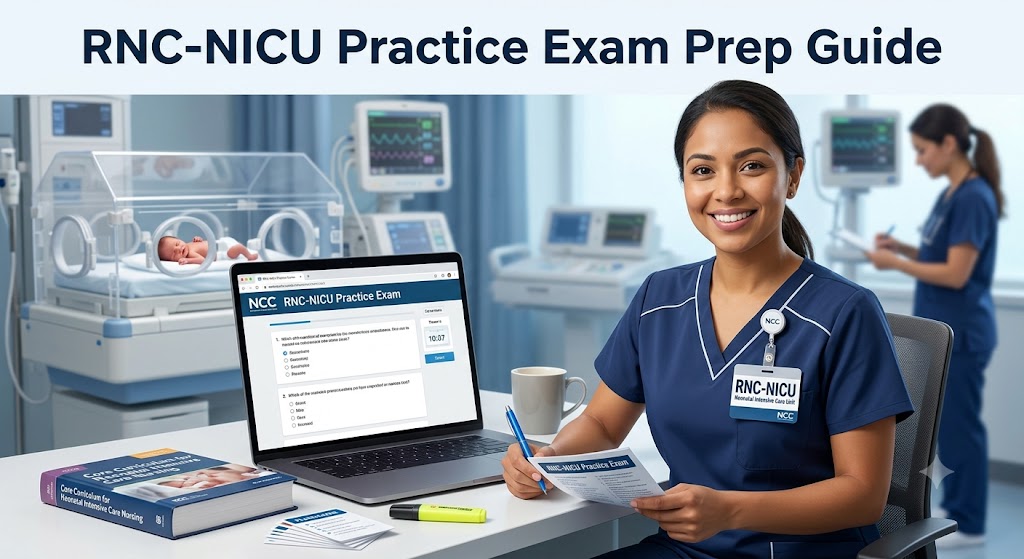
Additional Information
What the Course Entails and Exam Details
To be eligible for the RNC-NICU exam, candidates must hold a current, unencumbered RN license in the U.S. or Canada and possess a minimum of 24 months of specialty experience (at least 2000 hours) in neonatal intensive care nursing. The certification exam is comprehensive, testing the application of knowledge across several key domains. The core content areas covered include:
General Assessment and Management: Maternal risk factors, physical assessment, gestational age assessment, and thermoregulation.
Physiology and Pathophysiology: Detailed understanding of the cardiac, respiratory, gastrointestinal, renal, and neurological systems in neonates.
Pharmacology: Principles of neonatal drug administration, dosage calculations, and common medications used in the NICU.
Professional Issues: Ethical considerations, legal aspects, family-centered care, and collaborative practice.
What to Expect in the Final Exam
The RNC-NICU exam is a rigorous, computer-based assessment. You should expect the following details:
Format: The exam consists of 175 multiple-choice questions. It is important to note that only 150 of these questions are scored; the remaining 25 are unscored pretest items used for gathering statistical data on new questions.
Time Limit: Candidates are given a maximum of three hours to complete the examination.
Passing Score: The passing score is not a fixed percentage. It is determined by a criterion-referenced method, ensuring that all candidates who meet the passing standard receive the certification. However, for preparation purposes, candidates are generally encouraged to aim for a practice score of at least 70% to feel confident. The NCC reports that approximately 65% of the scored questions must be answered correctly to pass.
Rules: Standard testing protocols apply, including prohibition of reference materials and electronic devices.
How to Study and Exam Centers
Preparation for the RNC-NICU exam requires a combination of self-directed study and clinical experience. Effective strategies include:
Official Candidate Guide: Your first step should be downloading the most current "Candidate Guide" from the NCC website, which provides the detailed content outline and sample questions.
Practice Tests: Utilizing robust RNC-NICU practice exams is essential. These exams help you familiarize yourself with the question style, manage your time, and identify knowledge gaps.
Review Books: Dedicated certification review guides and textbooks, like the "Core Curriculum for Neonatal Intensive Care Nursing," are foundational resources.
Clinical Experience: Never underestimate the value of your bedside experience. Reflect on complex patient scenarios you have managed.
Regarding registration and exam centers, candidates must apply online through the NCC website. Once approved, you will receive an eligibility letter. The exam can be taken year-round at authorized professional testing centers managed by NCC’s testing partner, PSI (often found at locations like Pearson VUE or H&R Block centers). Additionally, NCC offers Live Remote Proctoring (LRP), allowing eligible candidates to take the exam from the comfort of their home or office while being securely monitored online.
Job Opportunities from the Course
Earning the RNC-NICU certification demonstrates to employers and peers your dedication to neonatal nursing excellence. While it is not a degree program, this credential unlocks advanced roles and significant career growth. Job opportunities and paths include:
Certified Neonatal Intensive Care Nurse (RNC-NICU)
Neonatal Transport Nurse
NICU Nurse Educator
NICU Clinical Nurse Specialist (CNS) — Requires advanced degree
Neonatal Nurse Practitioner (NNP) — Requires graduate-level education
NICU Assistant Manager or Nurse Manager
NICU Research Nurse
Frequently Asked Questions
Reviews
5.0
Based on 0 reviews
Leave a Review
No reviews yet. Be the first to review!