
Registered Health Information Administrator (RHIA) Domain 2 Practice Test
$69.00
- Buy to unlock unlimited access to all Quiz questions.
- After purchase you can print a PDF of the whole quiz at any point. The PDF will contain the questions and the correct answers.
About this Exam
The Registered Health Information Administrator (RHIA®) credential, administered by the American Health Information Management Association (AHIMA), is a mark of excellence for professionals dedicated to managing patient health information, medical records, and the technology that supports them. RHIAs bridge the gap between clinical care, administration, and legal/ethical compliance, ensuring data accuracy, security, and accessibility. This level of certification is designed for individuals who have completed a CAHIIM-accredited baccalaureate-level (or higher) Health Information Management (HIM) program, preparing them for leadership roles within the dynamic healthcare landscape. Earning your RHIA demonstrates a comprehensive mastery of medical, administrative, ethical, and legal requirements.
Ready to test your knowledge?
Buy Now to Access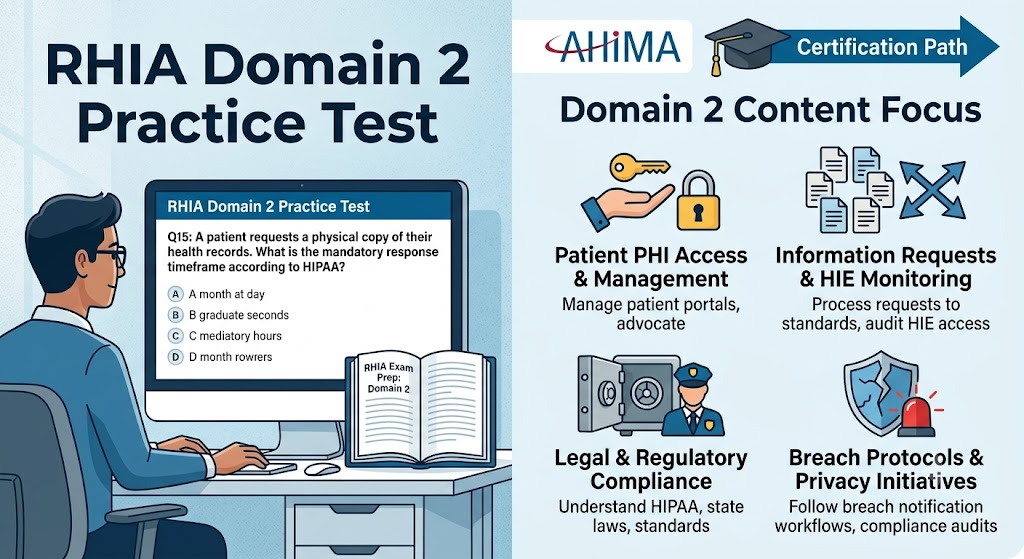
Additional Information
What the Course Entails and Exam Details
This practice test is specifically tailored to mirror the content and complexity of Domain 2 of the full RHIA certification exam. Domain 2: Compliance with Access, Use, and Disclosure of Protected Health Information (PHI), represents a significant portion of the final exam. Mastering this domain is crucial for ensuring that a healthcare organization operates ethically and legally.
The core syllabus and skills you must demonstrate in Domain 2 include, but are not limited to:
Managing patient access to their own health information, including proper use of patient portals.
Advocating for patients and families in navigating the process of obtaining health records.
Processing internal and external health information requests in strict accordance with federal (e.g., HIPAA) and state legal and regulatory standards.
Monitoring access to PHI within the organization and through complex external health information exchanges (HIEs).
Developing, implementing, and reviewing health information request workflows to guarantee compliance.
Understanding and executing proper breach of information protocols.
Ensuring ongoing compliance with various privacy and security initiatives.
What to Expect in the Final Exam
While this tool is a dedicated practice for Domain 2, it is essential to understand the final exam's format. The full RHIA exam is a comprehensive assessment covering five unique domains. It consists of 150 multiple-choice questions that must be completed within a time limit of 3.5 hours.
Approximately 15% to 18% of these questions will be specifically from Domain 2 content. Of the total 150 questions, 20 are "pretest" questions that are unscored but used for statistical validation. Candidates will receive a scaled score ranging from 100 to 400. To successfully earn your RHIA credential, you must achieve a final passing scaled score of at least 300. The final exam is a high-stakes, timed, proctored environment with no scheduled breaks.
How to Study and Exam Centers
Effective preparation is the key to success. For Domain 2, focus your studies on a deep understanding of HIPAA Privacy and Security Rules, legal definitions of PHI, state-specific disclosure laws, and institutional policy creation.
Actionable study strategies include:
Using this and other Domain-specific practice tests to identify knowledge gaps.
Reviewing official AHIMA study guides and recommended textbooks.
Creating a structured study schedule that allocates ample time to each exam domain, especially weaker areas.
Practicing under realistic, timed conditions to improve your pacing.
Analyzing both correct and incorrect answers to understand the underlying rationale.
The final, official RHIA certification exam is administered through standard testing center portals, most notably Pearson VUE. You must first apply to AHIMA, submit your academic transcripts, and receive your Authorization to Test (ATT) before you can schedule your exam appointment. Appointments can be made at authorized physical testing centers or, in some cases, via online proctored methods.
Job Opportunities from the Course
Earning your RHIA certification unlocks diverse and rewarding career paths within health information management, data governance, and leadership. Your specialized knowledge, particularly in areas like compliance (Domain 2), makes you a highly valued asset across many types of healthcare settings, from hospitals to insurance companies.
The certification unlocks specific job titles such as:
Health Information Manager
Director of Health Information Management
HIM Compliance Officer
Clinical Documentation Integrity (CDI) Specialist
Inpatient and Outpatient Facility Coder / Senior Coder
Data Analyst / Data Quality Manager
Revenue Cycle Manager
Healthcare Privacy Officer / Information Governance Manager
Trauma Registrar / Specialty Registrar
EHR System Administrator / Project Manager
HIM Educator or Trainer
UM Outpatient Coding Education Analyst
Frequently Asked Questions
Reviews
5.0
Based on 0 reviews
Leave a Review
No reviews yet. Be the first to review!