
Registered Electroencephalographic Technologist (R. EEG T.) Practice Exam
$69.00
- Buy to unlock unlimited access to all Quiz questions.
- After purchase you can print a PDF of the whole quiz at any point. The PDF will contain the questions and the correct answers.
About this Exam
Earning your Registered Electroencephalographic Technologist credential is a major milestone in the neurodiagnostic field.
This prestigious certification is designed for allied health professionals who specialize in monitoring and recording brain activity.
It validates your expertise in performing high-quality EEG tests, ensuring you are fully equipped to assist physicians in diagnosing neurological conditions like epilepsy.
Whether you are a recent neurodiagnostic program graduate or an experienced technician looking to advance your career, preparing with a reliable practice exam is your best path to success.
Ready to test your knowledge?
Buy Now to Access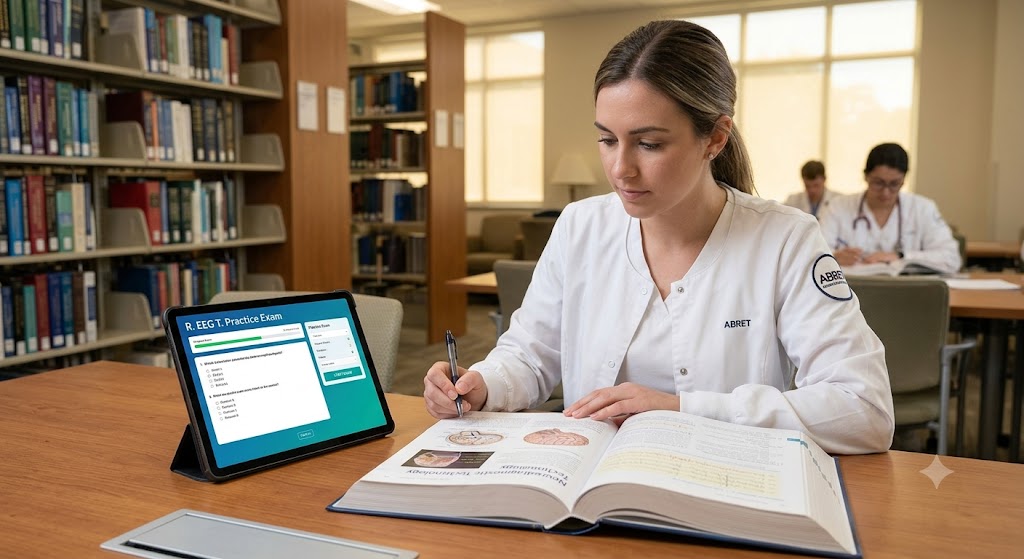
Additional Information
What the Course Entails and Exam Details
The curriculum and preparation for the R. EEG T. credential demand a deep understanding of multiple complex scientific disciplines.
Candidates must master neuroanatomy and neurophysiology, focusing heavily on the central and peripheral nervous systems.
You will also dive deep into electronics and instrumentation, learning exactly how EEG machines amplify, filter, and record brain waves.
The syllabus heavily emphasizes patient care, thorough history taking, and strict infection control, ensuring patient safety during every test.
Furthermore, the core skills covered include precise electrode placement using the International 10-20 System, pattern recognition, artifact troubleshooting, and identifying abnormal waveforms related to various neurological diseases.
What to Expect in the Final Exam
The official ABRET board exam is known for being rigorous and comprehensive, designed to test both your theoretical knowledge and practical decision-making abilities.
It typically consists of 200 multiple-choice questions, which include both scored items and a small number of unscored pre-test questions used for future evaluations.
Candidates are given a maximum time limit of four hours to carefully read and complete the examination.
Questions often present realistic clinical scenarios, requiring you to interpret technical data, identify electrical artifacts, and choose the correct troubleshooting methods on the spot.
The passing score is determined by a scaled scoring system established by the credentialing board, meaning you must demonstrate a high level of consistent proficiency across all tested domains to earn your registry.
How to Study and Exam Centers
A strategic and disciplined approach to studying is absolutely crucial for passing this challenging board examination on your first attempt.
Begin by taking a comprehensive practice exam to establish a baseline and identify your weak areas, particularly in complex technical topics like electronics or pharmacology.
Utilize flashcards for memorizing the International 10-20 System measurements and thoroughly review the clinical guidelines published by ASET and ACNS.
Form study groups or find an experienced mentor in your current neurodiagnostic lab who can help you break down difficult technical concepts and clinical correlations.
When you are fully prepared and ready to test, the examination is administered exclusively through Pearson VUE testing centers.
You can schedule your test at a physical Pearson VUE location near you, which provides a secure, quiet, and highly monitored computer-based testing environment conducive to optimal performance.
Job Opportunities from the Course
Achieving your R. EEG T. certification instantly opens the door to numerous high-demand, financially rewarding career paths in the healthcare sector.
Registered EEG Technologist: You will work directly with patients in hospitals, private clinics, or neurology offices to perform routine, sleep-deprived, and prolonged brain wave studies.
Neurodiagnostic Technologist: This broader clinical role involves utilizing various modalities to monitor central and peripheral nervous system functions for diagnosing complex disorders.
Epilepsy Monitoring Unit (EMU) Technologist: In this highly specialized role, you will continuously monitor patients over several days to capture, record, and analyze crucial seizure activity.
Lead EEG Technologist: With accumulated clinical experience and this official credential, you can step into supervisory roles, managing lab daily operations and training junior neurodiagnostic staff.
Intraoperative Neuromonitoring (IONM) Trainee: Having your foundational EEG registry is recognized as a fantastic stepping stone if you wish to transition into monitoring patients' nervous systems in real-time during complex surgeries.
Frequently Asked Questions
Reviews
5.0
Based on 0 reviews
Leave a Review
No reviews yet. Be the first to review!