
Regional Assessment and Selection Program (RASP) 2 Board Practice Test
$69.00
- Buy to unlock unlimited access to all Quiz questions.
- After purchase you can print a PDF of the whole quiz at any point. The PDF will contain the questions and the correct answers.
About this Exam
The Regional Assessment and Selection Program 2 (RASP 2) is the dedicated selection course for senior leaders within the U.S. Army’s elite 75th Ranger Regiment. Unlike RASP 1, which selects and trains junior enlisted soldiers, RASP 2 is tailored for senior Non-Commissioned Officers (SGT-E6 through MSG-E8), Warrant Officers, and Commissioned Officers (up to Captain). It is a demanding 21-day program focused on validating existing skills, physical stamina, and, most critically, the leadership potential and mental fortitude required to command in a high-tempo, special operations environment. The culmination of this course is a comprehensive "board" interview, where candidates are evaluated by the Regiment’s top leadership. This practice exam is designed to prepare candidates for the specific, high-stakes nature of that final assessment.
Ready to test your knowledge?
Buy Now to Access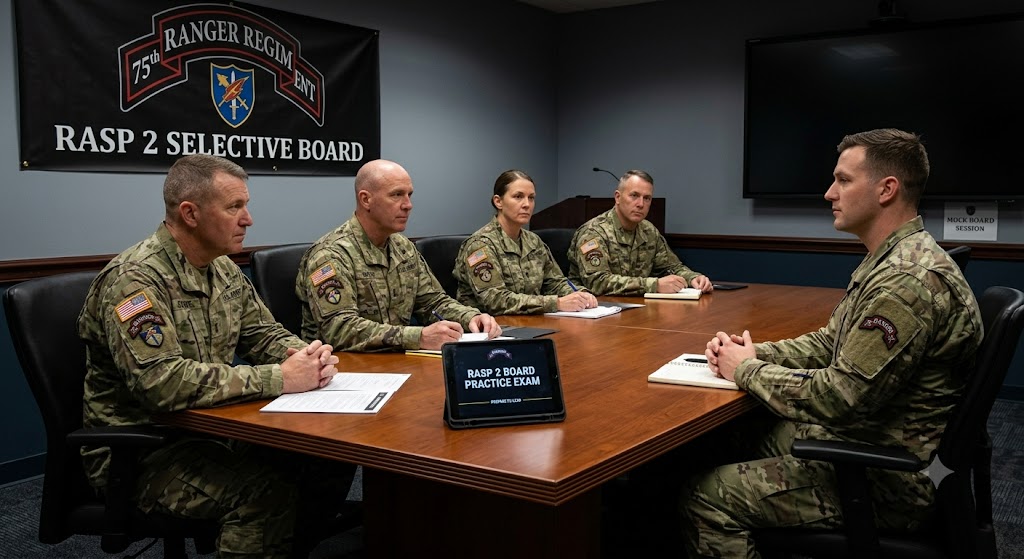
Additional Information
What the Course Entails and Exam Details
The three-week RASP 2 course is a series of escalating challenges. The initial phase includes critical event testing such as a physical fitness assessment, a 12-mile ruck march, and an assessment of foundational military knowledge. The subsequent phase involves a field training exercise (FTX) designed to test leadership under stress, advanced marksmanship, airborne operations, and validation in special tactics, techniques, and procedures (TTPs) unique to the 75th Ranger Regiment.
The final, and most decisive, 'exam' detail is the formal Board. Candidates who successfully navigate the physical and tactical evaluations face a panel of senior Regimental leadership. The RASP 2 Board isn't a traditional multiple-choice test; it's a rigorous, face-to-face interview. While it will touch on military knowledge (such as Ranger history, unit heritage, and Army regulations), it primarily assesses decision-making under pressure, commitment to the Ranger Creed, emotional intelligence, and leadership philosophy.
What to Expect in the Final Exam
The RASP 2 Final Exam is a high-pressure, formal board interview. You should expect an environment designed to be intimidating. The panel, composed of the Regimental Commander, Command Sergeant Major, and other select leaders, will grill you on a range of topics. Do not expect simple recall questions.
You must demonstrate:
A profound, personalized understanding of the Ranger Creed.
The ability to articulate ethical, decisive, and sound leadership decisions in complex scenarios.
An intimate knowledge of the 75th Ranger Regiment’s history, heritage, and unique organizational culture.
Professionalism, mental agility, and the ability to accept constructive (and often direct) feedback.
There is no "passing score" in the conventional sense. The Board will make a binary "select" or "non-select" recommendation to the Regimental Commander, who makes the final decision. Your performance throughout the 21 days is considered alongside your appearance before the board. You have only one chance to make this presentation; failure to impress will result in non-selection.
How to Study and Exam Centers
Studying for the RASP 2 board requires a unique approach. While physical preparation is continuous, mental preparation should focus on these key areas:
Regimental Immersion: Master the Ranger Creed. Understand the significance of the "Tan Beret" and the "Scroll." Study the lineage and history of the 75th Ranger Regiment, focusing on key operations and heroes.
Leadership Doctrine: Move beyond basic Army leadership regulations. Read from the perspective of a leader who must make rapid, consequential decisions. Review case studies of special operations leadership.
Mock Boards: This is critical. Have experienced leaders or peers conduct simulated boards. Practice answering open-ended, scenario-based questions with composure and clarity. The RASP 2 Board is about presence and poise.
The final RASP 2 assessment and selection board does not take place at standard exam centers like Pearson VUE. It is conducted exclusively at the 75th Ranger Regiment headquarters, located at Fort Moore (formerly Fort Benning), Georgia, as the final phase of the official RASP 2 selection course.
Job Opportunities from the Course
Successful completion of RASP 2 and selection by the board unlocks premier leadership opportunities within the 75th Ranger Regiment. This course is the gateway to some of the most challenging and impactful leadership roles in the U.S. military.
Career paths unlocked by this certification include, but are not limited to:
Platoon Sergeant
First Sergeant
Operations Sergeant Major
Platoon Leader (as an Officer)
Company Commander (as an Officer)
Regimental or Battalion Staff Officer (e.g., S3, S2)
Warrant Officer (Specialized technical and tactical roles)
Frequently Asked Questions
Reviews
5.0
Based on 0 reviews
Leave a Review
No reviews yet. Be the first to review!