
Regents Living Environment Practice Test 2024 Review with Answer Keys
$69.00
- Buy to unlock unlimited access to all Quiz questions.
- After purchase you can print a PDF of the whole quiz at any point. The PDF will contain the questions and the correct answers.
About this Exam
The Regents Living Environment examination is a crucial milestone for New York State high school students, testing their understanding of key biology concepts required for a Regents Diploma.
This standardized test is designed for high school biology students who have completed the Living Environment course, assessing their proficiency in biological science before they graduate.
Successfully passing this exam demonstrates a foundational knowledge of life sciences and is a key step toward pursuing further education and careers in science, healthcare, and technology.
Ready to test your knowledge?
Buy Now to Access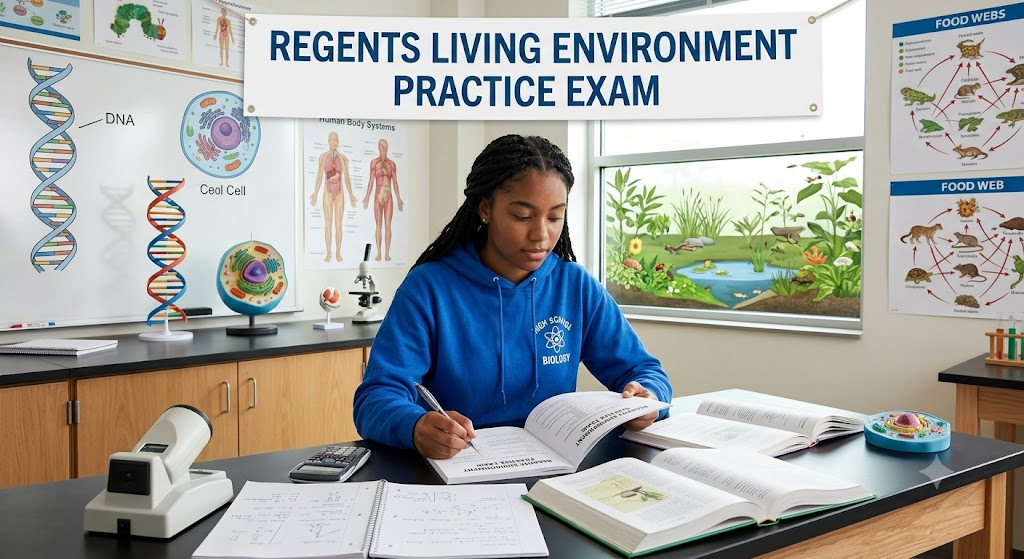
Additional Information
What the Course Entails and Exam Details
The Living Environment course curriculum covers fundamental biological principles and requires students to engage in laboratory exploration.
The core topics assessed include:
Cells and Cell Processes: Structure and function of cell organelles, transport mechanisms (active and passive), cellular respiration, and photosynthesis.
Genetics and Heredity: DNA structure and replication, protein synthesis, gene expression, inheritance patterns (Mendelian and modern), biotechnology, and modern genetic engineering concepts.
Evolution: Evidence for evolution, the mechanisms of natural selection, speciation, and the history of life on Earth.
Ecology and Ecosystems: The flow of energy through biomes (food chains and webs), nutrient cycling, ecological succession, and complex interactions between organisms and their environment.
Human Physiology and Homeostasis: In-depth study of human body systems (circulatory, respiratory, digestive, nervous, endocrine, etc.) and how they work together to maintain a stable internal environment.
Scientific Inquiry and Laboratory Skills: Applying scientific methods, analyzing data, and interpreting laboratory procedures based on required state labs.
The examination details typically include multiple sections that combine theoretical knowledge with practical skills learned throughout the course.
What to Expect in the Final Exam
The Regents Living Environment examination is usually divided into multiple parts, each focusing on different question types and cognitive levels.
Exam Format Breakdown:
Part A: Multiple-Choice Questions: This section tests broad knowledge and understanding of fundamental biology concepts from across the entire curriculum.
Part B: Multiple-Choice and Short-Answer Questions: This part assesses your ability to apply knowledge to real-world scenarios and often requires interpretation of data, diagrams, and graphs.
Part C: Constructed-Response Questions: These open-ended questions demand more extensive explanations, analyses, and applications of biological concepts, requiring students to demonstrate depth of understanding.
Part D: Multiple-Choice and Short-Answer Lab Questions: This section is dedicated explicitly to assessment of scientific inquiry skills and the procedures related to the required NYS Living Environment labs.
Exam Mechanics:
Passing Score: Students typically need to achieve a scaled score of 65 or higher to pass the Regents Living Environment exam.
Time Limit: The examination is usually a three-hour test administered in authorized New York State high schools.
Rules: Standard Regents exam procedures apply, including specific requirements for calculators and materials provided for the test.
How to Study and Exam Centers
Effective preparation for the Regents Living Environment exam involves a blend of content review and practical skill reinforcement.
How to Study and Practice Methods:
Take Practice Exams: Dedicate time to completing past Regents Living Environment exams and carefully reviewing the corresponding answer keys.
Analyze Answer Keys: Do not just check right or wrong; understand why the correct answer is right and why the distractors are wrong in practice questions.
Focus on Key Diagrams: Review essential biological diagrams such as the structure of DNA, cell organelles, food webs, and the human digestive and circulatory systems.
Review Laboratory Requirements: Ensure you are familiar with the required state labs (like the diffusion across a membrane and relationships and biodiversity labs) and can explain their procedures and conclusions.
Form Study Groups: Collaborating with classmates to quiz each other and discuss complex topics can reinforce understanding and recall.
Use Review Books: Utilize comprehensive review guides that are aligned with the NYS standards and provide targeted practice.
Exam Centers and Testing Locations:
Regents exams are administered exclusively within authorized New York State public, private, and charter high schools. They are not taken at independent testing centers like Pearson VUE or online portals.
Students must register for and take the exam at their designated high school.
If you are a non-traditional student, you should contact the specific New York school where you intend to take the exam for registration information.
Job Opportunities from the Course
While the Regents Living Environment exam is not a direct vocational certification that unlocks specific job titles on its own, passing it is an essential academic requirement for obtaining a New York State Regents Diploma.
This diploma is a crucial prerequisite for enrolling in higher education institutions and pursuing a wide range of career paths within the life sciences and healthcare sectors.
Here is a clear list of career paths and job opportunities that are unlocked via the college pathways that require this foundational knowledge:
Healthcare Professional: This pathway includes doctors, registered nurses (RNs), dentists, pharmacists, physical therapists, and physician assistants.
Medical Laboratory Technologist: Professionals who perform sophisticated chemical, biological, hematological, immunologic, microscopic, and bacteriological tests.
Veterinarian or Veterinary Technician: These careers involve diagnosing, treating, and managing medical conditions in animals.
Biotechnologist: Working in research and development to utilize biological processes for various industries, including medicine, agriculture, and manufacturing.
Conservationist or Wildlife Biologist: Specializing in managing and preserving ecosystems, protecting endangered species, and studying animal populations.
Ecology and Environmental Scientist: Researching how organisms interact with their environment and working on solutions for ecological challenges.
Biology Teacher: Educating students at the middle school, high school, or college level in biology concepts.
Research Scientist: Conducting fundamental research in diverse biological fields, contributing to scientific knowledge and innovation.
Genetic Counselor: Providing guidance and information to individuals and families regarding genetic conditions and risks.
Marine Biologist: Studying organisms that live in the ocean and other water bodies.
Botanist: Specializing in the study of plant life and its various functions and applications.
Forensic Biologist: Analyzing biological evidence (like DNA) found at crime scenes.
Environmental Policy Analyst: Using scientific data to inform and help create environmental regulations and policies.
Frequently Asked Questions
Reviews
5.0
Based on 0 reviews
Leave a Review
No reviews yet. Be the first to review!