
Refrigeration Operator Level 1 Practice Exam
$69.00
- Buy to unlock unlimited access to all Quiz questions.
- After purchase you can print a PDF of the whole quiz at any point. The PDF will contain the questions and the correct answers.
About this Exam
The Refrigeration Operator Level 1 certification is an essential entry-level credential for individuals seeking to start a career in the operation and maintenance of commercial and industrial refrigeration systems. This certification validates a foundational understanding of refrigeration cycles, system components, safety procedures, and regulatory requirements. It is designed for aspiring refrigeration technicians, mechanics, and facility maintenance personnel who need to demonstrate their competence and commitment to safe and efficient system operation. The exam serves as the initial step on the path to becoming a qualified refrigeration professional.
Ready to test your knowledge?
Buy Now to Access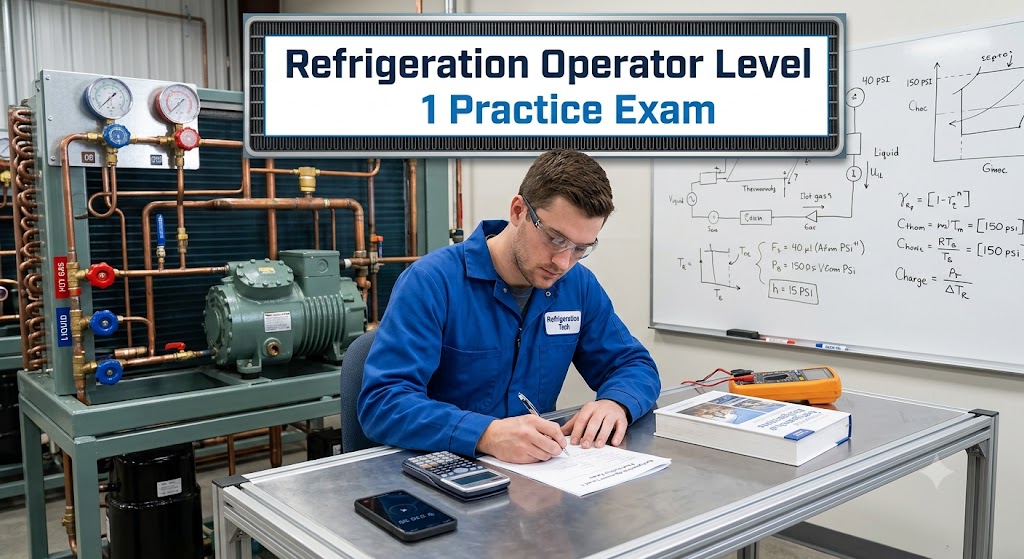
Additional Information
What the Course Entails and Exam Details
This comprehensive course covers the fundamental principles of refrigeration science and the practical aspects of operating refrigeration systems. Students will delve into thermodynamics, understanding how heat transfer and phase changes drive the refrigeration cycle. The curriculum covers the various types of refrigeration systems, including compression and absorption systems, and details the function of major components such as compressors, condensers, evaporators, and expansion devices.
Safety is paramount, so a significant portion of the course is dedicated to proper refrigerant handling, leak detection, and the use of personal protective equipment (PPE). Students will also learn about relevant codes and standards, including the ASME Boiler and Pressure Vessel Code and local environmental regulations. The exam details reflect these core topics, ensuring that candidates possess the necessary knowledge to operate systems responsibly and effectively.
What to Expect in the Final Exam
The final exam for the Refrigeration Operator Level 1 is typically a comprehensive written test designed to assess a candidate's theoretical knowledge. It is a closed-book exam, meaning candidates cannot refer to any external materials during the test.
Format: The exam predominantly consists of multiple-choice questions, which may be supplemented by some true/false or fill-in-the-blank items.
Number of Questions: Candidates can generally expect around 100 questions.
Time Limit: There is a strict time limit, typically three hours, allowing about 1.8 minutes per question.
Passing Score: A passing score is usually set at 70% or higher, demonstrating a strong grasp of the material.
Rules: Specific rules regarding calculators, electronic devices, and break times will be provided by the testing center and must be strictly followed to ensure exam integrity.
How to Study and Exam Centers
Preparation is key to succeeding on the Refrigeration Operator Level 1 exam. Candidates should adopt a multifaceted study strategy. Start by thoroughly reviewing the course materials and textbooks. Actively engage with the content by taking notes, creating flashcards for key terms and formulas, and explaining concepts to others. Hands-on experience, even in an entry-level capacity, can reinforce theoretical knowledge.
Practice exams are an invaluable resource. Utilizing sample questions allows candidates to familiarize themselves with the exam format, gauge their understanding of different topics, and identify areas that need further review. Group study sessions can also be beneficial, providing opportunities for discussion and peer support.
The exam is administered through authorized testing centers and online proctoring services. Candidates can typically schedule their exam through major testing networks like Pearson VUE or directly with accredited technical schools and industry organizations. Specific exam centers may include:
Local community colleges and technical institutes that offer refrigeration technology programs.
Authorized training providers and industry associations such as the International Institute of Ammonia Refrigeration (IIAR).
Dedicated professional testing centers equipped to administer computer-based exams.
Job Opportunities from the Course
Earning the Refrigeration Operator Level 1 certification opens doors to various rewarding career paths in the heating, ventilation, air conditioning, and refrigeration (HVACR) industry. Certified individuals are in demand across multiple sectors, including food processing, cold storage, manufacturing, and building management. Potential job opportunities and career paths include:
Entry-Level Refrigeration Technician
Assistant Refrigeration Operator
Maintenance Technician (with a focus on refrigeration systems)
Building Engineer
Industrial Cooler Operator
HVACR Service Mechanic Apprentice
Cold Storage Facility Attendant
Refrigeration Equipment Sales Representative
Frequently Asked Questions
Reviews
5.0
Based on 0 reviews
Leave a Review
No reviews yet. Be the first to review!