
Refrigeration Operating Engineer License Practice Exam
$69.00
- Buy to unlock unlimited access to all Quiz questions.
- After purchase you can print a PDF of the whole quiz at any point. The PDF will contain the questions and the correct answers.
About this Exam
A Refrigeration Operating Engineer License is a critical certification for individuals aiming to operate and maintain high-tonnage refrigeration and air conditioning systems safely and efficiently. This license is generally required by municipalities or states for buildings with large-scale cooling plants, such as commercial skyscrapers, hospitals, and industrial facilities. The exam is designed for professionals with background experience in HVAC/R, engineering, or facilities management who wish to validate their technical expertise and take on greater responsibility in plant operations.
Ready to test your knowledge?
Buy Now to Access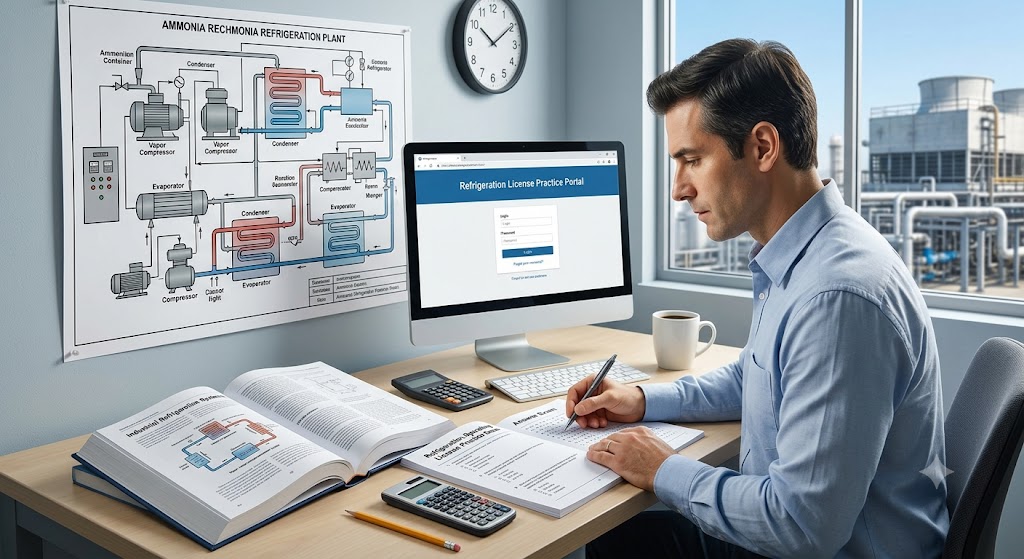
Additional Information
What the Course Entails and Exam Details
To prepare for the exam, candidates must master the theoretical principles of large-scale systems and demonstrate practical knowledge of their operation. Core topics typically covered include:
Thermodynamics and basic refrigeration cycles (vapor compression, absorption).
Operation of major components (compressors, condensers, evaporators, expansion valves).
Refrigerants and their properties, including safety, environmental regulations, and handling protocols.
Piping systems, control circuits, and electrical systems specific to refrigeration plants.
Maintenance schedules, troubleshooting, and emergency shutdown procedures.
OSHA regulations, building codes, and safety procedures for high-pressure systems.
What to Expect in the Final Exam
The actual licensing exam is designed to be rigorous. While specific formats vary by jurisdiction (e.g., New York City, Chicago), the following elements are common:
Format: A timed, written exam, usually featuring complex multiple-choice questions. Some jurisdictions also include a practical or simulation-based component to test hands-on troubleshooting.
Time Limit: Exams are often long, spanning 3 to 4 hours, requiring significant stamina and focus.
Passing Score: A passing grade is generally 70% or higher.
Rules: The exam is typically closed-book. A non-programmable calculator may be allowed, but all other electronic devices and reference materials are prohibited.
How to Study and Exam Centers
Preparation is key to passing on your first attempt. Utilize these strategies to study:
Review Manuals and Codes: Study the latest editions of relevant codes (e.g., ASME, ANSI/ASHRAE) and your local municipal safety guides.
Take Practice Tests: Our [Refrigeration Operating Engineer License Practice Exam] is designed to mirror the structure and difficulty of the real test, allowing you to identify knowledge gaps.
Practical Experience: Hands-on time in a mechanical room is invaluable. Relate your theoretical studies to the equipment you work with daily.
Exam Centers: The exam is usually administered by the local government's Department of Buildings, Fire Department, or a contracted testing service like Pearson VUE. Check your specific municipality's requirements to find authorized physical testing centers and register.
Job Opportunities from the Course
Earning your Refrigeration Operating Engineer License opens the door to high-paying, stable career paths in facilities and infrastructure. Job titles include:
Refrigeration Operating Engineer: (High-Rise Residential/Commercial)
Stationary Engineer: (Hospitals, Universities, Municipal Buildings)
Chief Engineer: (Facilities Management)
Industrial Refrigeration Operator: (Cold Storage, Food Processing)
HVAC Plant Manager
Frequently Asked Questions
Reviews
5.0
Based on 0 reviews
Leave a Review
No reviews yet. Be the first to review!