
Refrigerant 410A Certification Practice Test
$69.00
- Buy to unlock unlimited access to all Quiz questions.
- After purchase you can print a PDF of the whole quiz at any point. The PDF will contain the questions and the correct answers.
About this Exam
The R-410A Certification is a specialized, voluntary safety and knowledge-based qualification for HVAC/R technicians who work with high-pressure refrigerants. R-410A, commonly known by brand names like Puron® or Genetron® AZ-20, has replaced R-22 as the standard refrigerant for new residential and commercial light AC and heat pump systems.
This course is designed for certified EPA Section 608 Type II or Universal technicians who wish to work safely and effectively with R-410A. Because of its significantly higher operating pressures compared to R-22, special handling procedures, tools, and safety protocols are required. Obtaining this certification validates your capability to perform these tasks correctly, reducing personal risk and system liability.
Ready to test your knowledge?
Buy Now to Access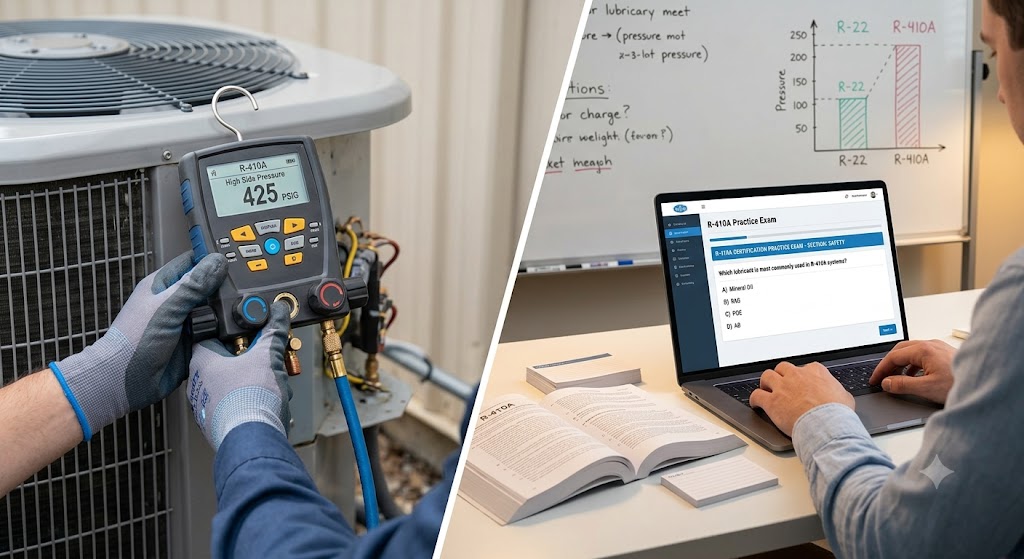
Additional Information
What the Course Entails and Exam Details
The R-410A curriculum does not repeat the foundational environmental rules covered in EPA 608 but focuses entirely on the unique properties and safety aspects of R-410A.
Core Topics Covered:
R-410A Fundamentals: Its specific properties, pressure-temperature relationships, and comparison to R-22.
Safety Requirements: Understanding the dangers of higher operating pressures, including the proper use of required safety equipment and handling techniques.
Lubricants (POE Oil): Learning about Polyolester (POE) oils, which are mandatory for R-410A systems, including their hygroscopic nature and moisture control.
Charging and Blended Refrigerants: Proper procedures for liquid charging blended refrigerants to prevent fractionation and maintain system efficiency.
System Tools and Equipment: Identifying the correct tools rated for R-410A pressures, including manifold gauges, recovery cylinders, and vacuum pumps.
Leak Detection and Repair: Specific techniques for finding and fixing leaks in a high-pressure system.
What to Expect in the Final Exam
While not an EPA-mandated test like Section 608, the final exam for R-410A is rigorous and focused on practical safety.
Format: The most common format is a multiple-choice exam.
Length: The test typically consists of approximately 25 to 50 questions, depending on the proctoring organization.
Time Limit: You will generally have a set time limit, often around 1 to 1.5 hours.
Passing Score: Most programs require a score of 70% to 80% to achieve certification.
Open/Closed Book: This varies. Some organizations offer an open-book exam, allowing you to use a study manual, while others require it to be closed-book and proctored. You must verify the specific rules of your chosen testing body.
How to Study and Exam Centers
Study Strategies:
Obtain the Official Study Guide: Download or purchase the official training manual from your proctoring organization. This is your primary source of truth.
Focus on Differentiation: Pay close attention to the sections detailing the differences between R-22 and R-410A systems. This is frequently tested.
Take Practice Exams: Utilize multiple practice tests online to familiarize yourself with the question style and manage your time.
Create Flashcards: Use flashcards for key terms, pressure values (e.g., standard high and low side operating pressures), and safety procedures.
Exam Centers and How to Take the Test:
This exam is administered through third-party training organizations and not directly by the EPA. Common providers include:
Online Portals: Many organizations, such as Mainstream Engineering or ESCO Group, offer the ability to purchase the exam and take it online from your home or workplace, often without a live proctor (for open-book versions).
Authorized Schools and Training Centers: HVAC/R trade schools, community colleges, and supply houses frequently offer the training course and proctor the closed-book exam.
Pearson VUE: For certain proctored versions, you may be directed to a professional testing center like Pearson VUE.
Job Opportunities from the Course
Obtaining your R-410A certification can open doors to numerous career paths within the HVAC/R industry. This certification is highly sought after by employers who need to ensure their staff can safely service modern equipment.
Unlockable Job Titles and Career Paths:
HVAC/R Service Technician: (Residential and Commercial)
HVAC Installation Technician: (For new construction and system retrofits)
Maintenance Technician: (For apartment complexes, hotels, and commercial buildings)
Building Engineer / Facilities Manager: (Managing large HVAC systems)
HVAC Inspector / Auditor: (Specializing in safety and compliance)
Technical Trainer: (Teaching high-pressure refrigerant safety)
HVAC Counter Sales / Representative: (Requiring technical product knowledge)
Frequently Asked Questions
Reviews
5.0
Based on 0 reviews
Leave a Review
No reviews yet. Be the first to review!