
Refresher Practical Problems Practice Test
$69.00
- Buy to unlock unlimited access to all Quiz questions.
- After purchase you can print a PDF of the whole quiz at any point. The PDF will contain the questions and the correct answers.
About this Exam
Are you a skilled technician, an experienced tradesperson, or a dedicated lab professional who has taken time away from your field? The Practical Skills Refresher Practice Exam is your vital bridge back to confidence and career success. Designed specifically for individuals needing to validate and modernize their hands-on capabilities, this certification or refresher program confirms that your practical skills meet today's rigorous industry standards.
Whether you're re-entering the workforce after an absence, looking to advance within your current role, or preparing for a required license renewal, a practical skills test proves your competency in a real-world setting. A dedicated refresher exam provides the necessary structure, simulation, and feedback to ensure you are fully prepared for the final assessment.
Ready to test your knowledge?
Buy Now to Access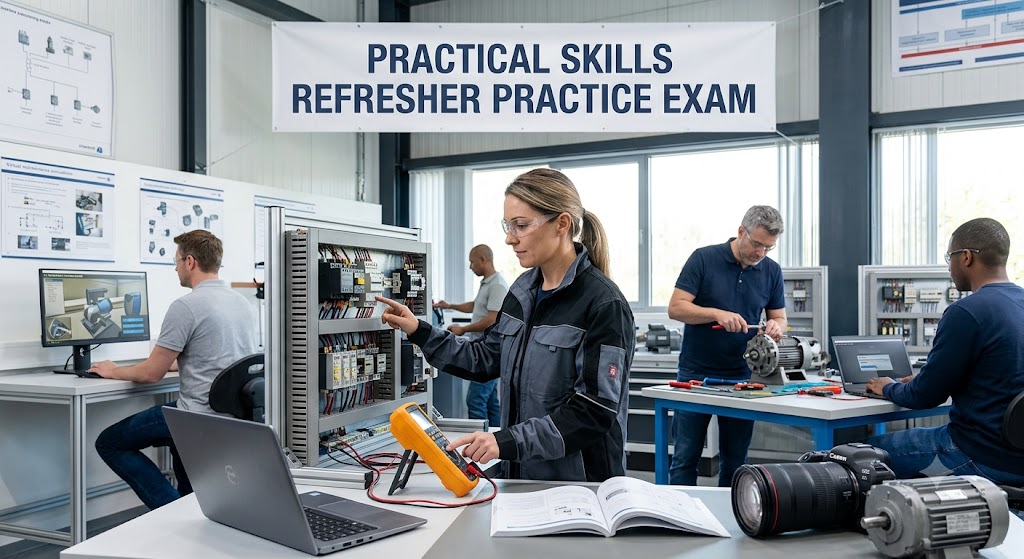
Additional Information
What the Course Entails and Exam Details
The practical skills refresher course is an intensive, hands-on program that goes beyond theoretical knowledge. It focuses on application, critical thinking, and the direct application of standard operating procedures within a safe, controlled, and simulated environment.
Core topics and skill areas typically covered include:
Diagnostic Techniques & Troubleshooting: Systematically identifying and resolving common and complex practical problems in your specific field, from advanced mechanical issues to network failures.
Modern Equipment Operations: Hands-on experience with the latest tools, machinery, software, and laboratory equipment relevant to your industry.
Updated Safety Protocols: A comprehensive review and practical application of the most current safety regulations (such as OSHA or industry-specific standards) to prevent workplace accidents.
Compliance & Code Review: Understanding and implementing the newest industry codes, quality control processes, or technical standards.
Emergency Response Procedures: Practicing simulated emergency scenarios to ensure correct and efficient reactions during critical situations.
What to Expect in the Final Exam
The final assessment is a comprehensive, multi-part evaluation designed to mirror real-world challenges. It requires a blend of mental acuity and physical dexterity. You can typically expect:
Practical Problem-Solving Stations: A series of hands-on challenges where you must diagnose an issue, perform a repair, or complete a specific, technical task under observation.
Time Constraints: Most practical sections are timed to simulate realistic work pressures and test efficiency and competence.
Written Knowledge Assessment: A concurrent or separate written or digital test, often in a multiple-choice or short-answer format, to verify theoretical understanding of safety, procedures, and core principles.
Weighted Scoring: A combined final score, where both practical and theoretical parts must be passed to receive certification. A common benchmark passing score is 70-80%, though this can vary by certification body.
Examiner Observation: A certified proctor or examiner may assess your form, technique, adherence to safety, and overall process for the hands-on sections.
How to Study and Exam Centers
The most effective way to prepare for a practical skills refresher exam is through repeated, direct application. Do not rely solely on textbooks.
Actionable Study Strategies:
Engage in Simulations: Utilize virtual reality simulations, interactive online scenarios, or dedicated practical training rigs to mimic real-world problems.
Practical Workshops: Enroll in a structured practical workshop offered by authorized training schools or colleges. These provide expert guidance and access to modern equipment.
Review Manuals & Procedures: Study the original operating manuals, updated codebooks, and standard operating procedures for the tools and techniques in your field.
Take Practice Tests: Actively take timed practice exams (both practical simulations and multiple-choice questions) to build confidence and refine your pacing.
Peer Review: Work with colleagues or peers to simulate a tester scenario, where you take turns observing and grading each other's procedures.
Exam Centers and Locations:
Practical skills exams are rarely delivered exclusively online. They often require physical attendance at one of the following:
Authorized Training Centers: Specialized technical schools or vocational training facilities that house the necessary equipment.
Colleges & Universities: Technical departments of post-secondary institutions, particularly those with dedicated trade or laboratory programs.
Physical Testing Centers: Established practical assessment vendors who provide a controlled environment for complex examinations.
Online Proctored Practical Tests: In emerging fields or with certain simulation-based certifications, exams can be taken through secure online platforms that monitor both screen and environment. Check with your specific certification body.
Job Opportunities from the Course
Successfully completing a practical skills refresher program and passing the certification exam can dramatically improve your career prospects, opening doors to both re-entry and advancement.
A list of specific job opportunities that benefit from this refresher includes:
Lead Industrial Electrician
HVAC Technician / Senior HVAC Specialist
Laboratory Supervisor / Research Technician
Facilities Manager
CNC Machinist / Precision Technician
Information Technology (IT) Field Engineer
Industrial Safety Inspector
Equipment Maintenance & Calibration Specialist
Construction Project Site Supervisor
Frequently Asked Questions
Reviews
5.0
Based on 0 reviews
Leave a Review
No reviews yet. Be the first to review!