
Red Seal Industrial Mechanic (Millwright) Practice Exam
$69.00
- Buy to unlock unlimited access to all Quiz questions.
- After purchase you can print a PDF of the whole quiz at any point. The PDF will contain the questions and the correct answers.
About this Exam
The Red Seal Industrial Mechanic (Millwright) certification represents the pinnacle of professional recognition for skilled tradespeople maintaining, installing, and repairing industrial machinery across Canada.
This Red Seal designation is designed for registered millwright apprentices who have successfully completed their technical training and required hours, as well as experienced industrial mechanics looking to challenge the exam and obtain national journeyperson status.
The Red Seal Interprovincial Exam confirms that a candidate possesses the required knowledge, skills, and abilities to work effectively and safely as an Industrial Mechanic (Millwright) anywhere in Canada.
Successfully earning this endorsement demonstrates mastery in your trade, increasing employability, mobility, and earning potential in diverse sectors like manufacturing, mining, oil and gas, and power generation.
Ready to test your knowledge?
Buy Now to Access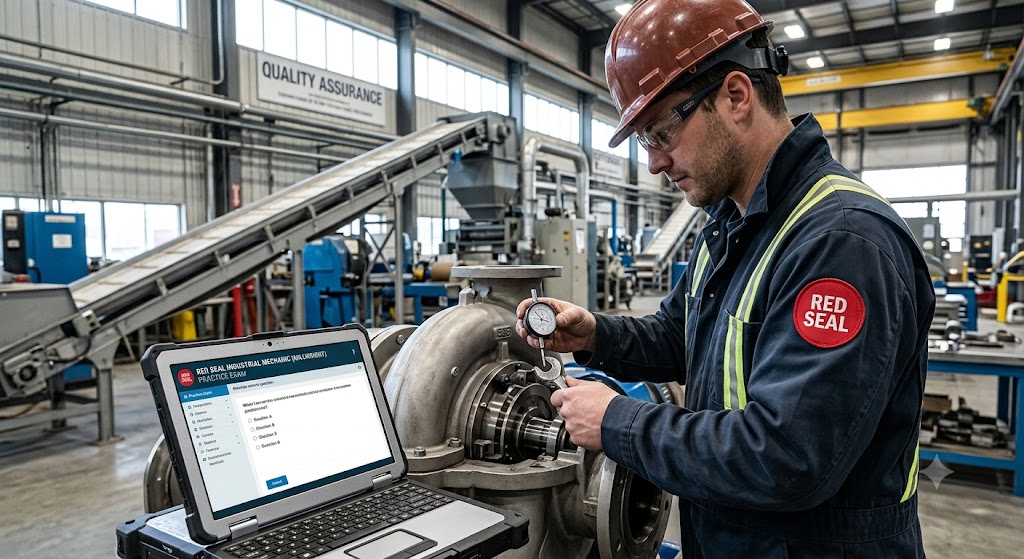
Additional Information
What the Course Entails and Exam Details
While the Red Seal exam itself is a single test, preparing for it requires comprehensive knowledge gained through formal apprenticeship training, on-the-job experience, and structured self-study.
The core curriculum and exam syllabus cover a wide spectrum of critical competencies necessary for an Industrial Mechanic (Millwright). Key areas include:
Trade Safety and Communication: Prioritizing occupational health and safety regulations (OH&S), hazard identification, environmental protection, and effective communication skills in an industrial environment.
Tools and Equipment: Selection, safe operation, and maintenance of hand tools, power tools, precision measuring instruments, and specialized equipment used in the trade.
Rigging and Hoisting: Safe procedures for moving, lifting, and installing heavy machinery, including knowledge of rigging hardware, slings, and hoists.
Machinery Installation and Maintenance: Proficiency in blueprint reading, precision alignment (laser and dial indicator), vibration analysis, and maintaining diverse industrial equipment such as pumps, compressors, turbines, and conveyor systems.
Power Transmission: Understanding the principles and maintenance of mechanical power transmission components, including gears, shafts, bearings, and belts.
Fluid Power Systems: Diagnostics, troubleshooting, and repair of hydraulic and pneumatic systems, reading schematic diagrams.
Basic Electricity and Automation: Knowledge of basic electrical theory, industrial circuits, motors, and automation systems used in modern industrial machinery.
The Red Seal Industrial Mechanic (Millwright) Interprovincial Exam is a standard multiple-choice test. It consists of approximately 135 to 150 questions that are randomly generated from a large pool, ensuring validity and comprehensiveness.
What to Expect in the Final Exam
When you sit for the official Red Seal Millwright exam, you are taking a rigorous, standardized assessment of your professional knowledge. Here is a clear outline of the exam format and environment:
Question Type: The exam consists entirely of multiple-choice questions. Each question has four possible answers, with only one being correct. There are no essay or practical components to the official Red Seal exam itself.
Duration: Candidates are typically allotted 4 hours to complete the entire exam. Time management is crucial for success.
Passing Score: To obtain the Red Seal endorsement, a minimum score of 70% is required. This high standard ensures that only individuals with a strong understanding of the trade pass.
Delivery Method: The exam is typically computer-based and administered at designated testing locations.
Rules and Regulations: The Red Seal exam is strict and high-stakes. Strict identification verification is enforced, and no outside materials, study aids, cell phones, or electronic devices are permitted in the testing room. Scrap paper and a basic calculator may be provided.
How to Study and Exam Centers
Preparation is the absolute key to success on the Red Seal Industrial Mechanic (Millwright) exam. Since the exam is comprehensive and covers both theoretical knowledge and practical applications from years of experience, a structured study plan is essential.
Study Strategies:
Utilize the National Occupational Analysis (NOA) / Red Seal Occupational Standard (RSOS): This is your most vital resource. It lists every competency and task an Industrial Mechanic (Millwright) must be able to perform. Read it thoroughly to identify your strengths and weaknesses.
Review Provincial Study Guides: Each province/territory provides specialized study guides and sample questions for Red Seal trades. These guides often break down the exam weighted structure (e.g., percentage of questions on hydraulics vs. safety).
Practice with Sample Questions: Get as much experience as possible answering multiple-choice questions. Use practice exams to simulate the test environment and improve speed and accuracy. Focus on understanding why a correct answer is correct and analyzing why you got others wrong.
Identify Knowledge Gaps: Focus your study time on areas where you are less confident. For example, if your work experience was primarily in hydraulics, spend more time reviewing vibration analysis or precision alignment.
Join a Study Group: Connecting with other apprentices and journeypersons preparing for the exam can provide valuable support, clarification, and practical tips.
Exam Centers:
Red Seal examinations are not typically taken through private training providers or online portals like Pearson VUE directly. Instead, they are administered by the designated provincial or territorial apprenticeship and certification authority. You must contact your local apprenticeship office to determine:
Your eligibility to challenge the exam.
Upcoming exam dates and registration deadlines.
Specific testing center locations within your province or territory (often government testing facilities, community colleges, or designated centers).
The cost and process for scheduling your exam.
You can find links to all provincial and territorial apprenticeship websites on the official Red Seal website (red-seal.ca). Always ensure you are following the exact registration process for your jurisdiction.
Job Opportunities from the Course
Earning your Red Seal Industrial Mechanic (Millwright) certification unlocks extensive career pathways across dynamic industrial sectors. This nationally recognized designation positions you for high-demand, well-paying roles including:
Industrial Mechanic (Millwright) Journeyperson: The primary role, working in various industrial settings like factories, refineries, mines, and power plants.
Maintenance Lead/Foreman: Supervise maintenance crews, scheduling work and ensuring compliance with safety and environmental standards.
Maintenance Manager: Oversighting entire maintenance departments within large facilities, managing budgets, and planning long-term equipment reliable programs.
Plant Supervisor/Superintendent: Responsible for overseeing operational areas, managing personnel, and ensuring production efficiency.
Reliability Technician/Engineer: Specialize in analyzing machinery health using tools like vibration monitoring and thermography to predict and prevent failures.
Vibration Analysis Technician: A specialized role focused on interpreting machinery vibration data to diagnose issues.
Precision Alignment Technician: Focusing on the critical installation and maintenance aspect of ensuring high-speed machinery operates efficiently.
Field Service Technician: Traveling to various client sites to install, maintain, and repair specialized equipment.
Industrial Construction Project Manager: Oversighting large-scale industrial machinery installation projects within construction firms.
Frequently Asked Questions
Reviews
5.0
Based on 0 reviews
Leave a Review
No reviews yet. Be the first to review!