
Reasoning in the Humanities & Social Sciences
$69.00
- Buy to unlock unlimited access to all Quiz questions.
- After purchase you can print a PDF of the whole quiz at any point. The PDF will contain the questions and the correct answers.
About this Exam
The Reasoning in the Humanities & Social Sciences exam is a unique assessment tool that evaluates a candidate’s critical thinking and analytical reasoning skills within the context of humanities and social science disciplines.
It is designed to test your ability to interpret and analyze written and visual texts, evaluate arguments, and apply reasoning concepts to various scenarios in fields like sociology, psychology, philosophy, literature, history, and political science.
This exam is primarily targeted at prospective students applying to graduate-level programs, specifically medical and health-related fields like medicine, dentistry, and veterinary science, as a common component of comprehensive admission tests such as the GAMSAT (Graduate Medical School Admissions Test).
Ready to test your knowledge?
Buy Now to Access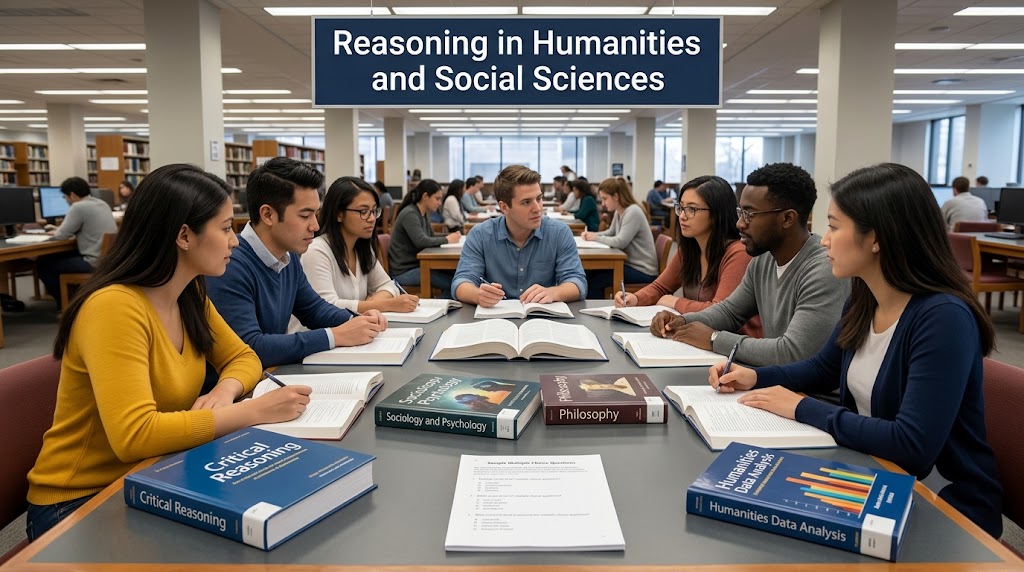
Additional Information
What the Course Entails and Exam Details
This examination is not a test of prior knowledge in
humanities or social science subjects; rather, it is a test of skills.
The course of study for this exam entails developing
proficiency in the following key areas:
- Critical
Reading and Interpretation: Accurately interpreting complex written
texts, including academic essays, poems, novels, historical documents, and
social science articles.
- Argument
Analysis: Identifying arguments, premises, and conclusions within a
text. Analyzing the logical structure of an argument and evaluating its
strengths and weaknesses.
- Data
and Visual Analysis: Interpreting graphs, tables, charts, maps, and
other visual data commonly used in social science research.
- Evaluation
of Evidence: Assessing the credibility and relevance of evidence
presented to support an argument or claim.
- Understanding
Conceptual Frameworks: Recognizing and applying key concepts and
theories common to humanities and social science disciplines, such as
social stratification, cultural relativism, logical fallacies, and ethical
principles.
- Inferential
Reasoning: Making logical deductions and inferences based on
information presented in a text or stimulus material.
- Evaluating
Objectivity and Bias: Recognizing perspectives, tones, and biases
inherent in various texts and understanding how they impact the
information presented.
What to Expect in the Final Exam
The Reasoning in the Humanities & Social Sciences
component is typically a section within a larger graduate admissions test like
the GAMSAT (specifically Section I).
The format is exclusively multiple-choice, focusing on
complex reasoning questions rather than recall of facts.
- Exam
Format: A set of stimulus materials (passages, poems, visual data,
etc.) is presented, each followed by several multiple-choice questions.
- Typical
Question Count: For the GAMSAT, Section I often contains around 62–75
multiple-choice questions.
- Time
Limits: The time allocated for this section is usually tightly
controlled. For example, in the GAMSAT, the entire Section I typically
allows approximately 100 minutes (including reading time).
- Passing
Score Requirements: There is no universal "passing score"
for this reasoning section alone. Results are typically presented as a
scaled score. Admission to specific graduate programs depends on your
overall score across all exam sections, your relative ranking, and
individual university admission criteria.
- Specific
Rules: Standardised exam rules apply: specific identification is
required, and only authorized materials are allowed in the testing center.
There is usually no negative marking (guessing is encouraged).
How to Study and Exam Centers
Preparation for this reasoning exam must prioritize skill
development over rote memorization.
Study Strategies and Practice Methods:
- Active
and Diverse Reading: Read widely in humanities and social sciences.
Tackle difficult material: read philosophical essays, sociology journals,
classic literature, contemporary poetry, and quality long-form journalism.
- Practice
Sample Questions: This is crucial. Use official practice materials
provided by the exam body (e.g., ACER for GAMSAT). Complete sample
reasoning questions and rigorously analyze the reasoning behind both
correct and incorrect answers.
- Engage
with the Text: Don't just read; actively analyze. Question the
author’s purpose, identify the main argument, summarize key points, and
look for supporting evidence. Annotate texts as you read them.
- Develop
Critical Thinking Skills: Familiarize yourself with logical reasoning
concepts and common fallacies. Practice identifying logical structure in
everyday arguments.
- Time
Management Practice: Simulate exam conditions. Complete sets of
multiple-choice reasoning questions under the actual time constraints to
build speed and maintain accuracy under pressure.
- Focus
on Analysis of Visuals: Don't neglect data interpretation. Practice
quickly analyzing graphs, charts, and maps to extract key information and
make inferences.
Exam Centers and Testing Logistics:
Since this exam is often a component of a larger graduate
admission test (like GAMSAT Section I), you will need to register for that
comprehensive exam.
- Online
Registration: Candidates register for the exam through the official
exam body’s website (e.g., ACER).
- Physical
Testing Centers: Tests are typically held in designated, authorized
physical centers worldwide (e.g., convention centers, large university
halls, or professional test centers like Pearson VUE).
- Authorized
Locations: The exact testing locations are provided during the
registration process and vary depending on the testing date. You will
select an approved testing center closest to you during registration.
- Authorized
Schools: In some specific regions or for smaller versions of this type
of reasoning test, some universities or schools may be authorized testing
sites, but standard major administrations occur at designated centers.
Job Opportunities
from the Course
Successfully preparing for and passing the Reasoning in the
Humanities & Social Sciences exam (typically as part of a graduate entry
requirement) is a vital step toward a career in several professional fields.
This reasoning skill set is highly valued and foundational
for success in demanding graduate-level programs, unlocking paths to these
specific career titles and roles:
- Medical
Doctor (MD/MBBS)
- Dental
Surgeon (DDS/BDS)
- Veterinary
Surgeon (DVM/BVSc)
- Advanced
Healthcare Practitioner (e.g., Occupational Therapist, Physiotherapist,
Optometrist—through graduate entry)
- Critical
Policy Analyst
- Social
Research Scientist
- Bioethicist
- Legal
Professional (e.g., Barrister, Solicitor—with subsequent law
qualifications)
- Post-graduate
Academic Researcher/Professor (in Humanities or Social Sciences)
Frequently Asked Questions
Reviews
5.0
Based on 0 reviews
Leave a Review
No reviews yet. Be the first to review!