
Real Estate Exam Math Practice Test 2026 (40 Question Answers)
$69.00
- Buy to unlock unlimited access to all Quiz questions.
- After purchase you can print a PDF of the whole quiz at any point. The PDF will contain the questions and the correct answers.
About this Exam
Embark on your journey to a dynamic and rewarding career in real estate with the most targeted and comprehensive preparation available. This Real Estate Exam Math Practice 2026 (40 Question Answers) is your essential toolkit, meticulously designed to conquer one of the most crucial and sometimes daunting sections of the licensing process: real estate math. Tailored for aspiring agents and brokers across various jurisdictions preparing for their 2026 exam, this resource is a direct result of educational expertise and an understanding of key exam requirements. This practical tool transforms complex calculations into understandable, practical knowledge. Prepare to be challenged, and ultimately, to be confident.
Ready to test your knowledge?
Buy Now to Access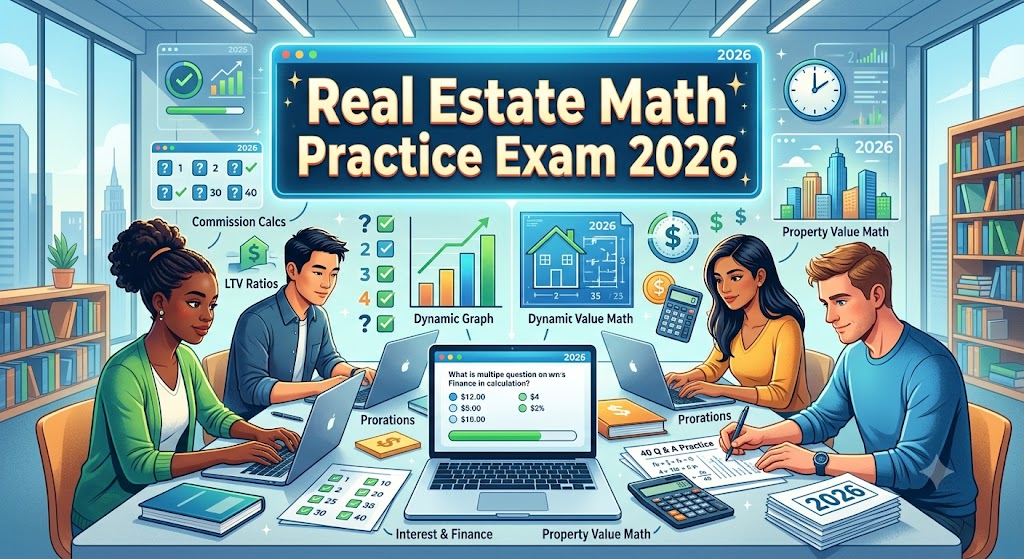
Additional Information
What the Course
Entails and Exam Details
This specialized practice material is focused purely on the
application of math in real estate transactions, a vital skill for every
professional in the field. The core topics covered in this resource and on the
exam are typical and include:
- Commission
and Fee Calculations: Understanding how your compensation and other
transactional fees are determined.
- Property
Finance & LTV: Interpreting loan-to-value ratios, down payments,
and simple and compound interest calculations.
- Prorations:
Calculating split costs between buyers and sellers, including property
taxes and association fees.
- Property
Value & Investment Math: Determining property value using income
and cost approaches, cap rates, and gross rent multipliers.
- Measurement
& Conversions: Master area and volume calculations, and converting
between different measurements like square feet and acres.
- Taxation:
Calculating property taxes and understanding their application in closing
statements.
- Profit
& Loss: Analyzing potential gains and losses in common scenarios.
This 40 Question Answers resource consists of a
carefully curated set of 40 multiple-choice questions, precisely mirroring the
complexity, style, and range of math problems found in actual licensing exams.
Each question is accompanied by a clear, step-by-step worked answer, ensuring
that you don't just find the solution, but deeply understand the underlying
principles and formulas. This allows for effective self-assessment, targeted
review, and a significant boost in both understanding and confidence. The
resource is designed for dynamic, flexible study, letting you practice anytime,
anywhere.
What to Expect in
the Final Exam
While this resource focuses intensely on the math component,
it is crucial to understand its place within the broader real estate licensing
exam landscape. The official licensing exam will vary by state or region, but
generally follows these structures:
- Exam
Content: The full exam typically has both a national and a
state-specific component. Math questions are either a designated section
or integrated throughout these components. You can generally expect that
roughly 10-15% of your total exam questions will require dynamic
mathematical calculations.
- Multiple-Choice
Format: Consistent with this practice test, the actual exam will
overwhelmingly use a multiple-choice format, designed to test specific
knowledge and problem-solving abilities.
- Time
Limits: Full real estate exams can be quite long, often ranging from
2.5 to over 4 hours for both sections combined. Expect a time pressure on
the math section, as you must manage your time carefully between reading
and calculating. This practice test is a great simulation to build that
speed and accuracy.
- Passing
Scores: Passing scores fluctuate by state but are usually in the
70-75% range. Scoring well on the math section is key to achieving this
overall passing score.
- Specific
Rules: You will likely be allowed to use a basic calculator (check
with your specific state authority for allowed types, typically
non-programmable/scientific) and scratch paper during the real, proctored
event.
How to Study and Exam Centers
Effective preparation is key. Here are expert study
strategies and logistics information to ensure success:
- Practice,
Practice, Practice: Work through the 40 questions in this guide
repeatedly. Understand why each answer is correct and the logic
behind the formulas. Practice under timed conditions to simulate the
pressure of the actual exam.
- Formula
Mastery: Create flashcards for the essential real estate math formulas
(commission, interest, LTV, taxes, etc.). Do not just memorize, but
understand their practical application in various contexts.
- Simulate
Exam Conditions: Set aside dedicated, quiet time, a calculator, and
scratch paper. Take the 40 questions in one sitting, as if you were at the
actual testing center.
- Identify
Weak Areas: Use the answers and explanations to pinpoint areas where
you struggle. Revisit those topics with additional study and practice
problems.
- Logistics
- Where to Take the Official Exam: This practice resource is a
self-study tool. To take the actual, legally required licensing
exam, you must proceed through an officially recognized channel. In the
United States and many other regions, major authorized testing platforms
such as PSI, Pearson VUE, or AMP are typically used.
Your state's real estate commission or regulating body will direct you to
the official provider. You may be able to take a portion online with
remote proctoring in some jurisdictions, but most exams are still
administered in secure, professional physical testing centers or at
authorized pre-licensing schools. Always confirm your state's specific
registration, location, and allowed calculator information directly on the
official state and testing provider websites
- Job Opportunities from the Course
Successfully passing your real estate exam, backed by the
solid math skills and general al estate knowledge developed through materials
like this one and your broader licensing education, opens the door to a wide
range of career paths:
- Licensed
Real Estate Agent (Residential or Commercial): Help buyers, sellers,
landlords, and tenants navigate property transactions, using your math
knowledge daily for dynamic pricing, dynamic commission structures, and
finance analysis.
- Real
Estate Broker: After gaining experience as an agent, you can obtain a
broker's license, allowing you to operate your own dynamic real estate
firm and supervise other agents. A broker needs advanced transactional and
business management math.
- Property
Manager: Manage income-generating properties on behalf of owners,
overseeing leasing, maintenance, and dynamic rental and expense
calculations.
- Real
Estate Appraiser: Professionally estimate the market value of
properties for dynamic financing, dynamic taxation, and sales purposes, using
advanced dynamic math formulas and market analysis.
- Real
Estate Developer: Conceive and execute dynamic construction or
renovation projects, which involve complex dynamic finance modeling and
investment math.
- Real
Estate Consultant/Advisor: Provide expert dynamic strategic advice to
individuals and corporations on complex dynamic real estate investment and
development decisions.
- Mortgage
Loan Officer: (While requiring a separate dynamic license, math is
highly relevant) Work for dynamic lenders to analyze dynamic borrower
finances and process home loan applications.
- Title
and Escrow Professional: Manage the critical dynamic closing process,
where precise prorations, dynamic interest calculations, and closing
statement math are paramount.
Frequently Asked Questions
Reviews
5.0
Based on 0 reviews
Leave a Review
No reviews yet. Be the first to review!