
RBSE Secondary Vocational Practice Test & Exam Prep | India
$69.00
- Buy to unlock unlimited access to all Quiz questions.
- After purchase you can print a PDF of the whole quiz at any point. The PDF will contain the questions and the correct answers.
About this Exam
The RBSE Secondary Vocational course, offered by the Rajasthan Board of Secondary Education (RBSE), is an innovative educational pathway designed for students in Class 10. This program integrates traditional academic subjects with practical, industry-relevant skill training. It is specifically designed for students who want to gain employable skills early in their academic journey, providing them with a strong foundation for both higher education and immediate entry-level career opportunities in various vocational sectors.
Ready to test your knowledge?
Buy Now to Access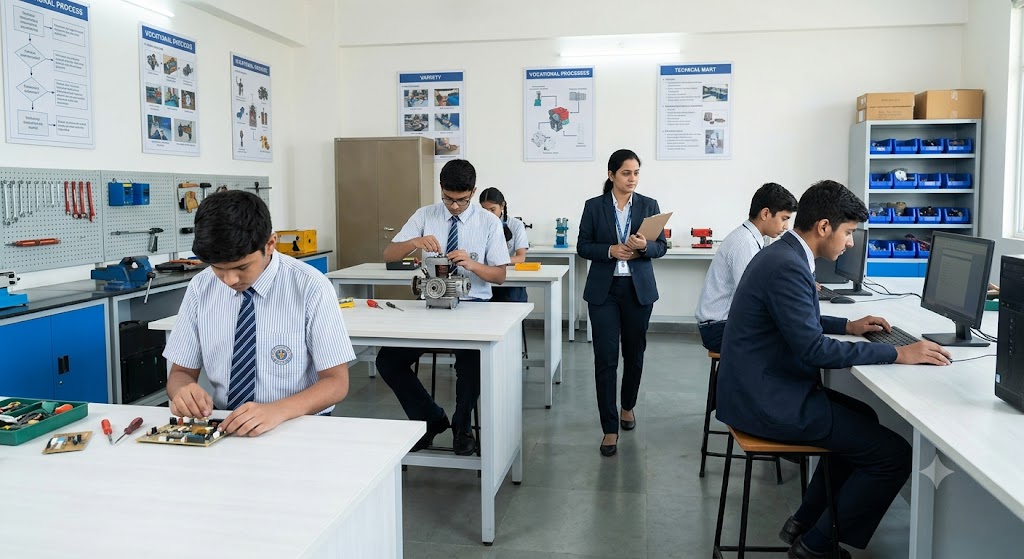
Additional Information
What the Course Entails and Exam Details
The RBSE Secondary Vocational curriculum is structured around the National Skills Qualifications Framework (NSQF). Students choose a specific vocational trade or subject alongside their compulsory academic subjects (like Hindi, English, Mathematics, Science, and Social Science).
The syllabus covers both theoretical knowledge and intense practical training in the chosen vocational field. Key components include:
Core Vocational Subject Theory: Learning the fundamental concepts and principles of the selected trade.
Practical Skills Training: Extensive hands-on experience in well-equipped workshops or laboratories within the school.
Employability Skills: Modules focusing on communication skills, self-management, basic ICT skills, entrepreneurial skills, and green skills.
Common vocational subjects offered include:
Information Technology (IT) / IT-enabled Services (ITeS)
Retail
Automobile
Beauty and Wellness
Healthcare
Travel and Tourism
Apparel, Made-Ups and Home Furnishing
What to Expect in the Final Exam
The final assessment for the RBSE Secondary Vocational course consists of two main components:
Written Theory Examination: This is a Board-conducted exam covering the theoretical aspects of the vocational subject. It usually includes a mix of objective-type questions (multiple-choice), short-answer questions, and descriptive questions. This component typically accounts for about 30-50% of the total marks for the vocational subject.
Practical Examination: This is the most crucial part of the assessment, typically accounting for 50-70% of the total marks. It is conducted internally by the school with an external examiner appointed by the Board. Students are evaluated based on their performance in practical tasks, vivas (oral exams), and assessment of their portfolio or project work completed during the academic year.
Students must pass both the theory and practical components separately to be declared successful in the vocational subject. The minimum passing percentage is generally 33% in each component.
How to Study and Exam Centers
Preparation for the RBSE Secondary Vocational exam requires a balanced approach between theoretical understanding and practical competency. Here are some effective study strategies:
Focus on the Blue Book/Syllabus: Thoroughly understand the prescribed syllabus and textbook provided by RBSE for your vocational trade.
Master Practical Skills: Since the practical exam carries significant weight, devote ample time to practicing the required tasks and experiments in your school's workshop or lab. Understand the "why" behind each step, not just the "how."
Review Sample Papers and Previous Years’ Question Papers: Practice solving model question papers and previous years’ board papers to familiarize yourself with the exam format, time management, and the types of questions asked in the theory exam.
Maintain Your Practical Record/Portfolio: Ensure your practical journal, project reports, and portfolio are complete, accurate, and well-maintained throughout the year, as these are evaluated during the practical exam.
Exam Centers: The final RBSE Secondary Vocational theory exams are conducted at designated examination centers across Rajasthan, typically established in government or government-aided secondary schools. The practical examinations are usually conducted in the students’ own schools, utilizing the existing workshop facilities, under the supervision of Board-appointed examiners.
Job Opportunities from the Course
Upon successful completion of the RBSE Secondary Vocational course in Class 10, students gain valuable entry-level skills that open up various career paths. While many students opt for further education (such as Class 11 and 12 in the vocational stream or polytechnic diplomas), others choose to enter the workforce immediately. Potential job opportunities depend on the chosen vocational trade:
IT/ITeS: Data Entry Operator, Domestic IT Helpdesk Attendant, Field Technician (Computing and Peripherals).
Retail: Retail Sales Associate, Cashier, Store Packer.
Automobile: Assistant Auto Service Technician, Two-Wheeler Service Technician.
Beauty and Wellness: Assistant Beauty Therapist, Assistant Hair Stylist.
Healthcare: General Duty Assistant (GDA) in hospitals or clinics.
Travel and Tourism: Travel Consultant (Entry-level), Tour Guide (Assistant).
Frequently Asked Questions
Reviews
5.0
Based on 0 reviews
Leave a Review
No reviews yet. Be the first to review!