
Quantity Surveying Practice Test & Exam Prep | Sri Lanka
$69.00
- Buy to unlock unlimited access to all Quiz questions.
- After purchase you can print a PDF of the whole quiz at any point. The PDF will contain the questions and the correct answers.
About this Exam
The Quantity Surveying Sri Lanka Practice Exam is a comprehensive preparatory tool designed for candidates aiming to achieve professional status or recognized qualifications within the Quantity Surveying field in Sri Lanka. This exam preparation is specifically tailored to align with the demanding standards set by the Institute of Quantity Surveyors Sri Lanka (IQSSL) and other related educational and licensing bodies in the country. It serves as a crucial milestone for students pursuing technical and professional membership.
This study guide and practice test are ideal for recent graduates with a degree in Quantity Surveying or related fields, professionals currently working as assistant quantity surveyors seeking advancement, and students preparing for the various tiered qualifying examinations, such as the Graduate Membership Qualifying Examination (GMQE). By utilizing this resource, you can gain a deep understanding of the exam's core competencies and effectively assess your readiness.
Ready to test your knowledge?
Buy Now to Access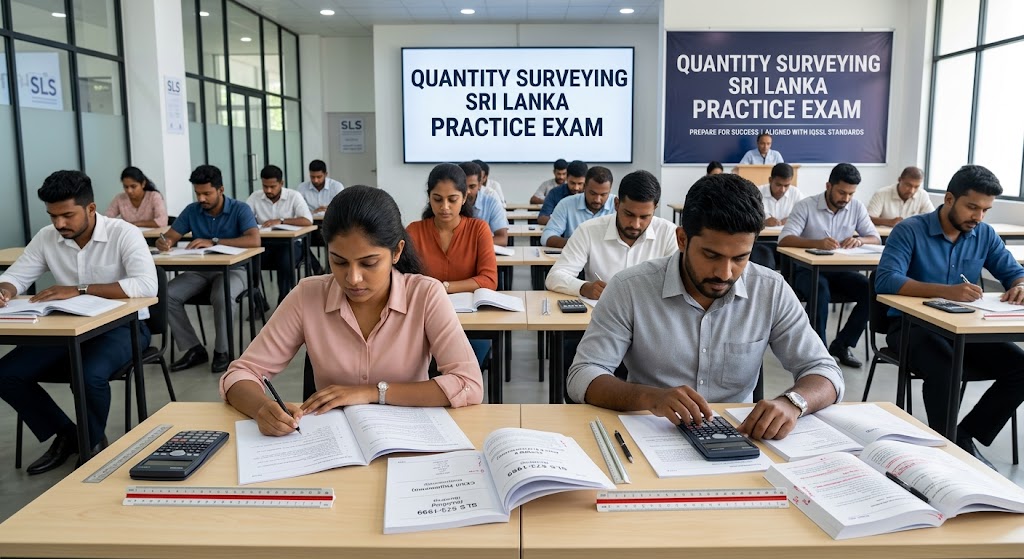
Additional Information
What the Course Entails and Exam Details
This examination assesses a broad and critical range of
skills required to operate as a competent quantity surveyor in Sri Lanka’s
unique construction landscape. You will need a strong grasp of both local and
international best practices. The course of study leading to this exam, particularly
for those on the path to professional status with bodies like the IQSSL,
typically covers the following fundamental areas:
- Advanced
Measurement: Practical proficiency in 'taking off' quantities for
buildings (using standards such as SLS 573:1999) and civil engineering
works (following CESMM 4). Candidates are often required to bring an
unmarked copy of these standards into the examination.
- Contract
Management: Detailed knowledge of construction contracts, standard
forms, comparative interpretation, contract administration, fluctuations,
variations, claims, final accounts, and dispute resolution methods.
- Construction
Economics: Understanding the construction industry’s role in the
national economy, feasibility studies, cost benefit analysis, life cycle
costing, cost planning, cost control, and risk management.
- Construction
Law: An overview of legal systems, essential elements of contract law,
torts (delict), and professional negligence specifically as they apply to
the construction process in Sri Lanka.
- Construction
Technology: A strong grasp of both traditional and modern construction
methods, site investigations, architectural and structural drawings,
finishes, and specific techniques for multi-storey and industrial
buildings.
- Project
Planning & Control: Practical skills in project scheduling, cash
flow forecasting, material management, human resource management, quality
management, and progress monitoring.
The depth and complexity of your evaluation may vary
depending on whether you are taking an exam for a technician-level
qualification, Graduate Membership, or the full Assessment of Professional
Competence (APC).
What to Expect in the Final Exam
While specific formats vary by the qualifying body (e.g.,
IQSSL vs. SLIATE or an academic program), candidates preparing for a full
professional qualification can generally expect a rigorous, multi-stage
assessment process. This is not typically a single multiple-choice test.
The core components often include:
- Written
Examinations: These are technical papers designed to test in-depth
knowledge and application. You might face multiple papers across different
days, focusing on technical areas such as Advanced Building and Civil
Engineering Measurement. These are timed and require you to solve
real-world calculation and case-study problems. For example, some
professional bodies split technical exams into three or more parts, covering
the key modules outlined in Section 2.
- Coursework
and Portfolios: At certain levels, candidates must submit logs of
experience, known as 'diaries,' demonstrating structured training and
professional development over several years.
- Case
Studies: A substantial written case study may be required to
demonstrate comprehensive, integrated competence.
- Oral
Examination or Viva: Successful completion of the written components
is often followed by a final panel interview. This 'viva' assesses your
communication skills, ethical awareness, and ability to handle questions
on your portfolio and general quantity surveying knowledge.
The passing requirements are high, reflecting the level of
professional responsibility. You will need to demonstrate not just knowledge
but the ability to apply it accurately and ethically.
Frequently Asked Questions
Reviews
5.0
Based on 0 reviews
Leave a Review
No reviews yet. Be the first to review!