
PTCB Practice Test on Patient Safety and Quality Assurance 2026
$69.00
- Buy to unlock unlimited access to all Quiz questions.
- After purchase you can print a PDF of the whole quiz at any point. The PDF will contain the questions and the correct answers.
About this Exam
Earning your Certified Pharmacy Technician (CPhT) designation from the Pharmacy Technician Certification Board (PTCB) is a milestone achievement. This specialized [PTCB Practice Test on Patient Safety and Quality Assurance 2026] focuses on what many argue is the most crucial pillar of the profession: the protection of the public and the continuous improvement of the healthcare environment.
It is designed specifically for aspiring pharmacy technicians who are preparing to take the Pharmacy Technician Certification Exam (PTCE) in 2026. This practice test provides a focused, rigorous simulation of the "Patient Safety and Quality Assurance" domain, ensuring you understand the methodologies and required standard protocols to minimize medication errors and uphold regulatory compliance.
Ready to test your knowledge?
Buy Now to Access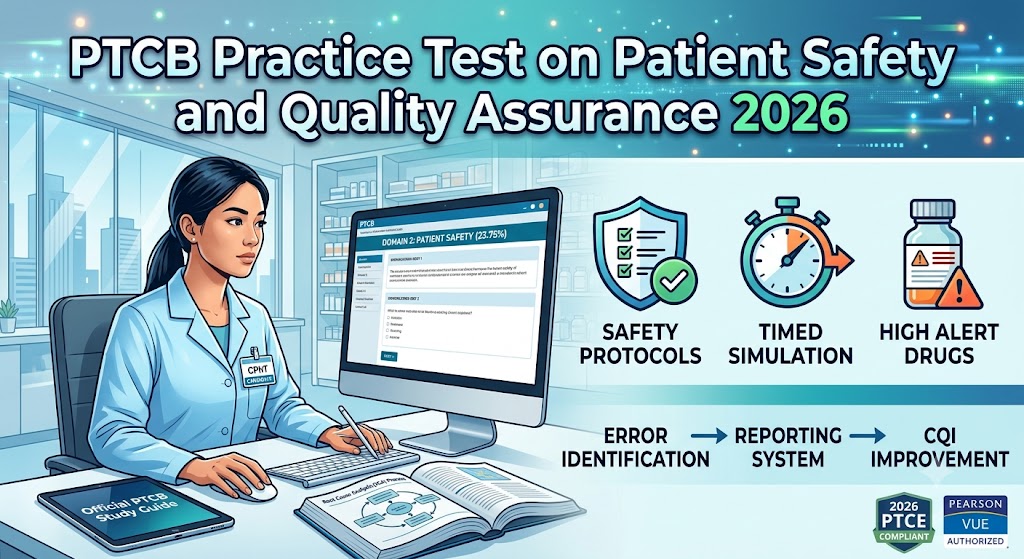
Additional Information
What the Course Entails and Exam Details
The actual [PTCB Practice Test on Patient Safety and Quality Assurance 2026] is not a separate exam, but a targeted component of the comprehensive 2026 PTCE content outline. For the 2026 exam, this domain is heavily prioritized, representing 23.75% of the total scored questions.
The core areas you must master for this domain include:
Risk Management: Identifying and managing high-alert and look-alike/sound-alike (LASA) medications.
Error Prevention Strategies: Utilizing strategies like Tall Man lettering, leading zeros, and barcoding.
Pharmacist Interventions: Recognizing when professional, immediate intervention by a pharmacist is required to prevent harm.
Event Reporting Systems: Familiarity with error and near-miss reporting tools like ISMP's MERP and MedWatch.
Infection Control: Adhering to USP <795> (non-sterile), <797> (sterile), and <800> (hazardous) compounding standards.
Quality Assurance Terminology: Understanding concepts like Continuous Quality Improvement (CQI), Root Cause Analysis (RCA), and Drug Utilization Review (DUR).
What to Expect in the Final Exam
While this practice test isolates the safety and quality domain, the full PTCE you must pass to gain certification follows a specific structure. The entire Pharmacy Technician Certification Exam (PTCE) is a computer-based exam consisting of 90 multiple-choice questions.
Crucially, 80 of these questions are scored, while 10 are unscored pilot questions randomly placed throughout the exam. You will not know which questions are which. The total time allowed for the exam is 2 hours, which includes a few minutes for a tutorial and a short post-exam survey.
The passing standard is set by a scaled score. PTCB uses a scaled score range of 1000 to 1600. A final passing scaled score of 1400 is required. Your final official score report will provide your performance breakdown across all four domains.
How to Study and Exam Centers
Effective preparation requires structured study, especially for a domain with so much nuance. Here are actionable study strategies:
Prioritize Official Tools: The most reliable practice comes from the PTCB itself. Utilize the Official PTCE Practice Bank® and, most importantly, the Pre-PTCE®.
Simulate Testing Conditions: Practice timed blocks. For this safety domain, dedicate study sessions where you answer 20–30 questions about LASA drugs and reporting systems under time pressure to build pacing.
Create Hot Sheets: Develop quick-reference sheets of Look-Alike/Sound-Alike drug pairings (e.g., buPROPion vs. busPIRone), high-alert medication lists, and standard infection control protocol requirements.
Regarding where and how to take the exam, PTCB partners with Pearson VUE for test administration. You can take the exam in person at a dedicated Pearson Professional Center or authorized test center. PTCB also offers an online proctored option, known as OnVUE, allowing you to take the exam from the comfort of your home.
Job Opportunities from the Course
Mastering the Patient Safety and Quality Assurance material is fundamental to every pharmacy environment. The CPhT certification, once earned, validates your expertise and unlocks numerous critical career paths, including:
Certified Pharmacy Technician (CPhT)
Lead Pharmacy Technician
Pharmacy Technician Supervisor/Manager
Clinical Pharmacy Technician
Inpatient/Hospital Pharmacy Technician
Outpatient/Retail Pharmacy Technician
Nuclear Pharmacy Technician
Specialty Pharmacy Technician
Pharmacy Technician Instructor
Frequently Asked Questions
Reviews
5.0
Based on 0 reviews
Leave a Review
No reviews yet. Be the first to review!