
PSAT Reading Practice Test 2022: New PSAT/NMSQT and PSAT 10
$69.00
- Buy to unlock unlimited access to all Quiz questions.
- After purchase you can print a PDF of the whole quiz at any point. The PDF will contain the questions and the correct answers.
About this Exam
The PSAT/NMSQT and PSAT 10 are pivotal standardized tests administered by the College Board to high school sophomores and juniors. The "Reading Practice Test 2022" specifically points to the paper-based format commonly used during that year, making it an excellent preparation resource for students aiming to build foundational skills and understand the general structure of these examinations. This exam is not merely about testing; it is designed to gauge your readiness for college-level reading and serves as essential practice for the SAT. More importantly for juniors, a strong performance on the PSAT/NMSQT can unlock entry into the prestigious National Merit Scholarship Program, providing significant financial opportunities and recognition. This study guide is crafted for ambitious students determined to maximize their potential in the Reading section.
Ready to test your knowledge?
Buy Now to Access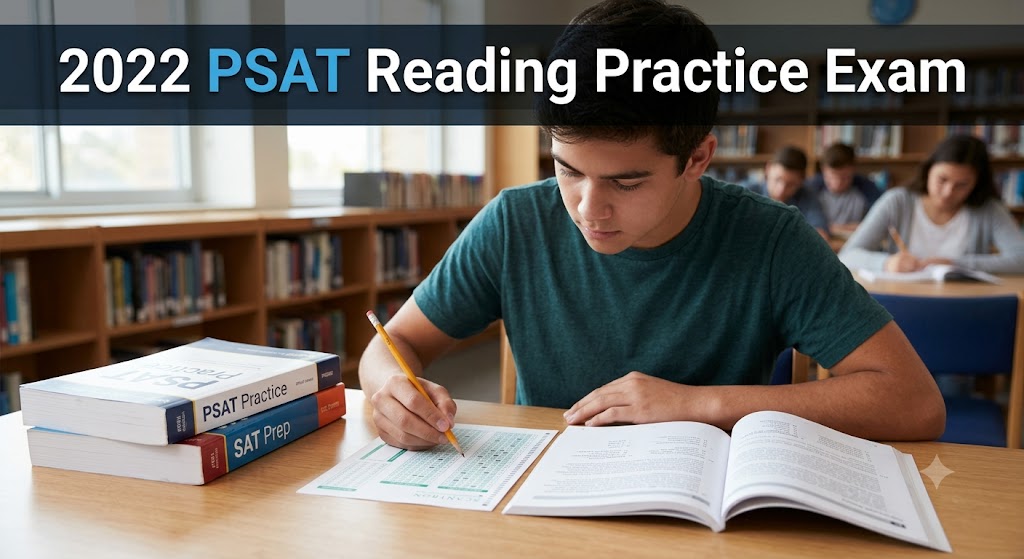
Additional Information
What the Course Entails and Exam Details
Preparing for the PSAT Reading section involves mastering
critical reading skills, rather than memorizing a fixed set of facts. This exam
tests your ability to read carefully, find evidence, analysis arguments, and
synthesis information. In the 2022 paper-based format, you must demonstrate
proficiency in:
- Evidence-Based
Reading: Locating explicit information and drawing reasonable
inferences. You will need to identify the specific words or phrases that
support an author's conclusion.
- Analysis
in Context: Understanding how an author's choice of words, tone, and
structure affects meaning and shapes their argument. This includes
understanding vocabulary in context.
- Information
and Ideas: Identifying main themes, summarizing passages, and
understanding relationships within a text.
- Synthesis
and Application: Comparing two related passages or analyzing
information presented in graphics like charts or tables alongside a text.
You must apply information to new situations.
The core subject matter for the reading passages is diverse,
drawing from classic and contemporary American and world literature, history
and social studies (like founding US documents or great global conversations),
and science. Students are evaluated on their ability to analyze and critique
these texts.
What to Expect in
the Final Exam
For the 2022 paper-based PSAT/NMSQT and PSAT 10, the Reading
section is one of multiple-choice questions. It is a separate timed segment.
You will have exactly 60 minutes to read several lengthy passages and
answer 47 questions. The entire test is multiple-choice, and you mark
your answers on a Scantron bubble sheet with a No. 2 pencil.
Unlike some other tests, there is no penalty for guessing
on the PSAT, meaning you should never leave a question blank; even an educated
guess can improve your score. It's crucial to manage your time effectively, as
you must stay within the Reading section for the entire duration and cannot
move to other parts of the exam. The proctors will provide specific
instructions and strictly monitor the timing and rules.
While there is no single "passing" score for the
PSAT, your section scores (on a scale from 160 to 760) are combined with other
sections to create a total score (320-1520). The scores on the PSAT/NMSQT are
used to calculate the National Merit Selection Index, which determines your
standing in that scholarship competition.
How to Study and Exam Centers
Preparation is the absolute key to success on any
standardized test. Effective study methods include:
- Official
Practice: Utilize free, high-quality official practice tests and study
materials available through the College Board, specifically for the
relevant paper format. Simulate real test conditions by timing yourself
strictly to build endurance and manage pacing.
- Active
Reading: Don't just read passively. Practice identifying main ideas,
analyzing evidence, and understanding the author's purpose in everything
you read. Annotate the passages to quickly locate key information.
- Analyze
Mistakes: After taking practice tests, meticulously review all
questions you missed. Understand why you chose the wrong answer and
what reasoning leads to the correct one. This is the most crucial
step for improvement.
- Build
Vocabulary in Context: Instead of memorizing isolated word lists, focus
on understanding complex vocabulary as it is used within a text. Practice
defining words based on the surrounding sentences.
Exam Centers: You cannot register for the PSAT/NMSQT
or PSAT 10 as an individual student. These exams are administered directly
by high schools. To take the test, you must communicate with your school
counselor to inquire about registration deadlines and the specific test dates,
which are often during the school day or on designated Saturdays. Students
whose schools do not administer the test should contact a neighboring high
school's counselor to see if they can accommodate an outside student. You will
need to bring your school ID, No. 2 pencils, and a required calculator (though
not typically needed for the Reading section).
Job Opportunities
from the Course
It is important to understand that the PSAT is an
intermediate academic assessment for high school students and is not a
professional certification that directly leads to job placement. No
employer will ask for your PSAT scores. Instead, a strong performance on this
exam is a powerful stepping stone that opens critical doors for higher
education, which in turn leads to a vast array of job opportunities. Your
dedication to this test builds key intellectual and critical thinking skills
that are foundational for long-term career success. A stellar outcome can
facilitate:
- Prestigious
College Admissions: Top scores and potential National Merit
recognition can make your college applications more competitive for highly
selective universities.
- Substantial
Scholarship Funding: The PSAT/NMSQT is the entry point for the
National Merit Scholarship Program, which can provide significant
financial aid. High scores can also attract other academic and
institutional scholarships.
- SAT
Preparation: Because it closely models the SAT, the PSAT is invaluable
preparation, helping you achieve a higher score on the subsequent required
exam for many college applications and degree programs.
By excelling here, you lay the groundwork for success in
higher education, which can unlock diverse and rewarding career paths, such as
becoming an Engineer, Doctor, Teacher, Software Developer, Accountant, Research
Scientist, Lawyer, Architect, Nurse, Marketing Manager, Psychologist, Financial
Analyst, Journalist, and many others. Your preparation now is an investment in
your future.
Frequently Asked Questions
Reviews
5.0
Based on 0 reviews
Leave a Review
No reviews yet. Be the first to review!