
Provincial PSC Practice Test & Exam Prep | Pakistan
$69.00
- Buy to unlock unlimited access to all Quiz questions.
- After purchase you can print a PDF of the whole quiz at any point. The PDF will contain the questions and the correct answers.
About this Exam
The Provincial Public Service Commission (PSC) exams in Pakistan are the gateway to prestigious and secure careers within the provincial government sectors. Each of Pakistan's four provinces—Punjab (PPSC), Sindh (SPSC), Khyber Pakhtunkhwa (KPSC), and Balochistan (BPSC)—as well as regions like Azad Jammu & Kashmir (AJKPSC), has its own commission. These commissions are constitutionally mandated to recruit suitable candidates for civil service posts ranging from Grade 16 to Grade 17 and above (BS-16, BS-17).
These exams are designed for talented, motivated, and qualified individuals who hold at least a Bachelor’s degree and are residents (domiciled) of their respective provinces. The certification represents not only a job but a lifetime opportunity to serve the public, shape provincial policies, and work within the administrative machinery of the country.
Ready to test your knowledge?
Buy Now to Access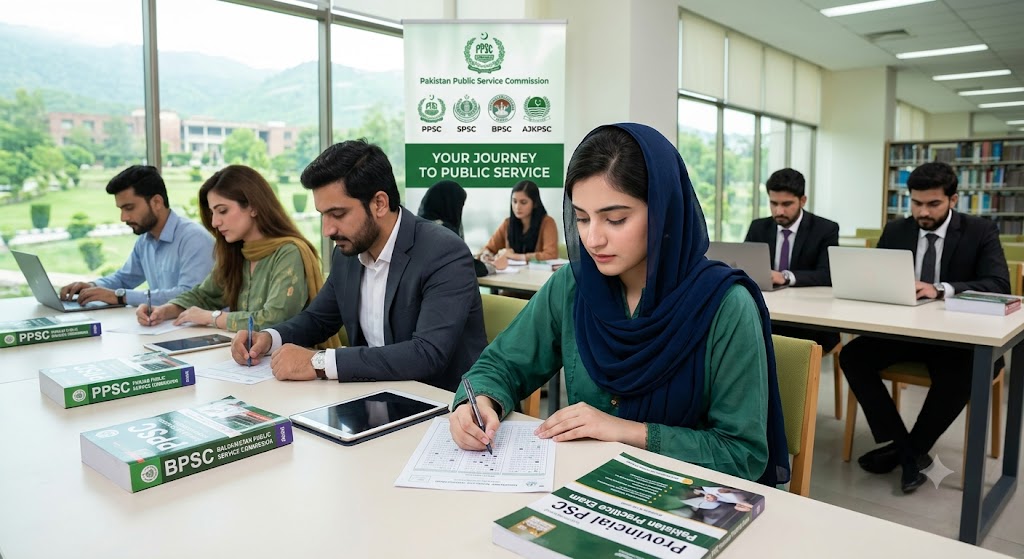
Additional Information
What the Course Entails and Exam Details
The term "course" is often used interchangeably
with the prescribed syllabus for a specific job post or combined competitive
examination. While each post can have a tailored syllabus, the core structure
remains broadly consistent across all Provincial PSCs in Pakistan.
For most general posts (like Naib Tehsildar, Assistant, or
specific officer grades), the exam is typically a "One Paper MCQ"
format. This paper tests a broad range of general subjects:
- General
Knowledge: World geography, international organizations, major events,
and basic science.
- Pakistan
Studies: The history, geography, economy, and political development of
Pakistan.
- Islamic
Studies: The fundamentals of Islam (Ethics/Civics for non-Muslim
candidates).
- Current
Affairs: National and international recent events, developments, and
issues.
- English:
Grammar, vocabulary, sentence structuring, and comprehension.
- Urdu/Regional
Language: General language proficiency and composition.
- Computer/IT
Skills: Basic computer knowledge and software applications.
For the most prestigious roles, such as the Provincial
Management Service (PMS) or Combined Competitive Examinations (CCE), the
"course" is far more rigorous. It entails a competitive multi-paper
written examination consisting of:
Compulsory Papers:
Typically 6 papers including English Essay, English (Précis & Composition),
Urdu, Islamic Studies/Ethics, Pakistan Studies, and General Knowledge.
Optional Papers: Candidates
select 3 papers from a diverse list of subjects such as Political Science,
History, Law, Economics, Public Administration, Sociology, and many specialized
fields, based on their educational background and interest.
What to Expect in
the Final Exam
The final phase of the examination process depends on the
type of recruitment.
For General Recruitment (One Paper MCQs), you can
expect a single question paper with around 100 Multiple Choice Questions to be
solved within a set time, usually 90 minutes.
For Combined Competitive Examinations (PMS/CCE), you
must expect a series of written tests spread over several days, consisting of
both objective (MCQ) and descriptive (essay-type, short, and long-answer)
questions. This tests not just knowledge, but analytical thinking, expression,
and depth of understanding.
Key things to remember for all exams:
- Time
Management: Time is a critical constraint. You must practice to answer
quickly and accurately.
- Negative
Marking: Most Provincial PSC exams apply negative marking for
incorrect answers in the MCQ section (e.g., deducting 0.25 marks for each
wrong answer).
- Passing
Marks: While the passing criteria for a written paper might be 40-50%,
the exam is highly competitive. To move to the next stage, you need to
score well above the passing mark to fall within the merit zone.
- The
Interview: Passing the written exam is only the first step. Shortlisted
candidates are called for a Psychological Test and a detailed Personality
Test/Viva Voce (Interview), which carries significant weight in the final
selection.
How to Study and
Exam Centers
How to Study and Prepare:
Success in Provincial PSC exams requires dedicated and
structured preparation:
Understand the Syllabus:
Carefully download and read the official syllabus for your specific post from
the relevant PSC website (e.g., www.ppsc.gop.pk). Do not study aimlessly; focus
only on the prescribed topics.
Use Past Papers: Past
papers are your best guide. Analyze them to understand the question pattern,
the weightage given to different topics, and the difficulty level.
Consult Standard Books:
For general papers, use recommended textbooks for Pakistan Studies, General
Knowledge (like Dogar’s or JWT), and English grammar. For PMS/CCE optional
subjects, use postgraduate-level textbooks.
Practice Mock Tests: Take
timed mock examinations, especially for the "One Paper" format, to
improve your speed and accuracy.
Stay Updated: For Current
Affairs and General Knowledge, read daily English newspapers (e.g., Dawn,
The News) and follow reputable news and knowledge-based portals.
Develop Writing Skills:
For descriptive papers, practice writing clear, coherent, and analytical essays
and answers on varied topics.
Exam Centers and How to Take the Exam:
- Online
Application: The entire process is now digitized. You must apply for
the exam through the official online portal of your province’s PSC.
- Physical
Centers: The exams are conducted physically (on paper) at official,
designated testing centers. These centers are typically set up in all
major divisional headquarters and cities across the province to ensure
accessibility.
- Roll
Number Slips: After successful application, the commission will issue
a Roll Number Slip online, specifying your exact examination center, date,
and time.
Job Opportunities from the Course
Successfully passing a Provincial PSC exam unlocks a wide
array of prestigious, stable, and rewarding career opportunities in the
provincial bureaucracy. While the exact job title depends on the specific
vacancy, this certification generally opens doors to Grade 16 (Gazetted) and
Grade 17 (Gazetted) posts in various provincial government departments.
A list of typical job opportunities includes, but is not
limited to:
- Assistant
Commissioner (Provincial Management Service - PMS)
- Section
Officer (Secretariat Service)
- Tehsildar
/ Naib Tehsildar (Revenue Department)
- Deputy
Superintendent of Police (DSP)
- Excise
& Taxation Officer
- Lecturer
/ Subject Specialist (Education Department)
- Medical
Officer (Health Department)
- Assistant
Engineer (Civil / Electrical / Mechanical)
- Assistant
Director (In departments like FIA, NAB, or Provincial Anti-Corruption)
- Accountant
/ Audit Officer
- Child
Protection Officer
Frequently Asked Questions
Reviews
5.0
Based on 0 reviews
Leave a Review
No reviews yet. Be the first to review!