
Program for the Assessment of Veterinary Education Equivalence (PAVE) Practice Exam
$69.00
- Buy to unlock unlimited access to all Quiz questions.
- After purchase you can print a PDF of the whole quiz at any point. The PDF will contain the questions and the correct answers.
About this Exam
The Program for the Assessment of Veterinary Education Equivalence (PAVE) is a vital pathway for veterinarians who have graduated from international, non-accredited veterinary programs and wish to practice in the United States and Canada. This comprehensive program is designed to evaluate and validate the educational equivalence of these foreign graduates, ensuring their knowledge and skills align with North American standards. Successfully completing PAVE enables candidates to enter the final clinical year at an AVMA-accredited veterinary school, ultimately leading to licensure and the opportunity to pursue a rewarding veterinary career.
Ready to test your knowledge?
Buy Now to Access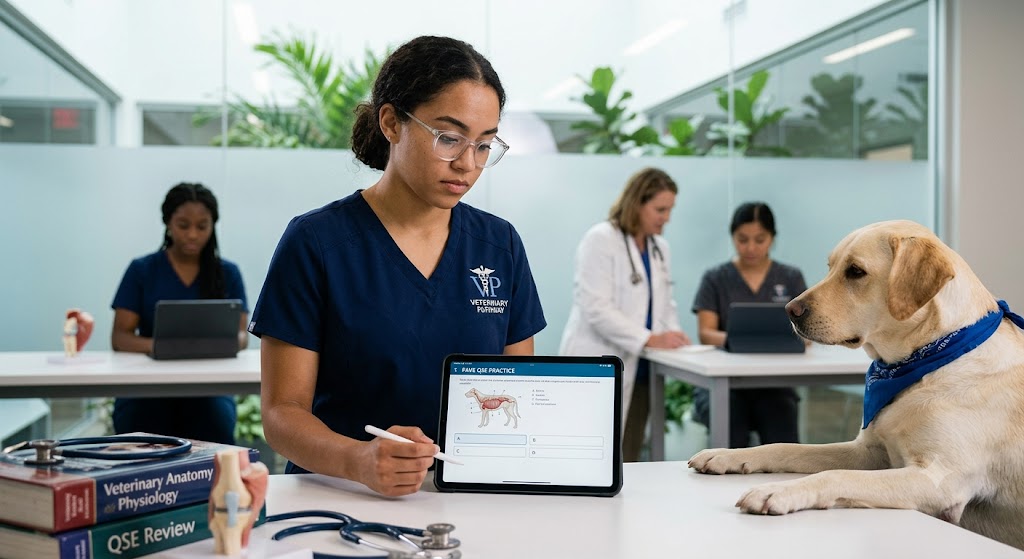
Additional Information
What the Course Entails and Exam Details
This PAVE pathway is not a structured "course" with a syllabus, but rather a multi-step assessment process. The fundamental academic component you must pass is the Qualifying Science Examination (QSE). The QSE is specifically developed to test your foundational and pre-clinical knowledge across the basic veterinary medical sciences. The topics covered are equivalent to the first three years of study at an AVMA-accredited veterinary college, including:
Veterinary Anatomy
Veterinary Physiology
Pharmacology
Pathology
Microbiology
Immunology
Parasitology
Toxicology
What to Expect in the Final Exam
The pivotal exam within the PAVE process is the Qualifying Science Examination (QSE). Here is a detailed breakdown of what you should expect on exam day:
Format: The QSE is a multiple-choice examination.
Number of Questions: It consists of 225 questions in total. This includes 200 "operational" questions, which are the ones that are scored, and 25 "pilot" questions, which are embedded to pre-test for future exams and do not count toward your final score.
Time Limit: You are given a single block of 220 minutes to complete the entire exam.
Passing Score Requirements: To pass the QSE, candidates must achieve a score of 450 or above.
Frequency: The exam is administered three times a year, typically in January, May, and September.
How to Study and Exam Centers
Preparation for the PAVE Qualifying Science Examination (QSE) demands a rigorous study schedule focused on core pre-clinical veterinary sciences. Here are actionable strategies:
AAVSB Resources: Your first point of reference should be the American Association of Veterinary State Boards (AAVSB) website. They provide an official QSE Content Outline, which details the percentage weight of each topic. A suggested bibliography is also available.
Textbook Review: Revisit key textbooks in fundamental subjects like veterinary anatomy, physiology, and pharmacology.
Practice Questions: While there is no official 'PAVE practice exam' provided by the AAVSB, you can find various commercial practice question banks or use NAVLE preparation materials to review your foundational knowledge, as the pre-clinical content is similar. Focus on understanding the why behind each correct answer.
Exam Delivery: The AAVSB partners with PSI to deliver the examination. You have two primary options when scheduling:
PSI In-Person Test Center: You can take the exam at a physical PSI computer-based testing facility, located throughout North America and internationally.
Live Remote Proctored (LRP) Exam: This allows you to take the exam from a secure location, such as your home or office, while being monitored live by a human proctor via your webcam and microphone.
Job Opportunities from the Course
Upon completion of the full Program for the Assessment of Veterinary Education Equivalence (PAVE)—which includes passing the Qualifying Science Examination (QSE), fulfilling English proficiency requirements, and completing an Evaluated Clinical Experience (ECE) at an AVMA-accredited school—you will receive a PAVE Certificate. This certificate confirms your educational equivalence and makes you eligible to apply for licensure in many US states and Canadian provinces. Successfully navigating this path unlocks the full spectrum of career opportunities available to a licensed veterinarian in North America, including:
Licensed Veterinarian (General Practice)
Small Animal Veterinarian
Mixed Animal Veterinarian
Large Animal Veterinarian (Equine, Food Animal)
Veterinary Specialist (Board Certification, e.g., Surgery, Oncology, Internal Medicine)
Veterinary Researcher
Veterinary Educator
Public Health Veterinarian
Veterinary Regulatory Officer
Veterinary Consultant
Frequently Asked Questions
Reviews
5.0
Based on 0 reviews
Leave a Review
No reviews yet. Be the first to review!