
Professional Cookery Exam Prep | United Kingdom
$69.00
- Buy to unlock unlimited access to all Quiz questions.
- After purchase you can print a PDF of the whole quiz at any point. The PDF will contain the questions and the correct answers.
About this Exam
The Professional Cookery qualifications in the United Kingdom are the cornerstone certifications for anyone serious about a career in the culinary arts.
Ready to test your knowledge?
Buy Now to Access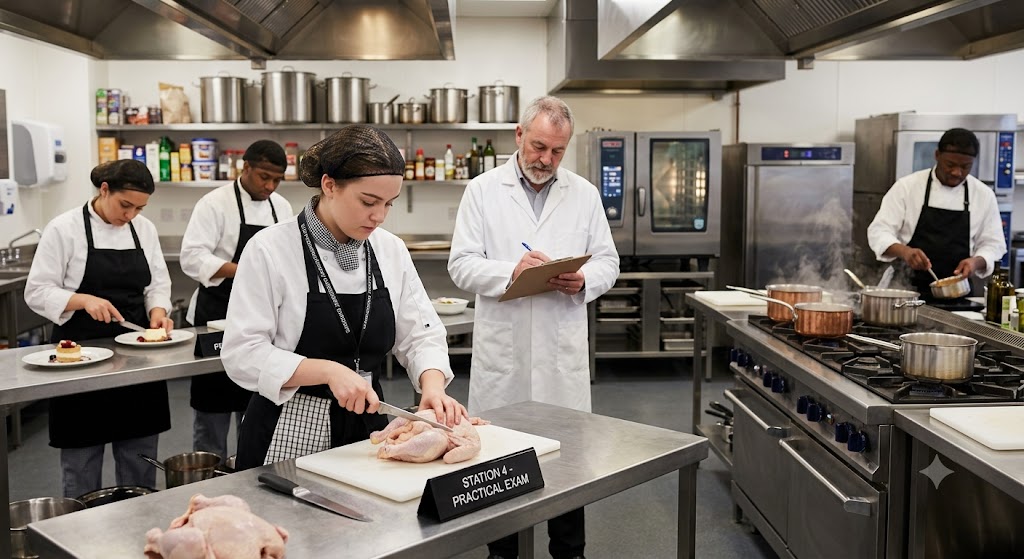
Additional Information
What the Course Entails and Exam Details
A Professional Cookery course is a blend of intense
practical training and theoretical understanding. Students don't just learn how
to cook; they learn the science and business behind the food. Depending on the
level (typically Level 1, 2, or 3), the syllabus covers a comprehensive range
of culinary skills.
Core topics include:
- Food
Safety and Hygiene: Mastery of HACCP principles, preventing
cross-contamination, and understanding temperature control is
non-negotiable.
- Professional
Kitchen Operations: Health and safety regulations, equipment
maintenance, and working effectively as a team under pressure.
- Culinary
Skills and Techniques: Expert knife skills are foundational. Students
learn preparation methods for complex stocks, sauces, soups, and
dressings. They must master the various cooking methods—including
roasting, poaching, steaming, frying, and braising—for meat, poultry,
fish, shellfish, vegetables, and vegetarian dishes.
- Pastry
and Baking: Creating doughs, pastries, sponges, and hot and cold
desserts is a significant component.
- Advanced
Level Skills: For higher qualifications, the syllabus extends to menu
planning, costing, resource management, dietary requirements, allergen
awareness, and supervisory leadership within the kitchen hierarchy.
What to Expect in
the Final Exam
The final assessment for a UK Professional Cookery
qualification is robust and double-pronged, ensuring you are capable both
mentally and physically in a high-stakes environment.
You should expect the following components:
- Continuous
Practical Assessment: This is the most critical part. Over the
duration of your course, you will be observed by qualified assessors while
working in a professional college kitchen or a licensed workspace. You
must demonstrate consistent proficiency across a range of tasks, from
jointing a chicken to creating a complex sauce, all while maintaining
strict hygiene standards. Your performance is recorded in a portfolio of
evidence.
- End-Point
Assessment (Practical): Some levels include a final,
"synoptic" practical exam. Under a time limit (which can range
from 3 to 6 hours), you will be given a set menu to prepare from scratch,
demonstrating your ability to plan, work efficiently, and produce dishes
that meet exact professional standards for taste, texture, and
presentation.
- Theory
Examination: This is usually a formal multiple-choice exam (e.g.,
40–60 questions) taken in a controlled environment. It tests your
underpinning knowledge of food safety legislation, costing, nutrition, and
cooking techniques.
- Passing
Requirements: While specific scores can vary by the awarding body
(such as City & Guilds or CTH), standard pass marks are typically
around 60–70% for theory. Practical assessments are often graded on a
Pass, Merit, or Distinction basis, demanding 100?herence to critical
food safety practices.
How to Study and Exam Centers
Preparation is the key to confidence. While your course
provides the training, your independent study will ensure you excel.
- Master
the Practical: Repeatedly practice your knife skills. Focus on speed
and accuracy. Recreate recipes from your course until the techniques are
instinctive. Practice timing yourself to mimic the pressure of a final
assessment.
- Portfolio
Building: Your portfolio is your evidence base. Document every dish
you make, take photos, and note feedback. Review it regularly to identify
weaknesses.
- Theory
Revision: Use the official textbooks provided by your awarding body.
Pay special attention to legislation, safety protocols, and costing
formulas. Practice with past multiple-choice papers to understand the
question formatting.
- Mock
Exams: Work with your tutors to arrange mock synoptic practical
assessments. The feedback from a trial run is invaluable.
- Exam
Centers: Practical assessments and synoptic exams take place within
the accredited Further Education Colleges or private Training
Providers where you are enrolled (such as the View Training Restaurant
at Richmond Upon Thames College). These facilities are audited to ensure
they meet the national standards required for a professional kitchen
assessment environment. Some theory exams can be taken online through
secure college portals or at dedicated testing centers approved by the
awarding body.
Job Opportunities
from the Course
A Professional Cookery qualification is not just a
certificate; it’s a global passport that unlocks career progression in one of
the UK’s most dynamic industries.
Completing the course provides direct access to job titles
such as:
- Commis
Chef
- Demi
Chef de Partie
- Chef
de Partie
- Sous
Chef (usually with Level 3 + experience)
- Head
Chef (with significant experience)
- Pastry
Chef
- Development
Chef
- Catering
Manager
- Private
Chef
- Menu
Consultant
- Culinary
Instructor
Frequently Asked Questions
Reviews
5.0
Based on 0 reviews
Leave a Review
No reviews yet. Be the first to review!