
Prison Service Practice Test & Exam Prep | Ireland
$69.00
- Buy to unlock unlimited access to all Quiz questions.
- After purchase you can print a PDF of the whole quiz at any point. The PDF will contain the questions and the correct answers.
About this Exam
The Irish Prison Service (IPS) offers a challenging yet deeply rewarding career path as a Recruit Prison Officer (RPO). This role is fundamental to the Irish justice system, combining the responsibility for the safe, secure, and humane custody of individuals with a powerful rehabilitative focus. The IPS seeks individuals with high integrity, strong communication skills, resilience, and the capacity to relate to a diverse range of people, ultimately acting as positive role models. The competitive selection process is designed to identify candidates who possess these specific competencies, starting with an initial series of assessment tests. This guide is your essential preparation tool for the first critical hurdle: the online aptitude tests, often referred to as the Irish Prison Service Practice Exam.
Ready to test your knowledge?
Buy Now to Access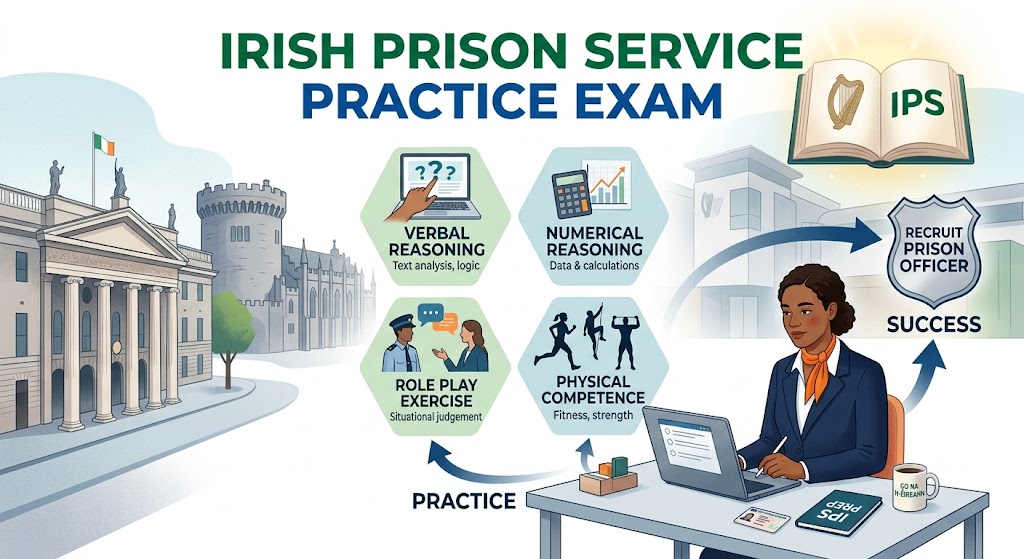
Additional Information
What the Course
Entails and Exam Details
This "course" isn't a single class but a
multi-stage recruitment journey. Your first, and most crucial, preparation
focus is Stage 1, which consists of a series of online assessments. These are
designed to evaluate the core intellectual abilities and personal attributes
required of a Recruit Prison Officer. The official syllabus for these tests
covers three main areas:
- Verbal
Reasoning: This test evaluates your ability to understand, interpret,
and logically analyze written information. You will be presented with
short passages of text, followed by statements that you must classify as
'True,' 'False,' or 'Cannot Say' based solely on the provided text.
- Numerical
Reasoning: This section measures your proficiency in interpreting and
analyzing numerical data, including charts, graphs, and tables. It
assesses your ability to perform basic mathematical calculations
(addition, subtraction, multiplication, division, percentages, ratios) and
apply logical deductions to solve quantitative problems under time
pressure.
- Assessment
Questionnaire: Also known as a Situational Judgement Test (SJT) or Job
Simulation, this questionnaire assesses your behavioral tendencies and
judgement in scenarios that reflect the realities of working as a prison
officer. It evaluates key competencies such as decision-making,
resilience, interpersonal skills, and integrity. There are no right or
wrong answers, but your responses determine how well you align with the
expected profile.
What to Expect in the Final Exam
For many candidates, the Stage 1 assessments are the most
nerve-wracking, as they serve as a rigorous shortlisting tool with the highest
failure rate in the process. Here is a clear breakdown of what you can expect
during the official 'exam' phase:
- Format:
The Verbal Reasoning and Numerical Reasoning tests are standard
multiple-choice assessments. The Assessment Questionnaire will require you
to rank potential actions or indicate your level of agreement with various
statements.
- Delivery:
These are online, remotely proctored (supervised) tests. You will take
them on your own computer (a laptop or PC is recommended) within a
specific time window.
- Time
Limits: Each section has a strict time limit, which is part of the
challenge. The Verbal Reasoning and Numerical Reasoning parts are
typically very fast-paced, testing not just your accuracy but also your
speed under pressure. For example, you might have 15-20 minutes to answer
20-25 questions.
- Passing
Score: There is no single, fixed universal passing score. Instead, candidates
are ranked based on their performance across all three tests. Only those
with the highest combined scores are invited to progress to Stage 2. This
makes it a relative competition, not a binary pass/fail.
- Rules:
You must have a working webcam and microphone. You will likely be required
to perform a 'room scan' to ensure you are alone and do not have
unauthorized aids. It is crucial to read the familiarization material and
candidate information booklet provided by the Public Appointments Service
(PAS) thoroughly before you begin.
How to Study and
Exam Centers
Preparation is the absolute key to success. You are not just
testing knowledge; you are testing a skillset and a way of thinking. Here are
actionable strategies:
- Actionable
Study Strategies:
- Master
the Format: Use practice materials that mirror the structure and
style of the actual tests. Familiarize yourself with how a verbal
reasoning question works: learn to distinguish between 'False' and
'Cannot Say.'
- Timed
Practice is Essential: Your biggest enemy is the clock. Take
full-length, timed practice tests to build your speed. Analyze where you
lose time and work to improve your efficiency without sacrificing
accuracy.
- Review
Fundamentals: For Numerical Reasoning, don't assume you remember
basic math. Brush up on percentage changes, currency conversions, and
interpreting complex tables.
- Understand
the Role: For the Assessment Questionnaire, research the core values
of the Irish Prison Service and the key competencies of a Recruit Prison
Officer (e.g., caring, non-judgemental, direct, assertive, effective
communicator). Answer the questionnaire honestly but keep the desired
professional behaviors in mind.
- Use
Official Familiarization Material: The Public Appointments Service
(PAS) provides a detailed information booklet and practice examples for
every recruitment campaign. These are the single most important resource
you can use.
- Exam
Centers:
- Location:
For the initial Stage 1 tests, there are no physical testing centers
like Pearson VUE. The tests are completed online, entirely at a
location of your choice with a stable internet connection and necessary
technology. You will access them through your candidate account on the
official Irish public sector recruitment portal, www.publicjobs.ie.
- Future
Stages: If you are successful in Stage 1 and are placed high enough
on the order of merit, future stages such as the Interview and Role Play
exercise are also currently conducted remotely, via video conferencing
platforms like Zoom. Physical components (Medical, Physical Competence
Test) will be held at specified locations within Ireland, detailed in
invitations to those stages.
Job Opportunities from the Course
Successful completion of the Irish Prison Service
recruitment process unlocks a clear career path with numerous opportunities for
progression and specialisation.
- Recruit
Prison Officer (RPO): This is the mandatory entry level. It is a vital
frontline role. During your first three years, which include your
probation period, you will complete the comprehensive 2-year Higher
Certificate in Custodial Care (HCCC), accredited by South East
Technological University (SETU). This is a paid apprenticeship program
that blends practical training with academic learning.
- Established
Prison Officer: After successfully completing the HCCC, your
probation, and three years of service, you are appointed as an established
Prison Officer, a permanent civil service position. This offers excellent
job security and benefits.
- Specialist
Roles and Progression: From a foundation as an established officer, you
can advance through promotion to ranks like Assistant Principal Officer
and Principal Officer. The Irish Prison Service also offers specialist
career paths, including:
- Work
Training Officer (instructing prisoners in trades and skills)
- Healthcare
Officer
- Canine
Unit
- Operational
Support Units
- Court
Escort Roles
- Headquarters
and Policy Development positions.
Becoming a Recruit Prison Officer with the Irish Prison
Service is more than a job; it is a commitment to public service and positive
change. With the right preparation, you can unlock a fulfilling and lifelong
career.
Frequently Asked Questions
Reviews
5.0
Based on 0 reviews
Leave a Review
No reviews yet. Be the first to review!