
PRC Engineering Practice Test & Exam Prep | Philippines
$69.00
- Buy to unlock unlimited access to all Quiz questions.
- After purchase you can print a PDF of the whole quiz at any point. The PDF will contain the questions and the correct answers.
About this Exam
The PRC Engineering Board Exam, officially known as the Licensure Examination for Engineers, is a critical step for graduates to legally practice engineering in the Philippines. Administered by the Professional Regulation Commission (PRC), this comprehensive assessment is designed to verify that candidates possess the necessary technical knowledge, skills, and ethical understanding required of a professional engineer. It is an indispensable certification for Filipino engineering graduates seeking a rewarding and impactful career in various fields.
Ready to test your knowledge?
Buy Now to Access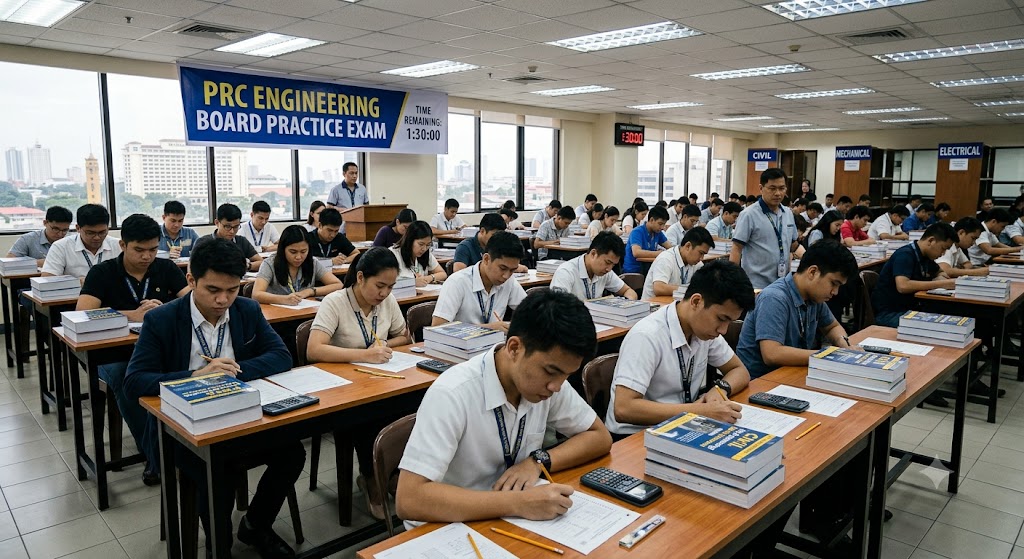
Additional Information
What the Course Entails and Exam Details
The exam details and specific course topics vary based on
the engineering discipline, but all share a foundation in mathematical and
scientific principles. The core topics generally cover essential areas such as
Advanced Mathematics (Calculus, Differential Equations, Probability and
Statistics), Engineering Sciences and Allied Subjects (such as Mechanics,
Thermodynamics, Materials Science, and Economics), and specialized subjects
unique to each field. For example, Civil Engineering focuses on Structural
Design and Geotechnical Engineering, while Mechanical Engineering centers on
Power Plant Design and Machine Elements. Each field has a specific Table of
Specifications (TOS) that outlines the percentage weight and list of topics.
What to Expect in the Final Exam
The PRC Engineering Licensure Exam is notoriously rigorous
and is a written, multiple-choice, pen-and-paper examination. It typically
spans two days, with several distinct subjects or sections each day. Candidates
must obtain a general weighted average (GWA) of at least 70%, with no grade
lower than 50% in any individual subject, to pass. The schedule, allowed
non-programmable calculator models, and strict dress code and examination rules
are strictly enforced by the PRC, and any violation can result in
disqualification.
How to Study and Exam Centers
To succeed, consistent and strategic preparation is vital.
Most candidates enroll in dedicated review centers that provide structured
programs and mock exams, which are highly effective for identifying weak areas.
Utilize official PRC pre-board exams and past licensure question banks to
become familiar with the question types and time pressure. Create a realistic
study schedule that allows for in-depth review and ample rest. The PRC does not
administer this exam through online portals or international testing services
like Pearson VUE. Instead, the exams are held in various physical testing
centers across the Philippines, located in major cities such as Manila, Cebu,
Davao, Baguio, and Iloilo. Candidates must register and choose their preferred
testing location through the PRC's online system, LERIS, during the application
period.
Job Opportunities
from the Course
Passing the PRC Engineering Board Exam opens the door to a
wide array of career paths and is often a mandatory requirement for key
positions in both the public and private sectors. Licensed engineers in the
Philippines can embark on roles including, but not limited to: Project
Engineer, Construction Manager, Structural Engineer, Mechanical Design
Engineer, Manufacturing Engineer, Power Systems Engineer, Electronics and
Communications Engineer, Chemical Process Engineer, Mining Engineer, Sanitary
Engineer, and Geodetic Engineer. With a professional license, individuals gain
credibility, qualify for specialized projects, and significantly increase their
earning potential and career advancement opportunities.
Frequently Asked Questions
Reviews
5.0
Based on 0 reviews
Leave a Review
No reviews yet. Be the first to review!