
Postal Police Exam Practice Test (USPS 630E/630) 2024
$69.00
- Buy to unlock unlimited access to all Quiz questions.
- After purchase you can print a PDF of the whole quiz at any point. The PDF will contain the questions and the correct answers.
About this Exam
The Postal Police Exam (USPS 630E/630) is the primary cognitive assessment for candidates aspiring to become a Postal Police Officer (PPO) in the United States Postal Inspection Service (USPIS). This specialized law enforcement role focuses on protecting U.S. Postal Service employees, facilities, property, and the U.S. Mail.
The exam is designed to measure the key cognitive abilities and situational judgment required to perform police duties effectively in a federal environment. If you are a dedicated individual seeking a career path that combines public service with federal law enforcement authority, this is the essential first step in your journey. Successful completion of this test demonstrates that you have the mental aptitude to enter the rigorous Postal Police Officer Basic Training program.
Ready to test your knowledge?
Buy Now to Access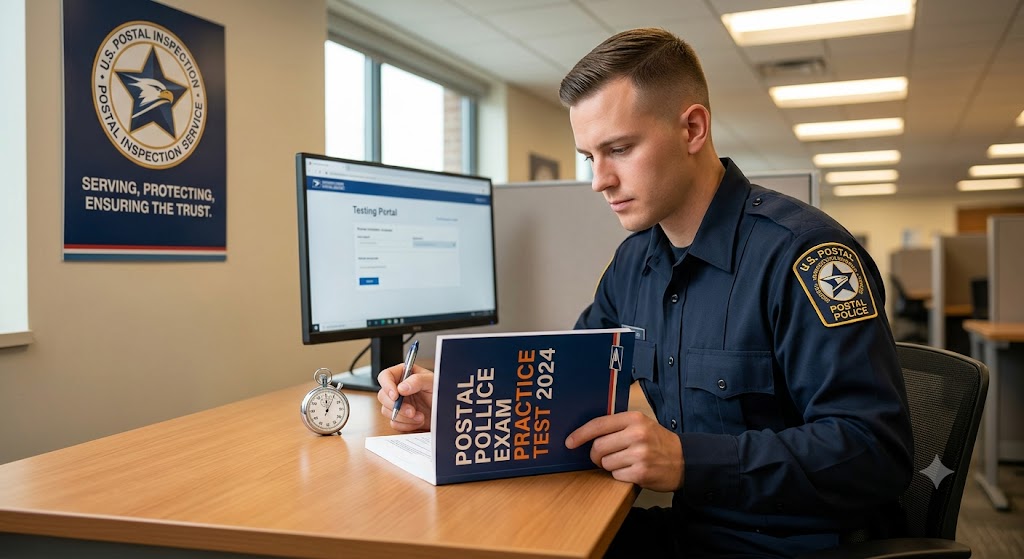
Additional Information
What the Course
Entails and Exam Details
This examination is not a course with a long syllabus; it is
a point-in-time assessment of your innate and developed cognitive skills. The
USPIS utilizes the Exam 630E/630 to screen for aptitude in specific domains
that are critical for success as a PPO. While you don’t need prior law
enforcement knowledge, you must demonstrate proficiency in the following core
areas:
Situational Judgment: This section tests your ability
to analyze critical, real-world scenarios that a Postal Police Officer might
encounter and select the most appropriate and effective course of action from a
list of options. It measures problem-solving and ethical decision-making.
Observation and Memory: PPOs must have sharp recall.
This part of the exam assesses your ability to view an image or witness a
detailed event briefly and then answer questions accurately about specific
details, people, and objects.
Reading Comprehension: You will read technical
information, policies, or legal snippets and must demonstrate the ability to
understand, interpret, and extract precise information.
Mathematics and Logical Reasoning: This section
covers numerical problems and sequences designed to evaluate your mental
alertness, basic arithmetic skills, and ability to follow logical steps to
solve a problem.
Writing Skills and Language Proficiency: You must
show competence in standard English grammar, punctuation, and usage, as PPOs
are required to write clear, concise, and accurate official reports.
What to Expect in the Final Exam
When you sit for the final exam, you can expect a
computer-based, multiple-choice format. It is a highly structured and timed
environment. To manage expectations effectively, prepare for the following:
Exam Format: The test consists entirely of
multiple-choice questions across the domains listed above. There is no essay or
oral component at this initial stage.
Time Limits: You will be given a specific, strict
time limit for the entire exam. Each section may also have its own internal
time constraints, requiring you to work efficiently without sacrificing
accuracy. Expect the entire testing process to last approximately 1.5 to 2
hours.
Passing Score: USPIS typically uses a competitive
ranking system. While a 'passing' score is established (often a raw score of
70), your final percentile rank is what determines if you advance to the next
stage of the hiring process. The higher your score, the better your chances.
Rules: The exam is strictly proctored. You are not
allowed to use any external aids, including calculators, smartphones, or
personal notes. You must bring valid government-issued identification to the
testing center.
How to Study and Exam Centers
The key to success on the Postal Police Exam is rigorous,
targeted practice that builds both speed and accuracy. Do not leave your
preparation to the last minute. We recommend the following actionable study
strategies:
Utilize Official USPS Resources: Your primary
resource should always be the official USPIS "Exam Information Package
(EIP)," which is typically made available to applicants who are invited to
test. This package includes the most accurate information on the test structure
and sample questions.
Take Multiple Practice Tests: Time yourself while
taking high-quality practice tests. This is critical for adapting to the speed
of the actual exam and identifying your weak areas. Focus on understanding the
logic behind correct answers, rather than just memorizing them.
Train Specific Skills: Practice active observation by
viewing detailed images and recalling facts later. Work on basic arithmetic
problems without a calculator and read complex passages to summarize them
efficiently.
Exam Centers: The Postal Police Exam is a proctored
federal examination. When you are invited to take the test, you will select a
time and location through an authorized proctoring service. This is commonly a
physical testing facility such as those managed by Pearson VUE or Prometric,
located in major cities throughout the United States. In some limited cases, or
depending on current USPIS policy, specific initial assessments may be offered
in an online, proctored format, but the official Exam 630E is traditionally
held at secure physical centers.
Job Opportunities
from the Course
A successful score on the Postal Police Exam 630E/630 is the
primary gateway to a rewarding and stable federal career. Candidates who
advance past this stage, and complete the full hiring process and training, can
unlock several key career paths within the U.S. Postal Inspection Service:
- Postal
Police Officer (PPO)
- Pathway
to Postal Police specialized units (e.g., K-9 Officer, specialized
protection detail - internal opportunities)
- Valuable
law enforcement experience required to apply to become a Federal Postal
Inspector (which requires separate, advanced entry-level testing).
Start your preparation today. With dedicated study and a
strategic approach, you can master the Postal Police Exam and move closer to a
prestigious federal law enforcement career.
Error!
Filename not specified.
Frequently Asked Questions
Reviews
5.0
Based on 0 reviews
Leave a Review
No reviews yet. Be the first to review!