
Police Recruitment Practice Test & Exam Prep | Kenya
$69.00
- Buy to unlock unlimited access to all Quiz questions.
- After purchase you can print a PDF of the whole quiz at any point. The PDF will contain the questions and the correct answers.
About this Exam
The Kenya Police Service Recruitment process is a rigorous national exercise designed to identify and select the most qualified, capable, and committed Kenyan citizens to join the National Police Service (NPS). This annual or bi-annual initiative is not merely an "exam" but a multi-stage selection course aimed at vetting applicants for their physical stamina, mental aptitude, medical fitness, and moral integrity. The recruitment is specifically designed for young men and women who possess a minimum grade of D+ in their Kenya Certificate of Secondary Education (KCSE), with a similar grade in either English or Kiswahili, and who are between the ages of 18 and 28. Successfully navigating this process is the gateway to a challenging but rewarding career in law enforcement, dedicated to maintaining law and order, protecting life and property, and preventing and detecting crime. This practice test guide is your comprehensive roadmap to prepare effectively for every facet of this life-changing selection
Ready to test your knowledge?
Buy Now to Access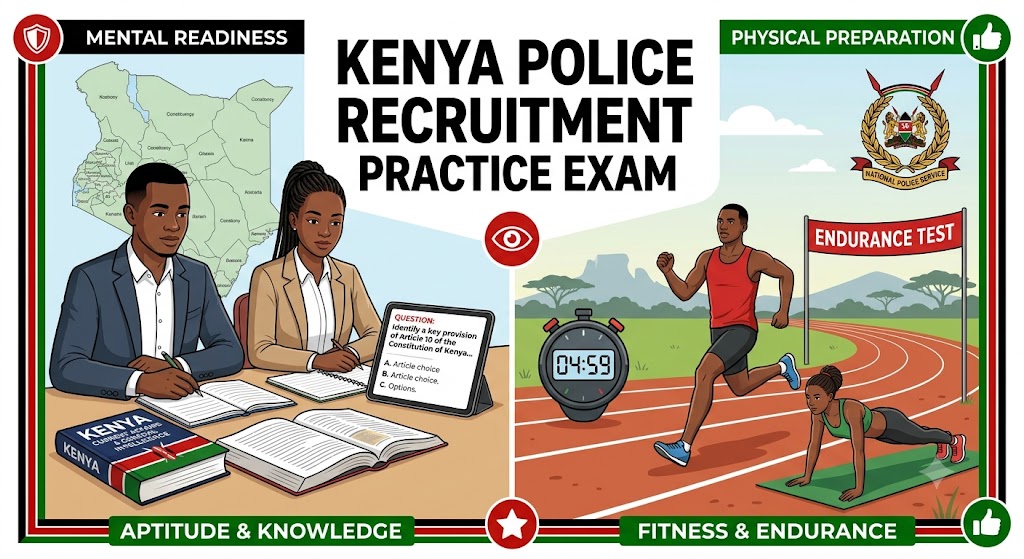
Additional Information
What the Course
Entails and Exam Details
The Kenya Police Recruitment "course" refers to
the entire selection process, which is comprehensive and demanding. It is not
an academic syllabus, but a practical and aptitude assessment. The details
include:
- Physical
Fitness Assessment: The initial and most visibly competitive stage. Candidates
must meet minimum height and weight standards. Men must be at least 5 feet
8 inches, and women 5 feet 4 inches, although these can vary slightly by
recruitment cycle.
- Medical
Examination: A detailed health check to ensure candidates are free
from any underlying conditions or physical impairments that would hinder
their ability to perform demanding police duties.
- Document
Verification: Rigorous verification of original academic certificates
(KCSE), Kenyan National Identity Card, Birth Certificate, and any
additional testimonials, such as NYS discharge certificates.
- Aptitude
and Written Test: Often included to assess general intelligence,
logic, and basic language proficiency (English and Kiswahili). Topics can
include current affairs in Kenya, basic mathematics, reasoning, and essay
writing.
- Interview:
A final assessment where recruitment panels evaluate a candidate's
personality, communication skills, confidence, and understanding of the
role of a police officer in Kenya.
What to Expect in the Final Exam
While there isn't a single traditional "final
exam" with a clock ticking in a massive hall, the final day of
recruitment, or the combined interview phase, is the cumulative point of the
selection process. Here is what you must expect and prepare for:
- Phased
Eliminations: The recruitment is a sequential elimination process.
Failing the height check, the running test, or the medical exam means
immediate disqualification. There is no overall "passing score"
that you can achieve by averaging; you must "pass" every stage.
- Physical
Testing Day: You will experience intense competitive physical tests,
usually in a public stadium or training ground. This will include short
and long-distance running (e.g., 5km for men, 3km for women, and sprints),
push-ups, sit-ups, and chin-ups (for men). You will be observed for
endurance and speed.
- Medical
Review: Expect a non-invasive physical examination, blood pressure
checks, vision, and hearing tests. Certain conditions are grounds for
disqualification.
- Structured
Interview: You will face a panel of senior police officers and public
service commissioners. Expect questions on why you want to join, your
understanding of the Kenyan Constitution Chapter Six (on integrity), how
you would handle ethical dilemmas, and current events in Kenya. Be
prepared to speak confidently and clearly in both English and Kiswahili.
- Discipline
and Conduct: Your conduct throughout the recruitment days is being
assessed. Disobedience, failure to follow instructions, or any attempt at
bribery or canvassing will lead to immediate disqualification and possible
prosecution.
How to Study and Exam Centers
Effective preparation for Kenya Police Recruitment requires
a dual focus on physical conditioning and mental readiness. The testing does
not take place online or in standard centers like Pearson VUE.
Actionable Study Strategies:
- Physical
Fitness Training (6–12 months prior): This is non-negotiable. Develop
a consistent routine. Focus on cardiovascular endurance by running 5-10km
multiple times a week. Build upper body strength with daily push-ups,
chin-ups, and core exercises. Train in an environment similar to Kenya’s
climate (heat and altitude). Track your progress to ensure you can
comfortably meet the typical time limits for specified distances.
- Mental
Aptitude and General Knowledge: Revise KCSE English and Kiswahili
grammar. Read daily Kenyan newspapers to stay updated on current
political, social, and economic affairs. Study the basic structure of the
Kenyan Government and the National Police Service. Practice basic mental
arithmetic and logical reasoning puzzles. There are many unofficial online
"aptitude test" generators that can help.
- Mock
Interviews: Practice answering common interview questions in front of
a mirror or with friends. Focus on clarity, eye contact, and professional
body language. Research the core values of the Kenya Police Service.
Exam Centers:
- Designated
Constituency Recruitment Centers: The Kenya Police Recruitment does not
happen in traditional schools or online portals. Instead, the National
Police Service Commission (NPSC) publishes a list of official recruitment
centers, usually organized by constituency or sub-county. These are
typically public sports grounds, stadiums, or government facilities within
each respective locality. You must present yourself physically at
your designated home constituency center on the specific date advertised,
with all original documents in hand. The timing is usually from 8:00 am to
5:00 pm.
Job Opportunities
from the Course
Upon successful completion of the nine-month rigorous
training at a police training college (e.g., Kiganjo for Kenya Police, or
Administration Police Leadership and Guards College in Embakasi), recruits are
officially absorbed into the National Police Service and bonded to serve for at
least ten years. The entry-level role is a direct gateway to diverse career
paths and significant progression.
Specific job titles and career paths this selection unlocks:
- Police
Constable (Entry Level): The fundamental rank, involving general
duties, patrol, and community policing.
- Detective
(within the Directorate of Criminal Investigations, DCI): Specializing
in crime scene investigation, forensics, and intelligence gathering.
- Traffic
Officer: Enforcing traffic laws, managing road safety, and
investigating accidents.
- Specialized
Units: Opportunities to join specialized formations such as the
General Service Unit (GSU), Anti-Stock Theft Unit (ASTU), or the Rapid
Deployment Unit (RDU).
- NPS
Career Progression Ranks:
- Corporal
- Sergeant
- Senior
Sergeant
- Inspector
- Chief
Inspector
- Superintendent
- Senior
Superintendent
- Assistant
Commissioner of Police
- Senior
Assistant Commissioner of Police
- Commissioner
of Police
- Assistant
Inspector General
- Senior
Assistant Inspector General
- Deputy
Inspector General
- Inspector
General of Police (Highest Rank)
This multi-stage "exam" is the foundation for an
impactful, secure, and progressively influential career dedicated to the
service of the Kenyan people.
Frequently Asked Questions
Reviews
5.0
Based on 0 reviews
Leave a Review
No reviews yet. Be the first to review!