
PiCAT Mechanical Comprehension Practice Test 2026
$69.00
- Buy to unlock unlimited access to all Quiz questions.
- After purchase you can print a PDF of the whole quiz at any point. The PDF will contain the questions and the correct answers.
About this Exam
The PiCAT Mechanical Comprehension Practice Test 2026 is an essential diagnostic tool designed for individuals preparing for the PiCAT (Pending Internet Computerized Adaptive Test), specifically the Mechanical Comprehension (MC) subtest.
The PiCAT is an unproctored version of the ASVAB (Armed Services Vocational Aptitude Battery) often taken at home, and the MC section measures your understanding of mechanical principles and your ability to solve problems involving simple machines, basic physics, and mechanical systems.
This practice exam is designed for potential military recruits seeking to validate their mechanics knowledge, improve their AFQT (Armed Forces Qualification Test) score, and secure specialized military occupational specialties (MOS) or ratings that require mechanical aptitude.
Ready to test your knowledge?
Buy Now to Access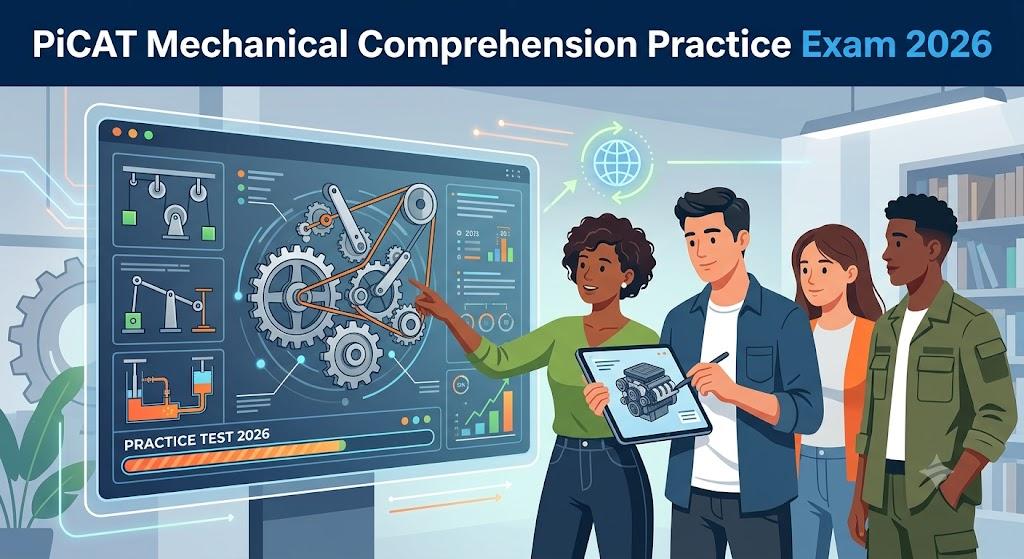
Additional Information
What the Course Entails and Exam Details
This comprehensive practice course covers the fundamental concepts required to excel in the mechanical domain.
The course syllabus includes detailed modules and practice questions focusing on:
Simple Machines: Understanding the principles and calculations for levers, pulleys, gears, inclined planes, wedges, and screws.
Basic Mechanics: Covering concepts like force, work, energy, power, velocity, and acceleration.
Fluids and Hydraulics: Principles of fluid pressure, Pascal's law, and hydraulic systems.
Thermodynamics and Heat: Basic understanding of heat transfer (conduction, convection, radiation) and thermal expansion.
Structural Support and Materials: Concepts of tension, compression, shear, and basic structural design.
What to Expect in the Final Exam
While the full PiCAT is unproctored and computerized adaptive, this practice exam simulates the format and difficulty level of the Mechanical Comprehension subtest.
The actual PiCAT MC subtest typically consists of approximately 16 to 20 multiple-choice questions.
Because it is an adaptive test, the difficulty level of questions will adjust based on whether your previous answers were correct or incorrect.
There is no strict passing score for the MC section alone; however, your score directly impacts your line scores for specific military jobs and contributes to your overall AFQT score.
You should aim to complete the subtest within a time limit that usually averages less than a minute per question, encouraging both speed and accuracy.
How to Study and Exam Centers
Effective preparation is key to optimizing your performance on the PiCAT Mechanical Comprehension subtest.
Utilize Targeted Practice: Take full advantage of this 2026 practice test to familiarize yourself with the question formats and identify your strengths and weaknesses.
Visualize Systems: Create or study diagrams of simple machines (pulleys, gears) and practice visualizing how a change in one component affects the entire system.
Review Basic Physics: Brush up on fundamental concepts of force, motion, and Newton's Laws.
Simulate Exam Conditions: When taking practice tests, set a timer and work in a quiet environment without interruptions to replicate the actual testing atmosphere.
Regarding the official test, the PiCAT is typically taken on a secure computer provided by your military recruiter or at a designated testing site, often prior to visiting a Military Entrance Processing Station (MEPS) or a MET site for the official ASVAB verification test.
Job Opportunities from the Course
A high score on the Mechanical Comprehension subtest significantly expands your options for mechanical and technical career paths within all branches of the US military.
Success in this area can lead to exciting and high-demand job titles such as:
Aircraft Mechanic / Aviation Machinist's Mate
Automotive Mechanic / Motor Transport Mechanic
Construction Mechanic / Seabee
Machinery Technician
Missile technician / Fire Control Technician
Nondestructive Inspection Specialist
Nuclear Power Plant Operator / Mechanic
Shipfitter / Hull Maintenance Technician
Frequently Asked Questions
Reviews
5.0
Based on 0 reviews
Leave a Review
No reviews yet. Be the first to review!