
Phlebotomy CPT Practice Test Chapter 6 Quiz
$69.00
- Buy to unlock unlimited access to all Quiz questions.
- After purchase you can print a PDF of the whole quiz at any point. The PDF will contain the questions and the correct answers.
About this Exam
The Phlebotomy Certified Phlebotomy Technician (CPT) exam is a crucial certification for healthcare professionals specializing in the vital art and science of blood collection.
Administered by reputable organizations like the National Healthcareer Association (NHA) and others, this certification validates a technician's expertise in safely drawing blood, preparing specimens for testing, and interacting with patients.
It is designed for aspiring phlebotomists, medical assistants, and other healthcare workers looking to prove their competency and secure a place in this growing field. Passing this exam demonstrates a commitment to patient safety, procedural accuracy, and professional excellence.
Proper preparation is key, and focused practice is essential for success.
Ready to test your knowledge?
Buy Now to Access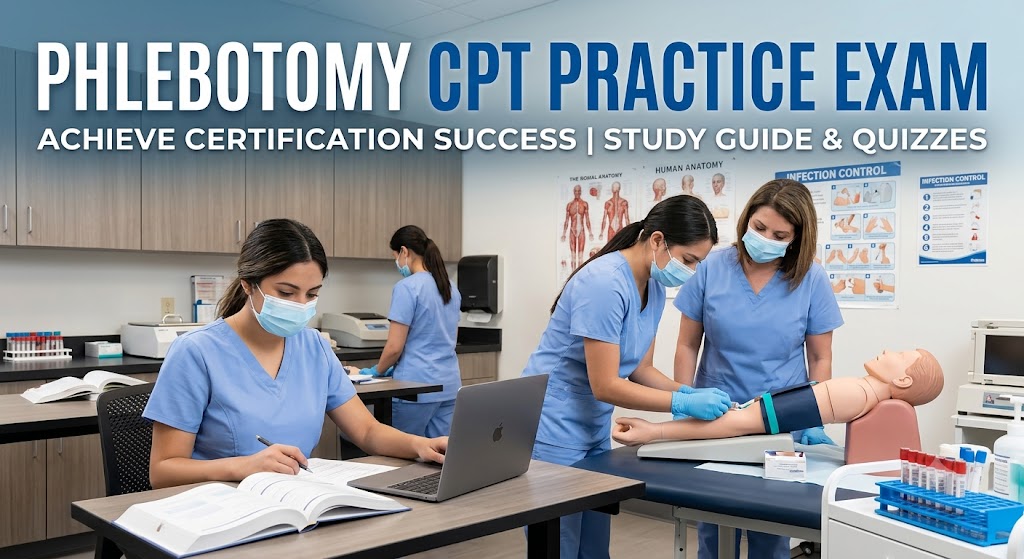
Additional Information
What the Course Entails and Exam Details
A comprehensive phlebotomy course and the subsequent CPT exam cover a wide range of critical topics to ensure a technician is well-rounded and safe.
The core syllabus typically includes deep dives into:
Safety and Compliance: Understanding OSHA regulations, infection control, standard precautions, and properly managing biohazardous materials.
Patient Interaction: Effective communication, patient identification, obtaining consent, and managing patient care before, during, and after a draw.
Anatomy and Physiology: Specific knowledge of the circulatory system, including vein selection and potential complications.
Medical Terminology: Basic medical language essential for understanding test orders and interacting in a clinical setting.
Procedural Knowledge: Detailed steps for various blood collection methods, including venipuncture (evacuated tube system, syringe, winged infusion set) and capillary puncture (finger and heel sticks).
Specimen Processing: Proper handling, labeling, transport, and storage of blood and non-blood specimens to maintain integrity.
Special Populations: Techniques for drawing from pediatric, geriatric, and difficult-to-draw patients.
Focused quizzes, such as a Phlebotomy CPT Practice Test Chapter 6 Quiz, often target specific sections, like procedural safety and infection control, allowing students to reinforce understanding in critical, high-yield areas.
What to Expect in the Final Exam
The final CPT certification exam is designed to be a comprehensive assessment of both knowledge and practical understanding.
The final exam is typically a multiple-choice, computer-based test (CBT).
While exact specifications may vary by certifying body, a common structure, such as the NHA CPT, includes approximately 100 to 110 questions. Candidates are often given around 1 hour and 45 minutes to 2 hours to complete the test.
A passing score generally requires achieving a scaled score of 390 or higher on a 200-500 scale, reflecting a high level of proficiency across all tested content domains.
Questions will assess foundational knowledge as well as the ability to apply that knowledge in practical, real-world clinical scenarios.
How to Study and Exam Centers
Effective preparation for the CPT exam requires a multi-faceted approach. To ensure success, students should:
Utilize a Comprehensive Study Guide: Obtain the official study materials provided by the certifying organization or reputable educational publishers.
Focus on Key Areas: Dedicate extra time to critical sections like safety, patient identification, and correct collection procedures, which make up a significant portion of the exam.
Take Multiple Practice Exams: Repetitive testing using high-quality practice tests and quizzes (like the Chapter 6 specific quiz) is one of the most effective ways to identify weaknesses and build confidence.
Practice with Real Equipment: If possible, reinforce your knowledge with hands-on practice in a laboratory or clinical setting.
Join Study Groups: Discussing concepts and sharing resources with peers can provide new insights and keep you motivated.
The actual CPT exam is usually taken at authorized testing centers. Major certifying bodies often partner with third-party providers like Pearson VUE, which have locations worldwide. Many phlebotomy training schools and healthcare institutions are also approved testing sites. Registration and scheduling are completed through the certifying organization's official website.
Job Opportunities from the Course
Earning your Phlebotomy CPT certification opens many doors within the healthcare industry and provides a strong foundation for future career growth. Certified phlebotomists are in high demand in various clinical and laboratory environments.
The specific job opportunities unlocked by this certification include:
Phlebotomy Technician
Laboratory Assistant
Specimen Processing Technician
Mobile Phlebotomist
Donor Phlebotomy Technician
Medical Assistant (with additional training)
Phlebotomy Supervisor
Research Phlebotomist
Home Health Aide (where authorized)
Frequently Asked Questions
Reviews
5.0
Based on 0 reviews
Leave a Review
No reviews yet. Be the first to review!