
Pennsylvania CDL Practice Test 2
$69.00
- Buy to unlock unlimited access to all Quiz questions.
- After purchase you can print a PDF of the whole quiz at any point. The PDF will contain the questions and the correct answers.
About this Exam
The Pennsylvania Commercial Driver's License (CDL) is the definitive professional credential for individuals seeking to operate large, high-capacity, or hazardous materials vehicles commercially within the Commonwealth. It is designed for aspiring professionals across diverse industries—from logistics and construction to public transportation and specialized delivery services. Earning your CDL unlocks a career defined by stability, competitive pay, and the responsibility of keeping Pennsylvania's economy moving. The "PA CDL Practice Test 2" is not a separate official exam but rather a critical, focused study module designed to reinforce high-level knowledge after initial, basic concept review. It concentrates on more advanced vehicle systems, complex regulatory compliance, and challenging driving scenarios that are heavily weighted in the final state examination.
Ready to test your knowledge?
Buy Now to Access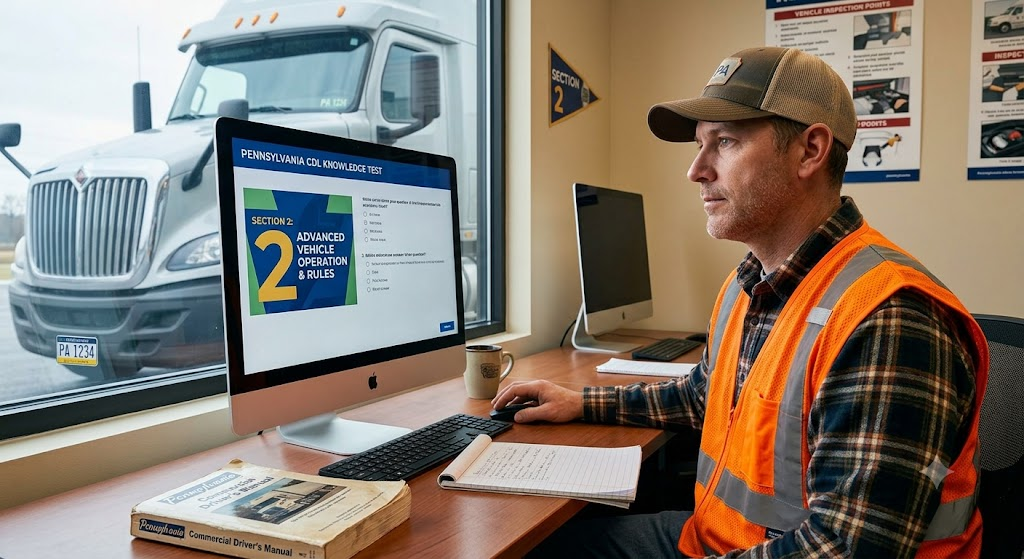
Additional Information
What the Course Entails and Exam Details
While official PennDOT documentation categorizes the initial knowledge requirement as the "General Knowledge Test," "Practice Test 2" modules typically deep-dive into crucial, complex sections of the official Pennsylvania Commercial Driver’s Manual. By focusing on these specific areas, applicants build the technical mastery required for real-world operations and the comprehensive state exam.
Key topics covered in this advanced study phase include:
Advanced Vehicle Inspection: Detailed procedures for pre-trip, en-route, and post-trip inspections, focusing on critical systems like suspension, steering, braking, and coupling devices.
Basic Control and Shifting: Mastery of accelerating, steering, and backing safely, alongside proper techniques for shifting gears in varied commercial vehicles, including manual transmissions.
Managing Space and Speed: Understanding and calculating proper following distance, adapting speed to road conditions (curves, visibility, traffic), and managing space above, below, and to the sides of the vehicle.
Hazard Awareness and Defensive Driving: Identifying and responding correctly to potential hazards such as distracted drivers, aggressive behaviors, work zones, and changing traffic patterns.
Driving in Adverse Conditions: Special techniques for navigating night driving, fog, winter weather (snow/ice), and extreme heat common in Pennsylvania.
Emergency Procedures and Accident Response: Correct actions for dynamic emergencies like tire blowouts, brake failure, and fires, as well as mandatory procedures following an accident.
Alcohol, Drugs, and Staying Alert: A thorough understanding of the stringent federal and state laws regarding substance use and the effects of fatigue on commercial driving safety.
Cargo and Hazardous Materials Basics: General rules for loading, securing, and transporting cargo safely, and a critical overview of hazardous materials regulations applicable to all CDL holders.
What to Expect in the Final Exam
The actual exam you are preparing for is the Pennsylvania CDL General Knowledge Test, administered exclusively by PennDOT. You cannot take a partial "Test 2" with the state; you must take the comprehensive knowledge test required for your desired CDL class.
Here are the specific details for the final PennDOT knowledge exam:
Format: The exam is a computer-based, multiple-choice test. It must be taken in person.
Number of Questions: The General Knowledge test typically consists of 50 questions, drawn from the entire Commercial Driver's Manual.
Passing Score: Applicants must achieve a minimum score of 80%, which means correctly answering at least 40 out of 50 questions.
Time Limit: While there is no strict, stated universal time limit, the tests are designed to be completed within a reasonable timeframe (typically about one hour). Exceeding a practical time window or failing to finish can lead to a failure.
Language: The exam is administered in English.
Retesting: If you do not pass on your first attempt, you may retake the knowledge test after a mandatory waiting period (typically at least two days).
How to Study and Exam Centers
A strategic approach to studying is essential to succeed in the comprehensive state exam. The "Practice Test 2" concepts are technical and require diligent application.
Actionable Study Strategies:
Start with the Source: The single most important resource is the official Pennsylvania Commercial Driver's Manual (Pub 223). Download a copy from the official PennDOT website and treat it as your primary textbook.
Section-by-Section Mastery: Do not try to memorize the whole book at once. Study the manual section by section, starting with those outlined in the 'What the Course Entails' section above.
Utilize Practice Tests: Once you have studied a chapter, use "Practice Test 2" modules (from authorized training schools or reputable online portals) to test your retention and identify weak points.
Create Custom Flashcards: For technical terms, vehicle inspection items, or specific regulatory limits (like blood alcohol concentration levels), create flashcards for quick, regular review.
Hands-on Reinforcement: If possible, ask to observe a professional CDL driver or instructor conduct a vehicle inspection to make the manual’s concepts tangible.
Official Exam Centers: In Pennsylvania, you must take your official CDL knowledge exams in person at a designated PennDOT Driver License Center. These state-run facilities are located throughout the Commonwealth. Third-party testing centers can only administer the subsequent practical Skills Test, not the initial written Knowledge Test. You can find a complete list of these Driver License Centers and their operating hours (which often require arriving at least one hour before closing for tests) on the official Pennsylvania Department of Transportation website.
Job Opportunities from the Course
Obtaining your Pennsylvania CDL after passing the full knowledge and skills testing opens the door to a diverse and rewarding field of employment within the state.
Your CDL, along with any necessary endorsements, enables you to pursue career paths such as:
Class A Commercial Driver (e.g., Long-Haul Tractor-Trailer Operator)
Class B Commercial Driver (e.g., Local Delivery Truck Driver, Dump Truck Operator)
Class C Commercial Driver with specific endorsements (e.g., Small Hazardous Materials Vehicle)
Specialized Flatbed or Refrigerated (Reefer) Transport Driver
Heavy Equipment Transporter
Public Transit Bus Driver
School Bus Driver (requires 'S' and 'P' endorsements)
Construction Vehicle Operator (e.g., Concrete Mixer, Crane Operator)
Fuel or Chemical Tanker Driver (requires 'N' and 'H' endorsements)
Motorcoach or Charter Bus Tour Operator
Waste Management and Recycling Collection Driver
Vehicle Recovery and Towing Specialist
Local/State Government Operations Vehicle Driver (e.g., Snowplow/PennDOT)
Frequently Asked Questions
Reviews
5.0
Based on 0 reviews
Leave a Review
No reviews yet. Be the first to review!