
Paramilitary Recruitment Practice Test & Exam Prep | India
$69.00
- Buy to unlock unlimited access to all Quiz questions.
- After purchase you can print a PDF of the whole quiz at any point. The PDF will contain the questions and the correct answers.
About this Exam
Prepare to serve your nation with confidence!
This comprehensive study guide is a vital resource for serious candidates aiming to join India’s respected paramilitary forces.
India's central armed police forces, including the Border Security Force (BSF), Central Reserve Police Force (CRPF), Central Industrial Security Force (CISF), Indo-Tibetan Border Police (ITBP), Sashastra Seema Bal (SSB), and Assam Rifles, require highly disciplined and capable personnel.
The recruitment process for these forces is notoriously rigorous, designed to select only the best through multiple demanding stages, including a critical written examination, stringent physical fitness standards, physical efficiency tests (PET), and detailed medical assessments.
This guide, and corresponding practice tests, are specifically designed for aspiring personnel looking to master the exam, understand the structure, and build the skills and knowledge required to succeed.
Whether you are aiming for a role as a Constable (GD), Head Constable, Sub-Inspector, or even Assistant Commandant through the Central Armed Police Forces (CAPF) exam, this guide provides actionable insights and practice strategies.
Leveraging this resource is not just about exam prep; it's a strategic move to secure your future in a meaningful, respected, and uniformed career.
Gain a deep understanding, sharpen your skills, and approach your official recruitment exams with the assurance that comes from thorough, targeted preparation.
Ready to test your knowledge?
Buy Now to Access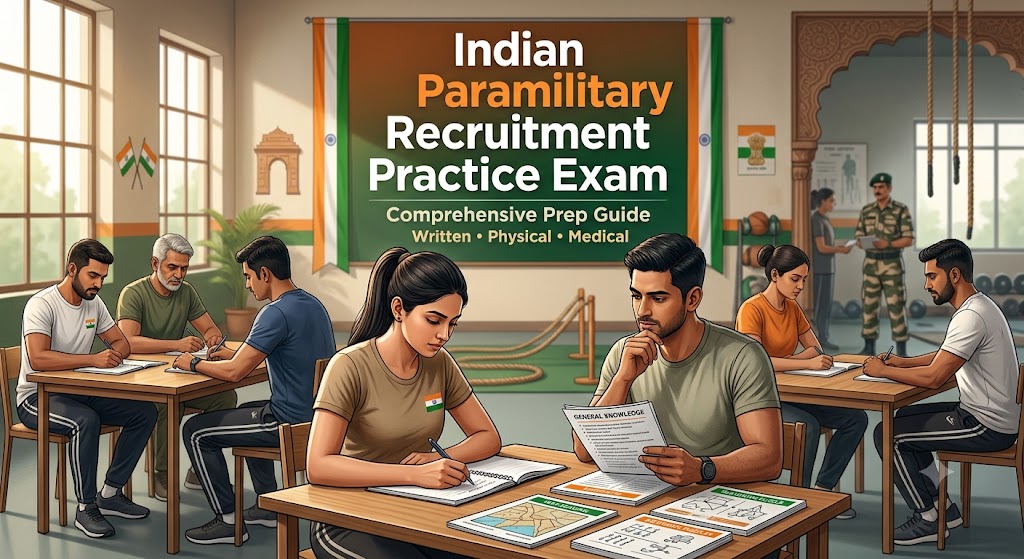
Additional Information
What the Course Entails and Exam Details
This preparation guide and practice test set mirror the
diverse topics and skills encountered in the official paramilitary recruitment
written examinations.
The core syllabus focus areas commonly covered in practice
materials include:
- General
Awareness & General Knowledge: History (Indian and World),
Geography, Indian Polity, Economy, Current Events (National and
International), Sports, Culture, Scientific Research.
- Elementary
Mathematics / Quantitative Aptitude: Number Systems, Computation of
Whole Numbers, Decimals and Fractions, Relationships Between Numbers,
Fundamental Arithmetic Operations, Percentage, Ratio & Proportion,
Average, Interest, Profit & Loss, Discount, Mensuration, Time &
Distance, Ratio and Time, Time & Work.
- Analytical
Aptitude & Reasoning Ability: Analogies, Similarities &
Differences, Spatial Visualization, Spatial Orientation, Visual Memory,
Discrimination, Observation, Relationship Concepts, Arithmetical Reasoning
and Figural Classification, Arithmetic Number Series, Non-verbal Series,
Coding & Decoding.
- English
Comprehension or Hindi Language: Basics of language, grammar, sentence
structure, vocabulary, idioms & phrases, reading comprehension,
synonyms, and antonyms. Candidates often have the choice to answer in
either English or Hindi for this component.
Comprehensive Preparation:
It is important to remember that while the written exam is a
crucial gateway, the official recruitment process is a multi-staged challenge:
Written Test: The
primarily covered area of this guide, assessing knowledge and aptitude.
Physical Standards Test (PST):
Meeting set height, chest (for males), and weight requirements.
Physical Efficiency Test
(PET): Performance in tasks like running specific distances within time
limits, long jump, high jump. While not directly tested in a standard
practice test, this guide stresses the importance of physical prep.
Trade Test (for specific
posts): Assessing practical skills for trade-related roles.
Medical Examination &
Document Verification: A thorough health check and validation of documents.
Personality Test / Interview
(for officer-level posts like CAPF AC): Assessing communication,
leadership, and suitability for command roles.
Note: The exact syllabus, number of questions, marks
distribution, and weightage for each stage can vary significantly between
different forces (BSF, CRPF, CISF, etc.), specific posts (Constable,
Sub-Inspector), and the conducting body (SSC, UPSC, or the force itself).
This practice material provides a foundational framework to prepare for common
elements.
What to Expect in
the Final Exam
While the exact nature will depend on the specific force and
post, you can generally expect the written examination (or Computer-Based Test
- CBT) to follow a typical format:
- Format:
Primarily Objective Type Multiple Choice Questions (MCQs). These tests are
increasingly conducted online (CBT) but can also be offline (OMR based).
- Duration:
The exam time limit commonly ranges between 90 minutes and 3 hours,
depending on the number and complexity of the questions and the specific
force’s rules.
- Total
Questions & Marks: Standard exams often feature 100 to 200
questions, with a potential total score of 100 to 200 marks. Each section
(GK, Math, Reasoning, Language) typically has a dedicated number of
questions and marks (e.g., 25 questions/marks each for 4 sections in a 100
mark exam).
- Medium
of Examination: The examination is typically available in both Hindi
and English, with the exception of the specific language (Hindi or English
comprehension) section itself.
- Passing
/ Qualifying Score: Minimum qualifying marks are set officially by the
recruiting body. These can be subject-wise/section-wise as well as
aggregate, and cut-off marks often depend on factors like total vacancies
and overall candidate performance. Candidates must achieve the specified
score and be ranked high enough to progress to subsequent stages
(PET/PST/Medical).
- Negative
Marking: Be aware! Many, but not all, paramilitary recruitment written
exams incorporate a penalty for incorrect answers. This can range from
0.25 to 0.50 marks deducted for each wrong answer, making careful and
accurate answering crucial. Always check the official notification for
confirmation.
- Rules
& Procedures: Standard rules for examination conduct apply,
including prohibited items (electronics, notes), strict timekeeping, and
verification procedures. Adhering to all instructions is non-negotiable.
Reiterate that this final stage is the official government
recruitment, not the practice material's final stage, though the material
should reflect this as closely as possible.
How to Study and Exam Centers
Success in paramilitary recruitment requires a strategic and
disciplined approach.
Actionable Study and Preparation Strategies:
Thorough Syllabus Review: Obtain the most recent and
precise syllabus for your specific force and post. Divide and allocate study
time based on the weightage and your strengths/weaknesses.
Mock Tests and Previous
Question Papers: This is your most powerful tool! Take full-length, timed
mock tests to simulate the actual exam experience. Consistently practicing
previous years’ question papers familiarizes you with the question types and
difficulty level.
Identify Weaknesses: After
each mock test, analyze your performance. Determine which sections or topics
are costing you marks. Dedicate targeted study time to improve those areas.
Build Foundational Knowledge:
Use standard, recommended educational resources and standard textbooks
(10th/12th/Graduate level as appropriate) for fundamental concepts in
Mathematics, General Studies, and Language.
Current Affairs: Stay
updated on national and international news, sports, politics, and key
developments. Develop a habit of reading newspapers and reliable news portals
daily.
Time Management: Practice
solving questions within the allocated time. In the exam, don’t get stuck on
single difficult questions – know when to skip and return if time permits.
Practice tests are ideal for mastering time allocation.
Physical and Mental Fitness:
This is crucial. A dedicated physical training routine (running, strength
training) is necessary for the PET/PST. Maintain a healthy lifestyle, stay
hydrated, manage stress, and prioritize sleep for optimal performance in both
written and physical stages.
Form a Study Group (optional):
Collaborative learning can be beneficial for discussion and motivation.
Official Exam Centers and Taking the Exam:
- Official
Authority: Your specific examination will be conducted and overseen by
an official government body, such as the Staff Selection Commission (SSC
for GD), the Union Public Service Commission (UPSC for CAPF AC), or the
individual paramilitary force itself for direct recruitments.
- Notification:
Official exam notices detailing exact center locations, dates, and
instructions will be published on the respective official websites. You
must register online through these official portals.
- Exam
Locations: Physical centers for the written exam, Physical Standard
Test (PST), and Physical Efficiency Test (PET) are designated across major
cities and towns in India.
- Specific
Schools / Centers: Candidates will be assigned a specific, official
testing venue (which might be designated specific schools, government
buildings, or specialized CBT centers like TCS iON, etc.) via their
official admit card. Do not trust unauthorized portals or entities
claiming to hold exams. All information comes directly from the
official notification and your authorized admission card. The practice
material itself is taken through the specific platform provider, not
official government locations.
Job Opportunities
from the Course
A successful paramilitary career opens doors to diverse and
respected roles within the Indian paramilitary forces, offering stable
employment, a chance to serve the nation, and excellent growth potential.
Specific Job Titles and Career Paths Unlocked:
- Constable
(General Duty - GD): The foundational and numerous role across all
forces, involving border security, internal law and order maintenance, and
varied operational duties. Career progression to Head Constable, Assistant
Sub-Inspector, etc.
- Head
Constable (various trades/GD): Enhanced responsibilities from
Constable, often involved in specialized roles or small team leadership.
Progression avenues to Assistant Sub-Inspector.
- Assistant
Sub-Inspector (ASI) and Sub-Inspector (SI): Section and platoon level
leadership roles, critical operational command, investigation, and
supervisory duties. Direct recruitment as SI is common through exams like
SSC CPO. Promising career path towards Inspector, Assistant Commandant,
etc.
- Inspector:
Senior non-gazetted officer role, commanding companies or equivalent
units, key operational and administrative responsibilities.
- Assistant
Commandant (AC - Gazetted Officer): The entry-level officer position
recruited typically through the prestigious UPSC CAPF (AC) examination.
Company Commanders, responsible for operational execution, tactical
planning, and personnel management. Excellent career progression to Deputy
Commandant, Second-in-Command, Commandant, and higher leadership ranks.
- Medical
Officer (various ranks): Specialized recruitment for doctors to
provide medical services to force personnel and in operational areas.
- Technical
& Specialist Roles: Opportunities exist in engineering,
communications, logistics, aviation, and other specialized areas within
the diverse infrastructure of these forces.
- Commandant
& Leadership: Progression to leadership ranks of Commandant, DIG,
IG, ADG, and DG for capable and dedicated officers.
This structured study guide and practice tests provide the
comprehensive foundation needed to tackle Indian Paramilitary Recruitment and
build a rewarding, purposeful career dedicated to national service and
security.
Embark on your journey, dedicate yourself to preparation,
and secure your place in India's esteemed Paramilitary Forces!
Frequently Asked Questions
Reviews
5.0
Based on 0 reviews
Leave a Review
No reviews yet. Be the first to review!