
Paramedicine Practice Test & Exam Prep | Australia
Unlock the full practice quiz
Get complete access to the questions, explanations and printable quiz resources.
About this Exam
Welcome to the definitive guide for aspiring paramedics preparing for the Paramedicine Practice Test & Exam Prep | Australia. This comprehensive resource is meticulously designed for students and graduates of accredited university paramedicine programs who are aiming to successfully pass their registration exams. In Australia, achieving registration with the Paramedicine Board of Australia (MBA) is the mandatory final step before commencing professional practice. This exam is not merely a formality; it is a rigorous assessment that evaluates your theoretical knowledge, clinical reasoning, and decision-making capabilities against the national competency standards. Our goal is to provide you with a clear roadmap of what this challenging process entails, offering actionable study strategies and insights into the examination structure to ensure you are fully prepared. Whether you are an undergraduate preparing for final assessments or a recent graduate gearing up for the national registration exam, this guide serves as your essential companion on the path to becoming a registered paramedic dedicated to serving the Australian community.
Ready to test your knowledge?
Buy Now to Access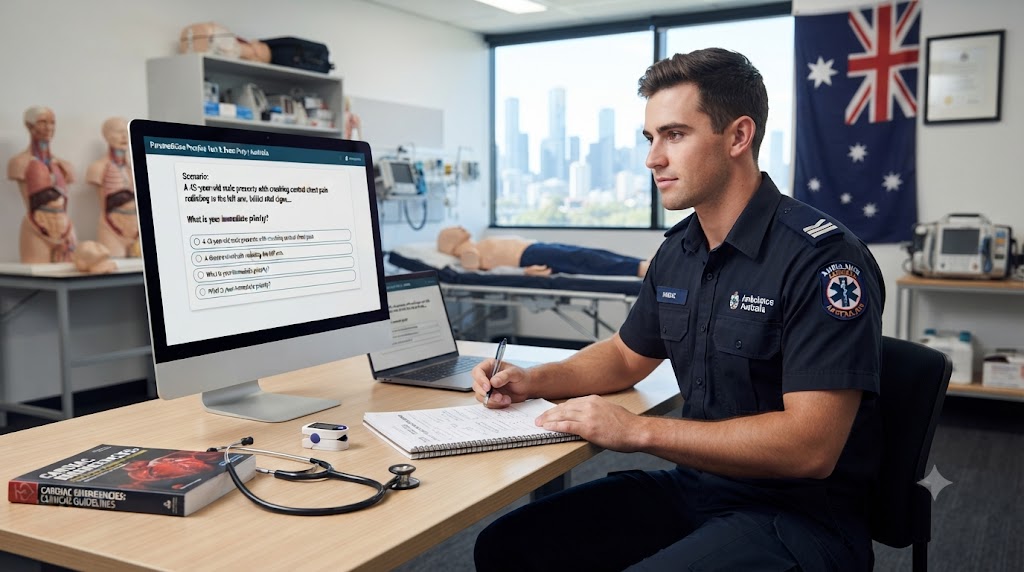
Additional Information
What the Course Entails and Exam Details
The Australian Paramedicine Registration Exam is a
comprehensive evaluation of the knowledge and skills required for safe,
effective, and ethical practice as an entry-level paramedic. The exam content
is directly aligned with the Paramedicine Board of Australia’s Registration
Standards and the Competency Standards for Paramedics. The
curriculum you have studied in your university degree forms the foundation of
this exam, encompassing a wide array of critical subjects. Candidates are
expected to demonstrate deep knowledge in core areas such as human anatomy and
physiology, pathophysiology across the lifespan, pharmacology, and medical
terminology. Furthermore, the exam rigorously tests your ability to apply
clinical guidelines and protocols to various patient scenarios, covering trauma
management, cardiac arrest, respiratory distress, medical emergencies,
obstetrics, and mental health crises.
Beyond clinical knowledge, the exam assesses your
understanding of the professional, legal, and ethical frameworks governing
paramedicine in Australia. This includes knowledge of privacy laws, consent and
capacity, documentation standards, professional boundaries, and the cultural
safety principles essential for providing equitable care to Aboriginal and
Torres Strait Islander peoples and culturally and linguistically diverse
communities. The scope of the exam is broad, reflecting the diverse and dynamic
nature of out-of-hospital emergency healthcare. A robust study plan must
therefore integrate these multifaceted components, ensuring a holistic
understanding rather than rote memorization of isolated facts.
What to Expect in the Final Exam
The format of the Paramedicine Registration Exam in
Australia is predominantly delivered as a Computer-Based Test (CBT),
often hosted by a designated testing provider such as Pearson VUE. The
examination consists of a substantial number of Multiple-Choice Questions
(MCQs), designed to efficiently test a wide breadth of knowledge. Some
exams may also incorporate Extended Matching Questions (EMQs) or complex
scenario-based questions that require multi-step reasoning. These question
types are carefully crafted to assess not only what you know but how
you apply that knowledge in simulated real-world situations. You may be
presented with a patient case study and asked to select the most appropriate
immediate action, prioritize interventions, identify contraindications for a
medication, or determine the likely underlying cause of a patient's
presentation.
The time limit for the exam is typically generous but
requires efficient time management; candidates often have 3 to 4 hours to
complete 150–200 questions. This equates to roughly one minute per
question, necessitating a disciplined approach to reading and answering. The
passing score is determined using a standard-setting methodology (such as the
Angoff method) to ensure fairness and consistency, meaning the pass mark is not
necessarily a fixed percentage but rather a score that reflects the standard of
an entry-level practitioner. It is crucial to be aware of specific rules: the
exam is strictly timed, you cannot return to previous questions once answered
(in some formats), and adherence to professional conduct throughout the process
is mandatory. Success in this environment depends on both deep knowledge and
the ability to maintain focus and composure under pressure.
How to Study and
Exam Centers
A strategic and disciplined approach is essential for
success on the Paramedicine Registration Exam. Relying solely on past
university notes may be insufficient; therefore, consider integrating the
following study strategies into your preparation:
- Develop
a Comprehensive Study Plan: Create a structured timetable that
allocates dedicated time to reviewing each core competency area (e.g.,
cardiology, trauma, pharmacology, law). Consistency is key; short, focused
study sessions are more effective than infrequent cramming.
- Master
Clinical Guidelines: Thoroughly review and understand the Clinical
Practice Guidelines (CPGs) relevant to your state or territory (or the
national consensus guidelines if applicable). The exam will test your
ability to apply these guidelines correctly.
- Utilize
High-Quality Practice Tests: Engage with reputable Paramedicine
Practice Test resources. These platforms simulate the CBT experience,
familiarizing you with the MCQ format, question complexity, and time
constraints. Analyze your results carefully to identify knowledge gaps.
- Form
Study Groups: Collaborate with peers to discuss complex clinical
scenarios, quiz each other on pharmacology, and debate ethical dilemmas.
Explaining concepts to others reinforces your own understanding.
- Focus
on Application, Not Just Recall: Use case studies and simulation
materials to practice applying theoretical knowledge to real-world
problems. Practice prioritizing care in multi-casualty scenarios.
The actual registration exam is administered at authorized
Pearson VUE test centers located in major cities and regional centers across
Australia. When you apply to sit the exam with the assessing authority (often
the Australian Health Practitioner Regulation Agency - AHPRA or a
contracted body), you will be provided with information on how to locate and
book your seat at a convenient center. Ensure you are familiar with the ID
requirements and the strict security protocols in place at the test center on
the day of your exam.
Job Opportunities
from the Course
Successfully passing the Paramedicine Registration Exam and
gaining registration with the Paramedicine Board of Australia is the gateway to
a fulfilling and dynamic career in the healthcare sector. This qualification is
recognized nationwide and unlocks a diverse array of career paths, including:
- Qualified
Ambulance Paramedic: The most common role, working on road ambulances
as a first responder to emergency and non-emergency calls, providing
advanced life support and patient transport.
- Intensive
Care Paramedic (ICP): After gaining experience, paramedics can
undertake further specialized university training to become an ICP,
managing more critically ill and injured patients with advanced
interventions.
- Extended
Care Paramedic (ECP) / Community Paramedic: These roles focus on
providing primary healthcare in the community, assessing and treating
patients in their homes to avoid unnecessary hospital admissions.
- Retrieval
Paramedic: Working as part of a specialist medical team (often with
doctors and nurses) on helicopters or fixed-wing aircraft to retrieve and
transport critically ill patients from remote areas or between hospitals.
- Special
Operations Paramedic (SOP): Trained to provide medical support in
high-risk and challenging environments, such as swiftwater rescue,
confined spaces, or tactical police operations.
- Clinical
Support Officer (CSO) / Clinical Educator: Experienced paramedics who
mentor new staff, provide clinical support on road, or develop and deliver
education and training programs.
- Paramedic
Educator / Academic: Teaching into university paramedicine programs,
conducting research, and shaping the next generation of paramedics.
- Health
Manager / Team Leader: Progressing into leadership roles responsible
for managing ambulance stations, operations, or broader health service
projects.
- Event
Medic: Providing on-site medical coverage for large-scale sporting
events, concerts, and festivals.
Related Quizzes
Australia Basic Scaffolding Practice Test
Australia CASA Instrument Proficiency Practice Exam
Australia Geography Practice Test
Australia Instrument Flight Rating (IFR) Practice Test
Frequently Asked Questions
Reviews
5.0
Based on 0 reviews
Leave a Review
No reviews yet. Be the first to review!