
PANCE / PANRE Practice Test Review Questions
$69.00
- Buy to unlock unlimited access to all Quiz questions.
- After purchase you can print a PDF of the whole quiz at any point. The PDF will contain the questions and the correct answers.
About this Exam
The Physician Assistant National Certifying Examination (PANCE) and the Physician Assistant National Recertifying Examination (PANRE) are rigorous tests administered by the National Commission on Certification of Physician Assistants (NCCPA). These exams are essential milestones in a Physician Assistant's career. The PANCE is designed for graduates of accredited PA programs to obtain their initial certification, granting them the title of Physician Assistant-Certified (PA-C). The PANRE, on the other hand, is required for practicing PAs to maintain their certification every ten years. Both exams assess the requisite medical knowledge and clinical skills necessary for safe and effective practice as a Physician Assistant.
Ready to test your knowledge?
Buy Now to Access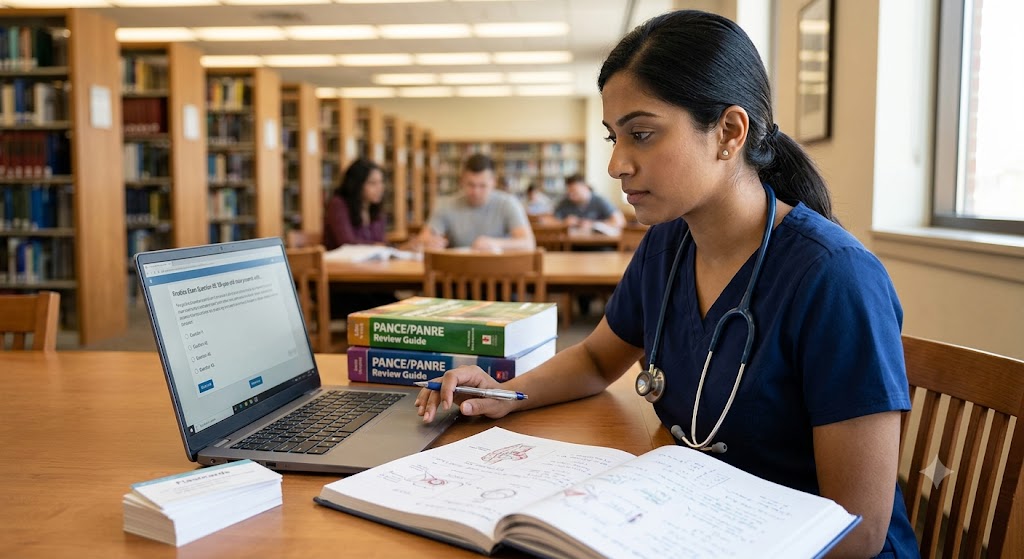
Additional Information
What the Course Entails and Exam Details
Preparing for the PANCE and PANRE requires a comprehensive review of fundamental medical concepts and clinical practices. Review materials and practice exams typically cover a vast spectrum of topics across all organ systems. You will delve into anatomy, physiology, pathophysiology, pharmacology, and diagnostic techniques for various medical conditions.
Specific areas of study often include internal medicine, pediatrics, obstetrics and gynecology, surgery, emergency medicine, and psychiatry. The focus is not just on factual recall but also on applying this knowledge to clinical scenarios, covering areas such as taking patient histories, performing physical examinations, ordering and interpreting diagnostic tests, formulating differential diagnoses, and developing comprehensive treatment plans. Review courses often structure their content based on the NCCPA blueprint, ensuring all critical areas are addressed.
What to Expect in the Final Exam
Both the PANCE and PANRE are administered in a computerized multiple-choice format. Candidates should be prepared for a long and demanding testing day.
PANCE Details: The PANCE consists of 300 multiple-choice questions administered in five blocks of 60 questions each. You are given 60 minutes to complete each block. The total exam time is five hours, with an additional 45 minutes allotted for break time.
PANRE Details: The PANRE traditionally consists of 240 multiple-choice questions administered in four blocks of 60 questions each, with 60 minutes per block. The total test time is four hours, with 45 minutes of break time. There is also an alternative option, the PANRE-LA (Longitudinal Assessment), which is taken in shorter, quarterly segments over several years.
General Rules and Scoring: Both exams are tightly controlled for security. No outside study materials or electronic devices are allowed in the testing room. Passing scores are determined by the NCCPA based on established statistical standards rather than a strict percentage correct. Results are usually available within a few weeks of completing the exam.
How to Study and Exam Centers
Effective preparation is key to success. Utilize high-quality PANCE/PANRE practice question banks extensively. Don't just answer questions; thoroughly review the detailed rationales provided for both correct and incorrect answers to deepen your understanding. Simulate the actual test environment by taking full-length timed mock exams to improve your pacing and stamina.
Incorporate review books, textbooks from your PA program, and medical podcasts or videos into your study routine. Forming or joining study groups can provide motivation and different perspectives on complex topics. Consistency is crucial; dedicate scheduled time each day to review.
The official PANCE and PANRE exams are administered at Pearson VUE professional testing centers. These centers are located worldwide, offering a standardized and secure testing environment. To schedule your exam, you must first register through the NCCPA website, after which you will be able to select a date and convenient testing center location. Ensure you bring the required identification (usually two forms of government-issued photo ID) to the testing center on exam day.
Job Opportunities from the Course
Successfully passing the PANCE to earn initial certification or the PANRE to maintain it is necessary for maintaining your eligibility for state licensure and employment as a PA. Obtaining the PA-C designation opens doors to a wide range of rewarding career opportunities in various medical settings. Some common job titles include:
Certified Physician Assistant (PA-C)
Primary Care Physician Assistant
Emergency Medicine Physician Assistant
Surgical Physician Assistant
Pediatric Physician Assistant
Orthopedic Physician Assistant
Dermatology Physician Assistant
Hospitalist Physician Assistant
Urgent Care Physician Assistant
Specialty Practice Physician Assistant (e.g., Cardiology, Oncology)
Passing these exams is a testament to your medical knowledge and dedication to the profession, ensuring you are well-prepared to provide high-quality care to patients.
Frequently Asked Questions
Reviews
5.0
Based on 0 reviews
Leave a Review
No reviews yet. Be the first to review!