
PALS Chapter 9: Shock Practice Test
$69.00
- Buy to unlock unlimited access to all Quiz questions.
- After purchase you can print a PDF of the whole quiz at any point. The PDF will contain the questions and the correct answers.
About this Exam
The Pediatric Advanced Life Support (PALS) certification, developed by the American Heart Association (AHA), is an advanced level of training designed for healthcare professionals who manage respiratory and/or cardiovascular emergencies and cardiopulmonary arrest in infants and children. This critical certification is essential for medical staff working in emergency response, emergency medicine, intensive care, and critical care units. The PALS course equips these providers with the skills to recognize and intervene early in pediatric patients who are deteriorating, utilizing high-performance team dynamics and high-quality individual skills to improve outcomes.
A vital component of this training, covered extensively in Chapter 9, focuses on Shock. This practice test guide specifically targets the knowledge required to assess, classify, and manage various forms of shock in pediatric patients, ensuring you are prepared to save lives in a crisis.
Ready to test your knowledge?
Buy Now to Access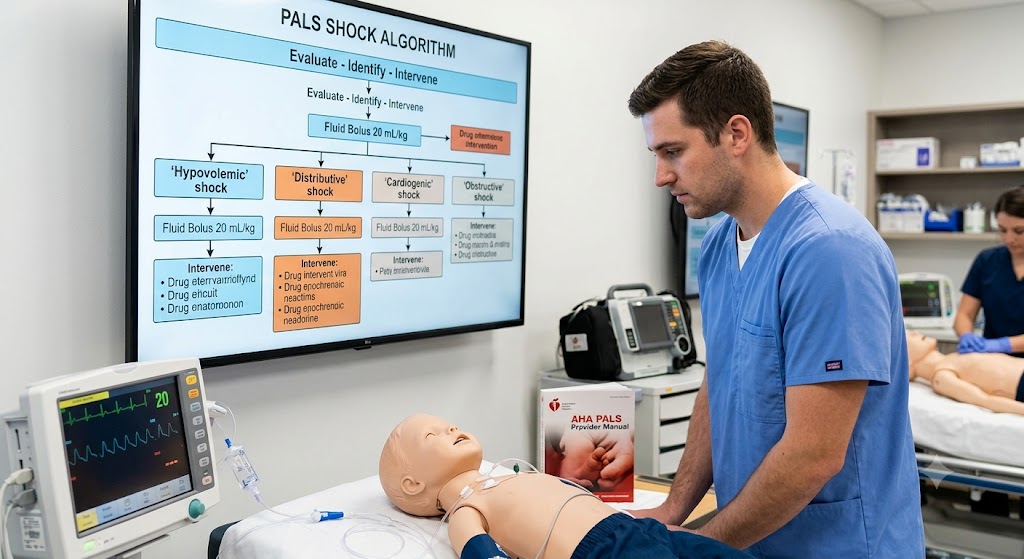
Additional Information
What the Course Entails and Exam Details
The complete PALS course integrates a wide range of pediatric emergency management protocols. Students learn to apply the systematic approach to pediatric assessment, utilize the Evaluate-Identify-Intervene sequence, and participate as effective members of a high-performance resuscitation team.
Key areas of study and practice include:
High-quality Basic Life Support (BLS), including CPR tailored for infants and children.
Recognition and management of respiratory distress and failure.
Recognition and management of cardiac arrhythmias, including bradycardia and tachycardia.
The core of Chapter 9: Recognition and management of Shock.
For the Shock module specifically, you must master the identification and treatment algorithms for the four primary types of shock:
Hypovolemic Shock: Caused by inadequate blood volume (e.g., hemorrhage, severe dehydration).
Distributive Shock: Caused by abnormal distribution of blood flow (e.g., sepsis, anaphylaxis, neurogenic shock).
Cardiogenic Shock: Caused by impaired heart contractility.
Obstructive Shock: Caused by physical obstruction to blood flow (e.g., tension pneumothorax, cardiac tamponade).
Your knowledge of fluid bolus dosages (typically 20 ml/kg of isotonic crystalloid), vasoactive medications, and algorithm flowcharts will be tested thoroughly in this chapter.
What to Expect in the Final Exam
The PALS final assessment is a two-part exam designed to test both your cognitive understanding and your practical ability to apply knowledge under pressure.
Part 1: The Written Exam
Format: Multiple-choice questions.
Coverage: Covers all modules, including respiratory emergencies, shock algorithms, arrhythmias, and post-resuscitation care. The knowledge tested in your Chapter 9 Shock Practice Test will be a significant portion of this written component.
Passing Score: Students must achieve a minimum score of 84% to pass the written exam.
Specific Rules: The exam is usually an individual assessment, meaning no notes or assistance are permitted, reflecting the need for timely, confident decisions in real emergencies.
Part 2: The Practical Skills Test
Format: This component consists of hands-on skills stations and simulated MegaCode scenarios. You will be assigned a specific scenario and must lead a team, correctly assessing the pediatric "patient," identifying the rhythm or condition (such as distributive shock), and managing the patient following AHA algorithms.
Requirement: You must demonstrate proficiency as a team leader in multiple scenarios, including one respiratory emergency, one cardiac emergency, and one shock or cardiac arrest scenario.
How to Study and Exam Centers
Effective preparation is key to passing PALS. As expert educational copywriters, we recommend a multi-faceted approach:
Thorough Manual Review: Read the official AHA PALS Provider Manual several times. Focus particularly on the algorithms in Chapter 9 (Shock) and the "Key Points" summarized at the end of every chapter.
Utilize Practice Tests: Use targeted tools like the [PALS Chapter 9: Shock Practice Test] mentioned in this title. These simulate the style and difficulty of actual written questions, reinforcing your recall of fluid dosages and algorithm steps.
Master Algorithms: Flashcards are excellent for memorizing fluid resuscitation rates, drug dosages for septic versus anaphylactic shock, and the signs distinguishing compensated from uncompensated shock.
Attend a Live Class: PALS is an instructor-led, classroom-based course. Engaging in discussions and hands-on simulation practice with a certified AHA instructor is the best way to prepare for the practical MegaCode.
Where to Take the Exam
You cannot take the PALS certification exam entirely online; a practical, hands-on skills session is required.
Physical Testing Centers: The most common path is through an authorized AHA Training Center (TC) or Training Site. Many hospitals, community colleges, and dedicated emergency medical training schools are authorized to teach the course and conduct the exams.
Blended Learning (HeartCode® PALS): You can complete the cognitive, online portion of PALS (including a virtual written test) through the AHA’s HeartCode portal. However, you must then schedule and complete the separate, hands-on practical skills session with an AHA instructor at an authorized center to receive your official certification card.
Job Opportunities from the Course
A PALS certification card is not just a regulatory requirement; it is a vital credential that unlocks a variety of dynamic and rewarding career paths within healthcare. Employers in acute and critical care settings often require or prioritize candidates with this certification.
Possessing a valid PALS certification provides opportunities to work as:
Registered Nurse (specifically in ER, ICU, PICU, or NICU)
Paramedic / Flight Paramedic
Emergency Medical Technician (EMT-Advanced)
Physician Assistant (PA)
Nurse Practitioner (NP)
Respiratory Therapist (RT)
Critical Care Transport Nurse
Pediatric Hospitalist
Anesthesia Technician
Emergency Department Physician
Good luck with your [PALS Chapter 9: Shock Practice Test] and your final certification. With dedicated study of the shock classification and algorithms, you will be well-prepared to excel.
Frequently Asked Questions
Reviews
5.0
Based on 0 reviews
Leave a Review
No reviews yet. Be the first to review!