
PALS Chapter 7: Bradycardia Practice Test 2026
$69.00
- Buy to unlock unlimited access to all Quiz questions.
- After purchase you can print a PDF of the whole quiz at any point. The PDF will contain the questions and the correct answers.
About this Exam
The PALS (Pediatric Advanced Life Support) certification is a vital credential for healthcare providers who respond to emergencies involving infants and children. This advanced course aims to improve the quality of care provided to seriously ill or injured children, resulting in better outcomes.
Specifically, the material within PALS Chapter 7 focuses on the recognition and emergency management of pediatric bradycardia, a slow heart rate that can quickly lead to cardiac arrest if not treated promptly.
This practice test is designed as a focused study aid for healthcare professionals—including nurses, physicians, paramedics, and respiratory therapists—preparing for their PALS renewal or initial certification exam in 2026. It targets the essential algorithms, assessment techniques, and interventions required to stabilize a pediatric patient experiencing symptomatic bradycardia.
Ready to test your knowledge?
Buy Now to Access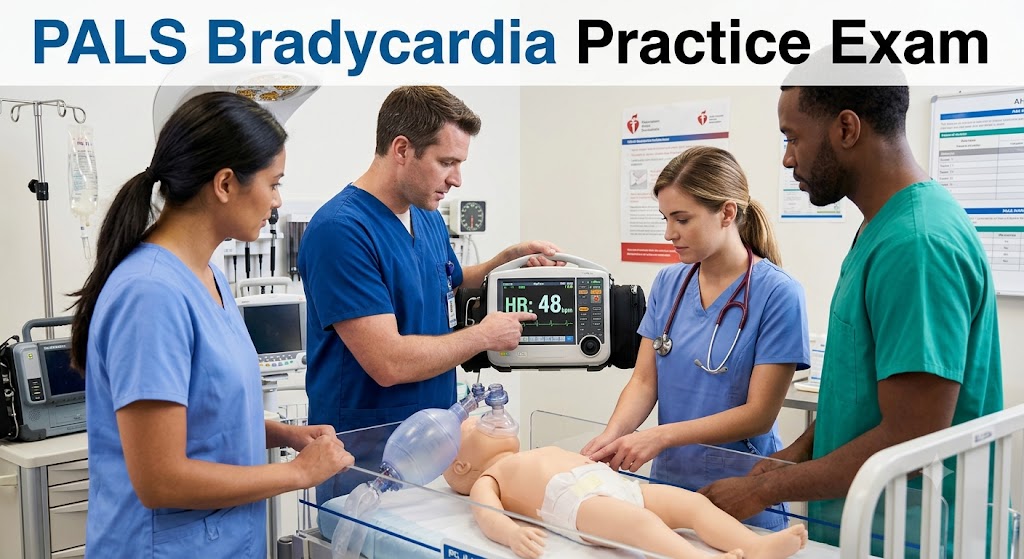
Additional Information
What the Course Entails and Exam Details
This PALS Chapter 7 review covers the core concepts needed to manage pediatric bradycardia effectively as outlined in the most recent American Heart Association (AHA) guidelines for CPR and ECC.
The course material focuses heavily on the Pediatric Bradycardia with a Pulse Algorithm. You must understand how to:
Quickly identify the signs and symptoms of symptomatic bradycardia.
Assess adequacy of perfusion and respiratory effort.
Initiate basic life support (BLS) interventions when necessary.
Identify and treat underlying causes, such as hypoxia, hypothermia, or medication toxicity.
Correctly determine dosages and administer emergency medications (e.g., Epinephrine and Atropine).
Understand when to utilize transthoracic pacing.
This practice test provides multiple-choice questions focusing specifically on these critical skills and decision-making pathways to help reinforce your knowledge before taking the comprehensive official PALS exam.
What to Expect in the Final Exam
While this practice test focuses on Chapter 7 (Bradycardia), the actual PALS comprehensive final exam, required for certification, evaluates knowledge across all areas of pediatric advanced life support.
The official PALS certification exam typically consists of two main components:
A Written Examination: This is a multiple-choice exam that covers all PALS algorithms, medication dosages, core concepts, and rhythm recognition. You must achieve a score of 84% or higher to pass this portion.
A Practical Skills Evaluation (Megacode): This hands-on assessment requires you to serve as a team leader in a simulated pediatric emergency scenario. You will be evaluated on your ability to apply PALS algorithms, communicate effectively with your team, perform skills correctly, and manage the case from start to finish. Bradycardia management is a very common scenario tested during the Megacode.
How to Study and Exam Centers
Effective preparation is key to succeeding on the PALS exam. Here are proven study strategies:
Review the AHA PALS Provider Manual: The official student manual is the definitive source for all test material. Dedicate significant time to studying the algorithms in detail.
Master the Algorithms: Focus specifically on the Pediatric Bradycardia Algorithm. Be able to recall every step of the flowchart without hesitation, including treatment decision points based on the patient's condition.
Practice Dosage Calculations: PALS requires precise medication dosing based on the child's weight. Practice calculations for common emergency drugs like Epinephrine and Atropine.
Use Practice Tests: Regularly taking focused practice exams, like this one for Chapter 7, helps you identify weak areas and get accustomed to the types of questions asked on the official exam.
Review ECG Rhythms: Ensure you can quickly identify various pediatric rhythms, especially symptomatic bradycardia and related blocks.
Where to Take the Exam:
PALS certification exams must be taken through an authorized American Heart Association (AHA) Training Center. These are often located within hospitals, medical colleges, EMS agencies, or dedicated professional training facilities. You cannot take the final comprehensive PALS written exam or the required hands-on skill evaluation through unauthorized online-only platforms. Many authorized centers offer a hybrid option, allowing you to complete the written portion online (via the AHA’s portal) before attending the required in-person hands-on skills session.
Job Opportunities from the Course
A PALS certification is either required or strongly preferred for healthcare professionals working in any setting where pediatric emergencies may occur. Achieving PALS certification validates your advanced skills and enhances your employability in critical care settings.
Job titles that commonly require PALS certification include:
Pediatric Registered Nurse (ICU, ER, General Floor)
Emergency Department Physician
Pediatrician
Paramedic / Flight Medic
Respiratory Therapist (working with pediatric populations)
Pediatric Nurse Practitioner
Anesthesiologist Assistant
Frequently Asked Questions
Reviews
5.0
Based on 0 reviews
Leave a Review
No reviews yet. Be the first to review!