
Orthotics Prosthetics Practice Test & Exam Prep | Canada
$69.00
- Buy to unlock unlimited access to all Quiz questions.
- After purchase you can print a PDF of the whole quiz at any point. The PDF will contain the questions and the correct answers.
About this Exam
Welcome to the essential guide for navigating the path to becoming a certified Orthotist or Prosthetist in Canada. This comprehensive practice test and exam preparation resource is meticulously designed for students and internationally trained professionals who are preparing for the national certification exams administered by Orthotics Prosthetics Canada (OPC). Achieving this designation is the culmination of your rigorous academic and clinical training, signifying your competency to provide safe, effective, and ethical patient care. This exam rigorously tests your theoretical knowledge and its practical application, ensuring you are ready to join the ranks of highly skilled healthcare professionals dedicated to enhancing the mobility and quality of life for individuals with musculoskeletal or neuromuscular conditions. Success in this exam is your gateway to a rewarding career in Canadian healthcare.
Ready to test your knowledge?
Buy Now to Access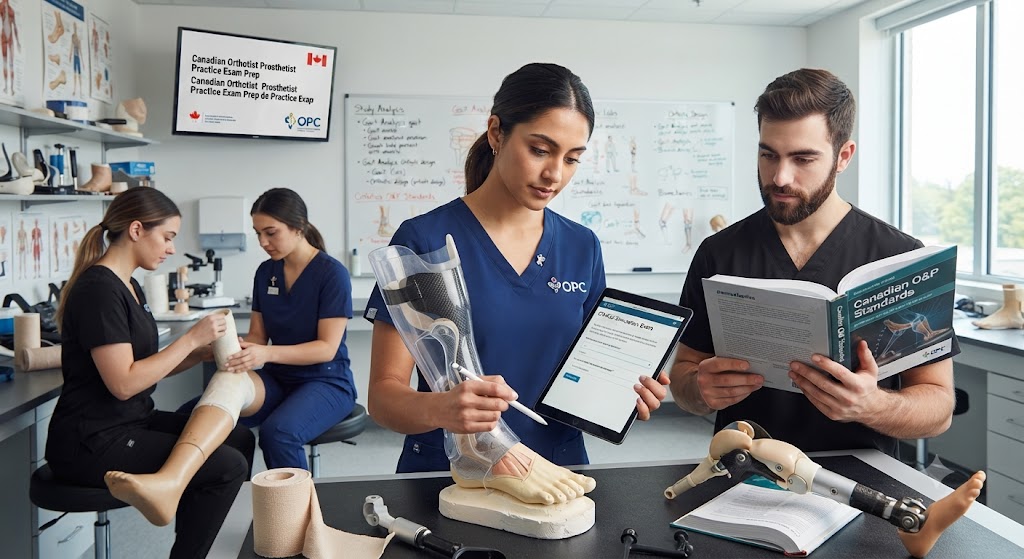
Additional Information
What the Course Entails and Exam Details
The journey to certification is comprehensive, reflecting
the diverse skillset required of a modern Orthotist and Prosthetist. Before
sitting for the final exams, candidates must typically complete an accredited
Master's program in Orthotics and Prosthetics, followed by a mandatory
residency period under the supervision of a certified practitioner. The final
certification process itself is structured to evaluate your readiness to
practice independently across two main domains.
The Written Exam assesses your depth of knowledge
across the full scope of practice. The syllabus covers a wide array of topics,
including biomechanics, anatomy, physiology, pathology, materials science, and
the specific design, fabrication, and fitting principles for a vast range of
upper extremity, lower extremity, and spinal orthoses, as well as various
levels of prostheses. You will also be tested on professional ethics, practice
management, and evidence-based clinical reasoning.
The Clinical Simulation Exam (CSE), or practical
component, evaluates your ability to apply this knowledge in real-world
scenarios. This may involve oral examinations, practical demonstrations of
casting or measuring techniques, troubleshooting exercises, and patient
assessment simulations. The exams are rigorous because the standard of care
demands precision, critical thinking, and deep empathy.
What to Expect in
the Final Exam
The OPC certification exams are a multi-stage process, and
understanding the format of each is key to your preparation strategy.
The Written Certification Exam is typically a secure,
proctored examination delivered electronically at designated testing centers
across Canada or via a secure online platform with live remote proctoring. It
consists of multiple-choice questions (MCQs), often numbering in the hundreds,
divided into sections that may span one or two full days. These questions are
scenario-based, requiring you to analyze clinical information, synthesize
knowledge, and select the most appropriate course of action from clinically
plausible options. A passing score, typically around 70-75% (subject to change
by OPC), is required on the overall exam, and in some cases, a minimum score
may also be required in specific subsections.
The Clinical Simulation Exam (CSE) is a practical,
objective structured clinical examination (OSCE) style assessment. You will
rotate through multiple stations, each presenting a different clinical scenario
(e.g., a patient needing a new transtibial prosthesis, an adult with scoliosis,
a child with cerebral palsy needing AFOs). At each station, you may be required
to:
- Interpret
a prescription or referral.
- Perform
a physical assessment or take measurements/casts on a standardized patient
(actor) or model.
- Justify
a specific orthotic or prosthetic design and material choice.
- Evaluate
and troubleshoot a fit or alignment issue on a device.
- Demonstrate
patient education on device use and care.
Your performance at each station is evaluated by trained
examiners using standardized rubrics, focusing on your clinical reasoning,
technical skills, safety protocols, and communication abilities. The timeframe
is strict, demanding efficiency and composure under pressure.
How to Study and Exam Centers
Preparation for the OPC exams should be strategic,
multifaceted, and begin well in advance of your exam date.
- Master
the Core Curriculum: Review your Master's program textbooks, course
notes, and clinical residency materials thoroughly. Focus on understanding
the why behind clinical decisions, not just memorizing protocols.
Create detailed summaries or mind maps of major pathologies and their
corresponding orthotic and prosthetic management.
- Utilize
OPC Resources: The official Orthotics Prosthetics Canada (OPC)
website is your primary source for accurate information. Download and
study the Candidate Handbook, the Scope of Practice, and any sample
questions or practice exams provided. Understanding the exam blueprint
will help you allocate your study time effectively.
- Form
Study Groups: Collaborate with peers who are also preparing for the
exam. Discussing complex cases, quizzing each other on terminology, and
practicing oral defenses for clinical scenarios is an invaluable learning
tool.
- Practice
for the Written Exam: Look for reputable third-party review materials
(though ensure they align with Canadian standards) or create your own
flashcards for anatomical landmarks, terminology, and material properties.
Take as many timed practice tests as possible to build your endurance and
improve your question-analysis speed.
- Simulate
the Clinical Exam: This is critical. Set up mock OSCE stations with
your study group. Use textbooks, models, and each other to practice taking
measurements, evaluating static and dynamic alignment, and formulating
treatment plans aloud. Record your practice sessions to review your
communication style and technical proficiency.
- Focus
on Professionalism: The CSE evaluates your interaction with patients
and examiners. Practice clear, concise, and empathetic communication.
Always prioritize patient safety and comfort in every scenario.
The written exam is typically administered at secure,
proctored testing centers (like Pearson VUE or similar providers) located in
major cities across Canada (e.g., Vancouver, Calgary, Edmonton, Winnipeg,
Toronto, Ottawa, Montreal, Halifax). Information regarding specific testing
locations and dates will be provided by OPC upon registration for the exam. The
Clinical Simulation Exam is usually held once or twice a year at a central,
authorized facility, often an educational institution with a well-equipped
O&P lab or a dedicated clinical training center.
Job Opportunities from the Course
Achieving certification as a Canadian Certified Orthotist
(C.O.(c)) or Canadian Certified Prosthetist (C.P.(c))—or holding both
certifications (C.P.O.(c))—opens the door to a fulfilling and specialized
career within the Canadian healthcare system. Your skills are in high demand in
various settings dedicated to restoring mobility and function.
- Private
O&P Clinical Practice: The most common setting, where you will
work directly with patients from diverse backgrounds (pediatric to
geriatric) with a wide range of needs (trauma, diabetes, neuromuscular
conditions, sports injuries).
- Hospital-Based
Clinics: Many large hospitals and rehabilitation centers have in-house
O&P departments, allowing for close collaboration with
interdisciplinary healthcare teams (physiatrists, physiotherapists,
occupational therapists, surgeons).
- Specialized
Rehabilitation Centers: Work in facilities focusing on specific
populations, such as amputee rehabilitation centers or pediatric care
hospitals (e.g., Holland Bloorview Kids Rehabilitation Hospital, GF Strong
Rehabilitation Centre).
- Clinical
Research and Product Development: With experience and advanced
degrees, you may contribute to research in biomechanics, new material
application, or the design and testing of next-generation orthotic and
prosthetic components.
- O&P
Education: Become a clinical instructor or faculty member in an
accredited Canadian O&P Master's program, shaping the next generation
of practitioners.
- Technical
Management or Sales: Transition into roles managing fabrication labs,
providing technical support for manufacturers, or working in sales and
clinical support for O&P component suppliers.
This certification is a recognized mark of excellence,
providing portability across Canadian provinces and a strong foundation for
international practice. Your dedication will empower countless individuals to
overcome physical challenges and live more active, independent lives.
Frequently Asked Questions
Reviews
5.0
Based on 0 reviews
Leave a Review
No reviews yet. Be the first to review!