
Oregon CDL General Knowledge Test Simulator
$69.00
- Buy to unlock unlimited access to all Quiz questions.
- After purchase you can print a PDF of the whole quiz at any point. The PDF will contain the questions and the correct answers.
About this Exam
The Oregon Commercial Driver's License (CDL) General Knowledge Test Simulator is a crucial educational tool for anyone seeking to launch a career in the commercial trucking and transportation industry within the state.
This exam is the foundational hurdle every prospective commercial driver must pass to obtain their Commercial Learner's Permit (CLP).
The CLP is the prerequisite to beginning behind-the-wheel training and eventually taking the skills test for Class A, Class B, or Class C licenses.
This simulator is designed for individuals from all walks of life, from career changers to recent graduates, who wish to operate vehicles like tractor-trailers, dump trucks, school buses, or delivery vehicles responsibly and safely on Oregon's diverse roadways.
Ready to test your knowledge?
Buy Now to Access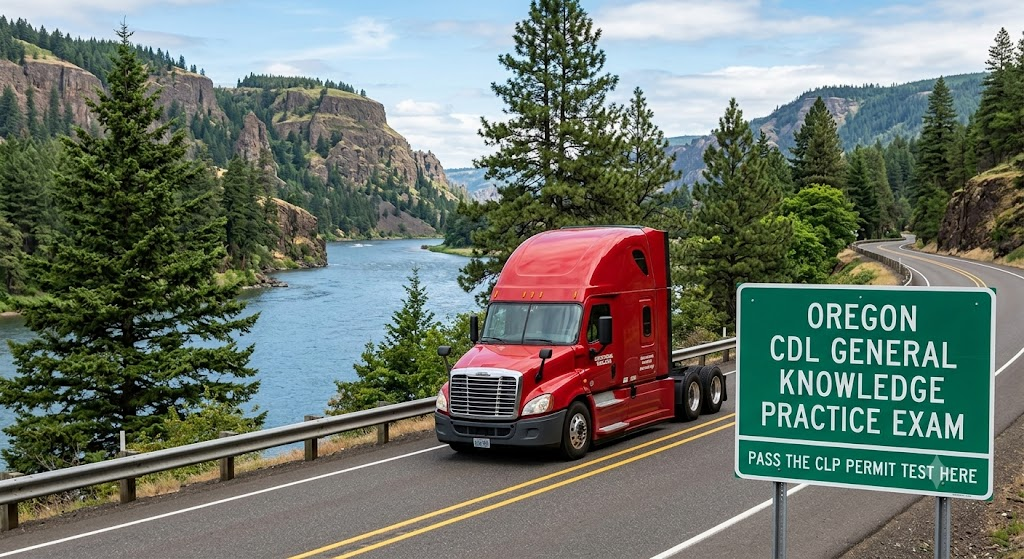
Additional Information
What the Course Entails and Exam Details
This comprehensive study guide and the associated simulator cover the vast range of essential topics mandated by the Oregon Department of Transportation (ODOT) and federal safety standards.
The simulator's primary goal is to assess your understanding of safe commercial vehicle operations before you ever start an engine.
You must master foundational knowledge, including the safe operation of your vehicle, the rules of the road specific to commercial drivers, and emergency procedures.
Core syllabus areas include:
Vehicle Inspection: Understanding how to perform critical pre-trip, en-route, and post-trip inspections to ensure safety and compliance.
Basic Control of Your Vehicle: Concepts related to shifting gears, braking, and managing space around the vehicle.
Shifting Gears: Techniques for manual and automatic transmissions.
Seeing: Proper use of mirrors and managing visual distractions.
Communicating: Using signals, horns, and other methods to interact with traffic.
Controlling Speed: Adjusting for road conditions, curves, and hills.
Managing Space: Maintaining safe following distances and managing space to the sides and rear.
Driving in Hazardous Conditions: Strategies for handling winter weather, hot weather, fog, and night driving.
Railroad-Highway Crossings: Specific safety procedures for navigating these critical intersections.
Mountain Driving: Specialized techniques for Oregon’s steep grades and winding roads.
Handling Emergencies: Identifying potential hazards and knowing how to react to evasive maneuvers, brake failures, and other crises.
Antilock Braking Systems (ABS): Knowing how they function and how to use them properly.
Skid Control and Recovery: Techniques for regaining control of a sliding vehicle.
Accident Procedures: Steps to take immediately following a collision.
Fires: Prevention and proper extinguishing methods.
Staying Alert and Fit to Drive: Addressing fatigue, drinking, and drugs while driving.
Hazardous Materials: General knowledge of regulations for transporting dangerous goods, even without a specific endorsement.
What to Expect in the Final Exam
The actual Oregon CDL General Knowledge Test is a computer-based written exam administered at an official Oregon DMV office.
It is designed to be rigorous but fair, ensuring that only knowledgeable drivers earn the privilege of operating large, heavy vehicles on public roads.
You should prepare for the following format:
Number of Questions: The exam consists of exactly 50 multiple-choice and true/false questions.
Passing Score: You must achieve a score of at least 80%. This means you must answer at least 40 of the 50 questions correctly.
Mistake Allowance: You are permitted to make a maximum of 10 mistakes. If you reach your 11th incorrect answer, the test will end.
Time Limit: You will be given one hour (60 minutes) to complete the 50 questions, which provides approximately 72 seconds per question.
Format: The test will randomizes questions from a comprehensive pool, so the simulator is an excellent tool to see a broad range of potential questions.
Retake Policy: If you do not pass, you may retake the test, although the DMV may impose a waiting period between attempts.
How to Study and Exam Centers
Successfully passing the Oregon CDL General Knowledge Test requires a structured study approach.
Your preparation strategy should involve a combination of primary source reading and active retrieval practice.
Proven Study Strategies:
Master the Official Manual: Your single most important resource is the Oregon Commercial Driver License Manual. You must read every section thoroughly. Do not skip chapters, as the DMV test can draw from any part of the text. Pay close attention to the section on 'General Knowledge'.
Use the Simulator Extensively: Our Oregon CDL General Knowledge Test Simulator is designed to mirror the actual DMV testing experience. Taking multiple full-length practice exams helps you identify your weak areas, understand the phrasing of DMV questions, and build your test-taking stamina.
Active Learning: After completing a practice test, do not just look at your score. Review every single question you missed. Cross-reference the correct answer with the corresponding section in the manual to understand why the answer is correct.
Simulate the Real Environment: Treat at least one practice session like the real exam. Set a timer for 60 minutes and take the test in a quiet, distraction-free space without referencing your manual.
How and Where to Take the Exam:
You must take the official knowledge exam in person at an Oregon DMV office. Third-party skills test providers cannot administer the knowledge tests.
To schedule your exam:
Find your local Oregon DMV office that offers CDL services.
Visit the DMV's official website or call them to make an appointment for the "CDL General Knowledge Test."
Ensure you have all required documentation ready, including proof of identity, Oregon residency, and your DOT Medical Examiner's Certificate.
Be prepared to pay the associated testing fees at the time of your appointment.
Job Opportunities from the Course
Passing the Oregon CDL General Knowledge Test and obtaining your CLP is the initial, essential gateway to a wide array of rewarding career paths.
This permit unlocks the ability to legally practice behind-the-wheel for the licenses that lead directly to these job opportunities:
Class A CDL Careers (Requires combination vehicles, usually tractor-trailers):
Over-the-Road (OTR) Truck Driver
Regional Truck Driver
Local Delivery Driver (Heavy)
Flatbed Truck Driver
Tanker Driver (requires endorsement)
Doubles/Triples Driver (requires endorsement)
Auto Transporter
Livestock Hauler
Class B CDL Careers (Requires single heavy vehicles):
Local Delivery Driver (Box truck, vocational)
Dump Truck Operator
Cement Mixer Driver
Bus Driver (School or transit; requires passenger endorsement)
Waste Management Driver (Garbage/recycling truck)
Heavy Equipment Transporter
Emergency Vehicle Operator (Fire truck)
Frequently Asked Questions
Reviews
5.0
Based on 0 reviews
Leave a Review
No reviews yet. Be the first to review!