
Oregon CDL Air Brakes Practice Test
$69.00
- Buy to unlock unlimited access to all Quiz questions.
- After purchase you can print a PDF of the whole quiz at any point. The PDF will contain the questions and the correct answers.
About this Exam
The Liquid Penetrant Testing Level 3 (PT-3) certification represents the pinnacle of expertise in this critical Non-Destructive Testing (NDT) method. Designed for experienced NDT professionals, quality managers, and engineers aiming for leadership roles, a Level 3 individual is not merely an operator; they are the architectural minds behind the inspection process. This certification validates a candidate’s ability to develop, review, and approve sound testing procedures, interpret complex codes and standards, manage inspection facilities, and train and examine lower-level personnel. This comprehensive study guide and the accompanying practice exam are essential tools to bridge the gap between practical Level 2 skills and the advanced strategic knowledge required for Level 3 success.
Ready to test your knowledge?
Buy Now to Access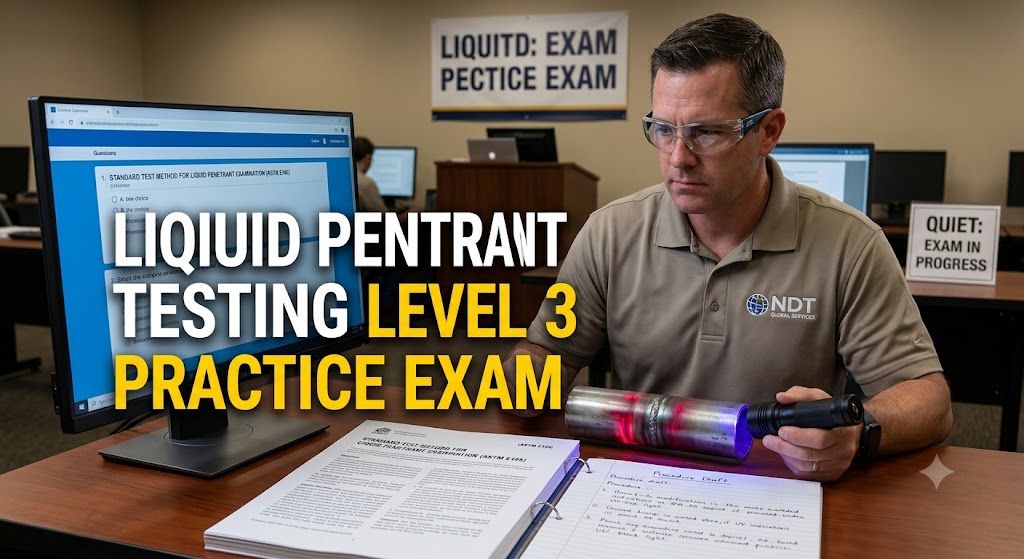
Additional Information
What the Course Entails and Exam Details
Preparing for the PT-3 exam requires moving beyond
"how-to" and mastering the "why." While the underlying
physical principles, such as capillary action and surface tension, must be
understood at a fundamental level, the Level 3 course and exam focus heavily on
process management, oversight, and the critical interpretation of industry
documents. Key areas of focus include:
- Principles
and Theory: A deep dive into capillary action, liquid characteristics,
penetrant families (fluorescent vs. visible), emulsifiers, developers, and
the factors affecting sensitivity and probability of detection (POD).
- Specifications
and Standards: The core of Level 3 work. Detailed analysis and
application of international codes and standards such as ASME Section V,
ASTM E165, ASTM E1417, and ISO 9712, including their specific requirements
for material compatibility, equipment calibration, and acceptance
criteria.
- Procedure
Development: Level 3 candidates must prove their ability to draft
comprehensive, technically accurate PT procedures tailored to specific
applications, materials, and product forms, incorporating all necessary
controls and safety requirements.
- Quality
Assurance and Control: Implementation of quality management systems,
managing equipment calibration schedules, and conducting internal audits.
- Ethics
and Qualification: Understanding professional codes of ethics and the
requirements of qualification systems like ASNT SNT-TC-1A and ANSI/ASNT
CP-189.
What to Expect in
the Final Exam
The actual PT-3 examination is a rigorous assessment, often
broken down into two distinct parts for Central Certification (like ASNT),
which a comprehensive practice exam must emulate:
NDT Basic Examination:
This tests overarching knowledge common to all NDT methods, including materials
and processes (casting, welding, heat treatment), other NDT methods, and
qualification systems. It is typically a multiple-choice exam, requiring
roughly 135 questions to be answered within 4 hours.
PT Method Examination: This
section focuses specifically on Liquid Penetrant Testing. It evaluates the
ability to apply concepts, write procedures, and solve problems based on
realistic scenarios and referenced specifications. The format is primarily
multiple-choice but includes detailed, procedure-based questions that test
analytical thinking. A high standard, such as a composite score of 80% or a
minimum of 70% in each section, is typically required to pass. The Method exam
is substantial, often allowing 2 to 4 hours for completion. The exam is
administered in a strict, proctored, closed-book environment.
How to Study and
Exam Centers
Effective preparation is the key to conquering the PT-3
exam. Candidates should adopt a multi-faceted approach:
- Analyze
Codes and Standards: Do not just read study guides; study the actual
industry specifications. Buy or access standard documents like ASME
Section V and ASTM E165. Learn to navigate them quickly and apply their
rules to hypothetical situations.
- Write
Mock Procedures: Practice drafting complete PT procedures from scratch
for different scenarios (e.g., a fluorescent PT procedure for a stainless
steel weldment). Have an existing Level 3 or a mentor review them.
- Utilize
Practice Exams: This is perhaps the most critical tool. High-quality
practice exams, like the one this guide supports, simulate the timing,
difficulty, and question structure of the actual test. Use them to
identify specific weaknesses, manage your time, and familiarize yourself
with navigating reference material efficiently under pressure.
- Attend
Refresher Courses: Formal Level 3 refresher courses, offered by bodies
like ASNT or specialized NDT schools, provide focused review, clarify
complex topics, and offer invaluable insights into exam strategies.
Exam Centers: The PT-3 certification exams for
international bodies are generally taken at computer-based testing centers. For
the American Society for Nondestructive Testing (ASNT), this includes the
globally accessible Pearson VUE professional centers. You must first apply
directly through the certifying body’s online portal and receive authorization
before scheduling an exam slot at an authorized location.
Job Opportunities
from the Course
A Level 3 certification in Liquid Penetrant Testing is a
potent career accelerator, opening doors to leadership, high-responsibility, and
financially rewarding positions across diverse industries:
- NDT
Manager or Director
- Responsible
Level III Inspector (with authorization for critical oversight)
- Quality
Assurance (QA) / Quality Control (QC) Engineer (NDT Specialization)
- Procedure
Writer and Technical Author
- NDT
Trainer and Examiner
- Auditor
(Internal or Third-Party)
- Consulting
NDT Engineer
- Welding
Engineer (often combined with PT L3)
Achieving Level 3 status signals a commitment to the highest
professional standards, making certified individuals indispensable in sectors
such as aerospace, nuclear energy, oil & gas, defense, and manufacturing.
Frequently Asked Questions
Reviews
5.0
Based on 0 reviews
Leave a Review
No reviews yet. Be the first to review!